+1 470-740-7099
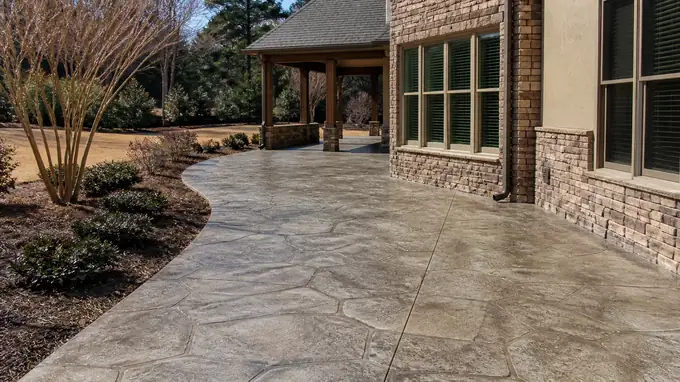
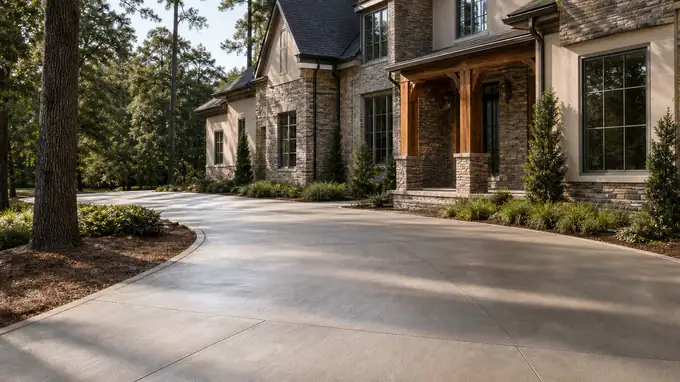
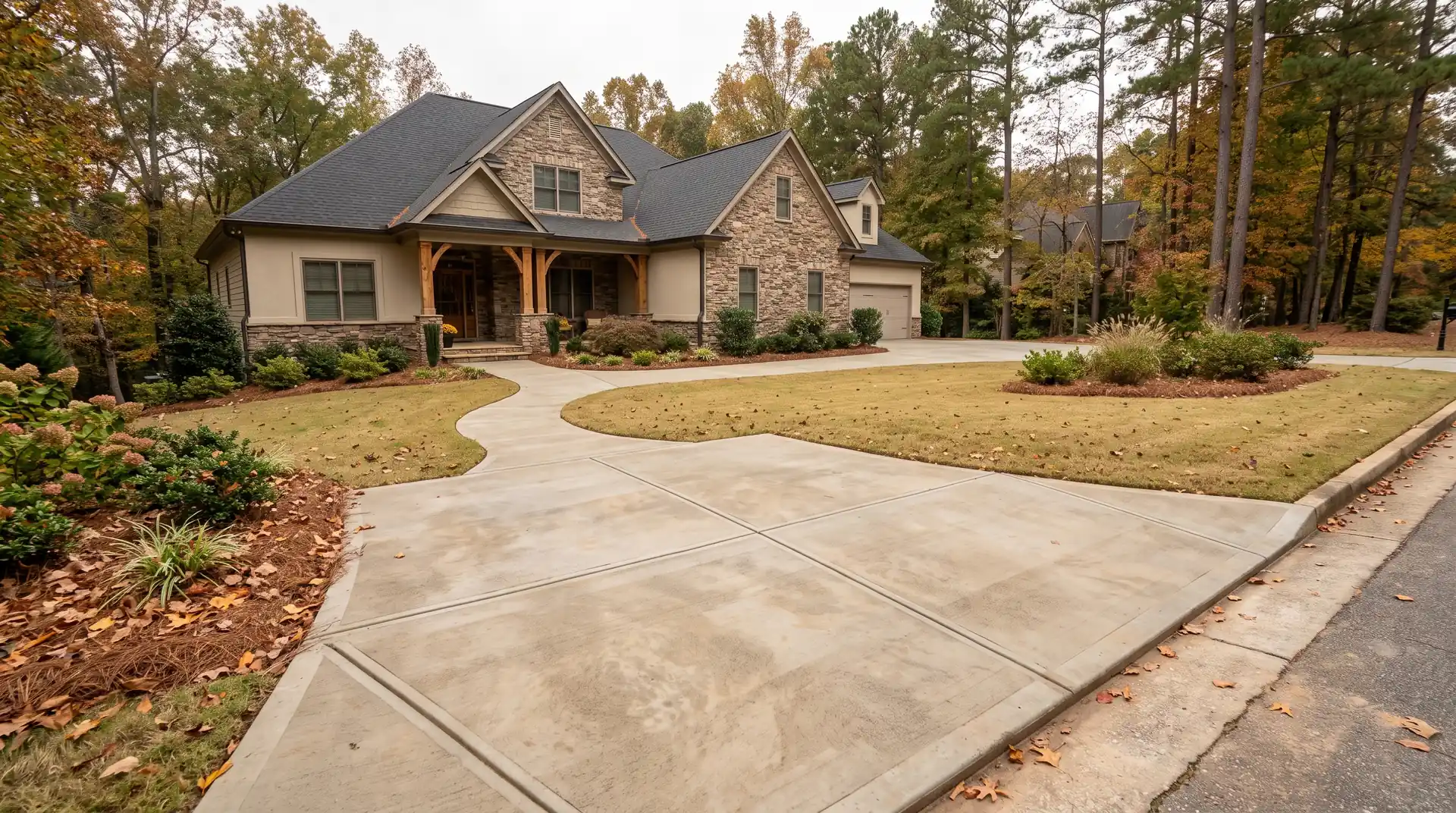
Wide view of finished concrete flatwork across the front of a home at a stacked-stone and stucco home in Sandy Springs, GA, under an overcast sky.

Sandy Springs Concrete Pros: Residential & Commercial Repair & Resurfacing, Driveways, Patios & Retaining Walls

We are a concrete contractor working in Sandy Springs, where most of what we pour replaces something that has already had a long life. The houses here went up starting in the 1950s, with a big wave in the early 1960s and infill continuing through the 1980s, so driveways and walkways have been carrying weight for decades. We do the same work on the commercial side of town, at Perimeter Center, along the Roswell Road corridor and around City Springs: sidewalk replacement, loading pads, entry flatwork.

Replacement work is not new construction. Before anything gets poured we find out what failed: washed out base, tree roots under a slab, concrete laid too thin for what parks on it. Demolition and haul off come with nearly every job here. Where a job needs a permit, we pull it through the City of Sandy Springs and build to what it approves. Broom finish, exposed aggregate, stamped concrete on a patio or a front walk: tell us what you want it to look like, and we will tell you how it holds up.

Call +1 470-740-7099

Licensed, Bonded, and Insured ยท A combined 15 years of experience

Get FREE Estimates

We warranty all of our work because we believe in what we do.

Our Concrete Services, Start to Finish

We pour driveways, patios, walkways and slabs, and most of that is replacement work, so the tear-out comes first. Stamped concrete, exposed aggregate and a plain broom finish all start the same way: a proper base.

A concrete sidewalk gets rebar or wire mesh, same as a commercial concrete pad. Every concrete installation runs from demolition through forming, pour and cure, and we do not hand any of it off.

Commercial and Industrial Concrete in Sandy Springs

Concrete walkway and entry paving at a suburban office building in Sandy Springs, GA, in clear late-morning sun.

Offices & Corporate Properties

Perimeter Center towers run on concrete that takes constant traffic. We handle sidewalks along building frontages, entry aprons, loading areas and parking islands, typically six inches of concrete over compacted base with rebar at the joints. What fails first is usually the transition where a walk meets a drive lane. We saw out the failed panel, tie into sound concrete with dowels, and pour back flush.

Concrete sidewalk and parking-lot island paving at a retail center in Sandy Springs, GA, in early morning light.

Retail & Shopping Centers

Along the Roswell Road corridor, retail concrete work happens around store hours. We stage sidewalks in sections so entrances stay open, pour four-inch walks with wire mesh, and reserve six inches with rebar for anything a delivery truck crosses. Spalled curbs, sunken trip edges at storefronts and cracked cart paths are the usual repairs. Broom finish holds up best under wet shoes.

Concrete patio slab and service apron behind a restaurant in Sandy Springs, GA, after a rain shower.

Restaurants & Hospitality

Kitchen door areas, dumpster pads and patio slabs take the worst of it. A dumpster pad needs eight inches with rebar, not a standard driveway thickness, because the truck lifts and drops on the same two points every week. Grease and constant washdown break down thin, weak concrete fast. We slope patios and service areas to drain away from the building rather than pond at the threshold.

Concrete loading dock apron and truck pad at a distribution building in Sandy Springs, GA, under an overcast sky.

Warehouses & Distribution

Loading dock aprons and truck courts fail when the slab is too thin for the axle loads crossing it. We pour eight inches or more with rebar mats over a properly compacted stone base, and we cut control joints on a tight grid so cracking goes where we put it. Common problems: faulted joints, spalled edges at the dock face, and slabs pumping water through cracks after rain.

Concrete entry walk and ADA ramp at a medical office building in Sandy Springs, GA, under bright midday cloud.

Medical & Dental Offices

Accessible routes matter here more than anywhere. We build entry walks, ramps and van-accessible aisles to correct slope and cross-slope, then finish them so they are not slick when wet. Settled panels near an entrance become a liability quickly for patients using walkers or wheelchairs. We replace the panel rather than patch it, and rebuild the base underneath so it does not settle again.

Concrete sidewalk network between buildings at an apartment community in Sandy Springs, GA, in late afternoon light.

Multi-Family & HOA Properties

Sandy Springs has apartment and townhome communities dating back to the 1960s boom, and much of that original flatwork is at the end of its life. We work through concrete driveways, parking bays, mail kiosk pads, pool decks and the sidewalk network connecting buildings. Boards usually phase the work by building. We map which panels are actually failing so money goes to those, not to concrete with years left.

Concrete for Homes in Sandy Springs

Replaced concrete driveway panel with clean saw-cut edges at a charcoal farmhouse-modern home in Sandy Springs, GA, in late afternoon light.

Repair, Leveling & Resurfacing

Older slabs crack, settle and spall long before they need full replacement. We slabjack sunken sections back to grade, saw out failed panels, and resurface worn flatwork with a bonded overlay once the substrate tests sound. Hairline shrinkage cracks get routed and sealed. Sections that have heaved over a root, or lost their base and rock underfoot, come out instead: patching those just moves the problem a few feet.

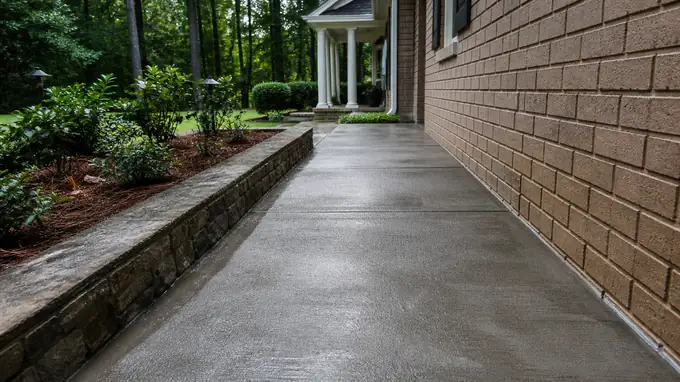
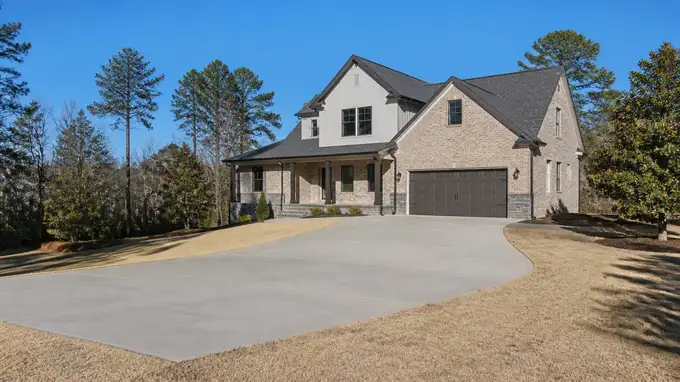
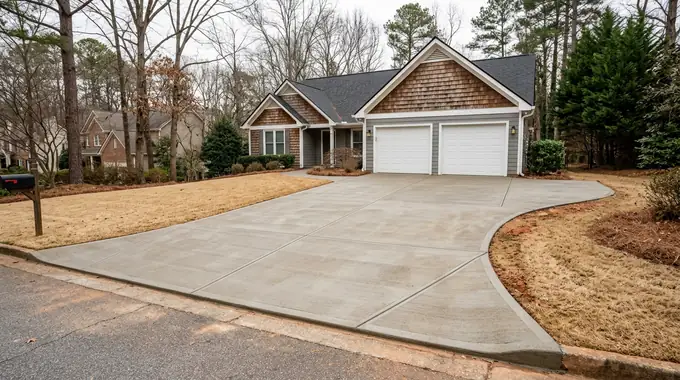
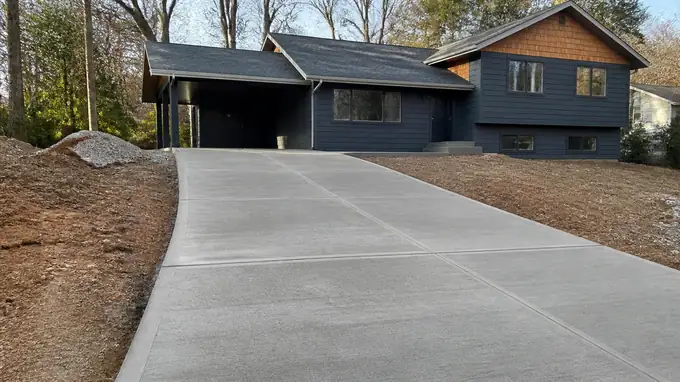
Broom-finished concrete driveway running up to a two-car garage at a grey split-level home in Sandy Springs, GA, under bright midday cloud.

Driveway Installation & Replacement

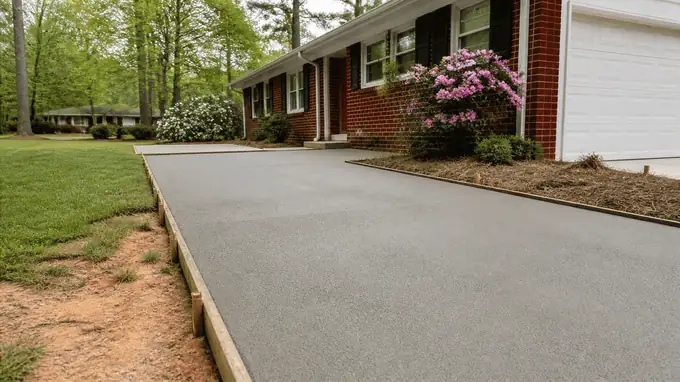
Most driveway work here is replacement of concrete poured decades ago. We break out the old slab, regrade and compact the base, then pour at four inches for cars and six where a truck or RV parks. Rebar on chairs, or wire mesh held up off the ground, keeps a cracked slab in one plane. Control joints go in early, cut roughly every ten feet, so the concrete cracks where we put it.

Rectangular concrete patio with a low step up to the rear door at a buff-brick ranch home in Sandy Springs, GA, in late afternoon light.

Patio Construction & Outdoor Living

Patios sit on the same base work as a driveway, four inches of concrete over compacted stone, with mesh or rebar and joints laid out to suit the shape. Finish is where the choices are: broom for grip, exposed aggregate, stamped and colored concrete in slate or wood plank patterns. We slope everything away from the house, usually a quarter inch per foot, and seal stamped work after cure.

Board-formed concrete retaining wall holding a raised lawn at a red-brick ranch home in Sandy Springs, GA, in early morning light.

Retaining Wall Construction

A wall fails at its base or its back, rarely in the middle. We dig below grade for the footing, set drainage stone and perforated pipe behind the stem, and run weep holes through so water leaves instead of pushing. Poured walls get vertical and horizontal rebar tied into the footing. Backfill goes in lifts and gets compacted. Walls built on dirt with no drainage lean out within a few seasons.

Square-edged concrete slab pad with a storage shed on it at a brick-and-siding two-story home in Sandy Springs, GA, under an overcast sky.

Concrete Slabs & Pads

Shed floors, garage slabs, generator and HVAC pads, hot tub bases: each one gets sized for what sits on it. Standard flatwork runs four inches over compacted stone with wire mesh or rebar and a vapor barrier where the space is enclosed. Equipment pads go thicker, often six inches with a heavier mat, and we set anchor bolts or sleeves before the pour rather than drilling later.

Poured concrete foundation wall and footing for a room addition at a charcoal farmhouse-modern home in Sandy Springs, GA, under bright midday cloud.

Foundation Pouring & Repair

Footings and foundation walls for additions, garages and outbuildings get poured to bear on undisturbed soil, formed with rebar tied continuous through the corners. On repair work we look at what caused the movement first, usually water and grading. Cracks get epoxy injected or repaired with carbon fiber straps. Spalled or deteriorated wall sections are cut back to sound concrete and rebuilt.

Poured concrete front steps rising to a landing at the front door at a brick-and-siding two-story home in Sandy Springs, GA, in late afternoon light.

Steps, Stoops & Landings

Front steps take the worst of the weather and the most foot traffic. We form and pour steps monolithic with the landing where we can, on a footing below frost depth, with rebar tying risers to the slab so the flight moves as one piece. Treads get a broom finish and a slight pitch to shed water. Settled or crumbling stoops usually come out entirely.

Concrete walkway meeting the driveway apron and front steps at a tan-brick colonial in Sandy Springs, GA, in clear late-morning sun.

Walkway & Sidewalk Installation

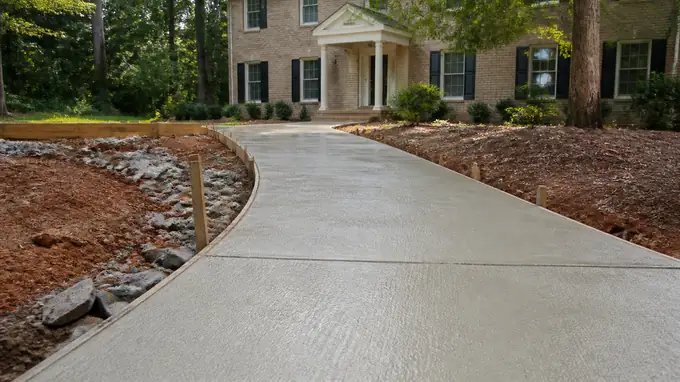
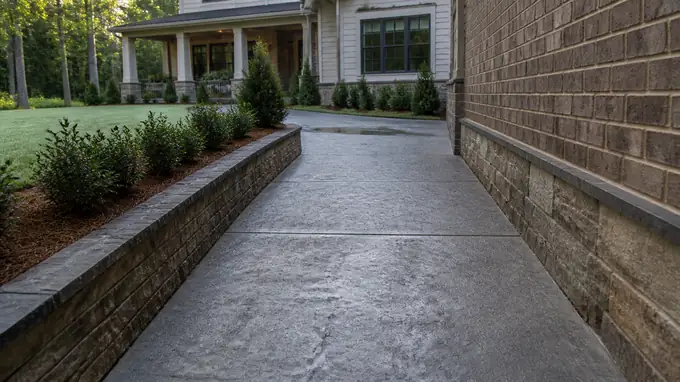
Sidewalk installation runs four inches thick, typically three to four feet wide, over compacted base with mesh or fiber. Joints go in at roughly the width of the walk. We hold the surface flush at doorways, keep transitions even so nothing catches a toe, and pitch away from foundations. Broom finish is standard; stamped or exposed aggregate works well on front walks that read as part of the entry.

Poured concrete curbing with a rolled profile along a driveway edge at a buff-brick ranch home in Sandy Springs, GA, in early morning light.

Curbing & Edging

Poured concrete curbing holds mulch beds, gravel drives and lawn edges in a clean line without the shifting that comes with plastic or steel edging. We machine-extrude continuous curb in standard profiles, or form and pour straight runs and driveway aprons by hand. Control joints get cut at intervals to manage cracking. Color and a light stamp pattern are options at the time of the pour.

What You Get When You Hire Sandy Springs Concrete Pros

The crew that measures your job is the crew that forms, pours and finishes it. Subbase comes first: graded, compacted, and checked before a form board goes down, because a slab is only ever as good as what sits under it. Rebar or wire mesh goes in where the load calls for it, tied and lifted off the ground rather than laid flat and tugged up partway through the pour. We cut control joints on schedule and in the right places, so the concrete cracks along a line we chose instead of wherever it feels like. Edges stay straight. Concrete work done this way looks ordinary for a long time, which is the whole point of it.

Most of what we pour around here replaces something. Houses from the 1950s and the early-1960s boom are on their second or third driveway by now, and the flatwork around them has spent decades absorbing settling, root pressure, and water that runs the same path every storm. We look hard at what is actually failing before quoting a tear-out. Sometimes the answer is full removal and a fresh pour. Often it is cutting out the failed sections and leaving the panels that still have plenty of life in them. Either way, you hear which one it is and the reasoning behind it before anything gets broken up.

How a Sandy Springs Concrete Project Runs

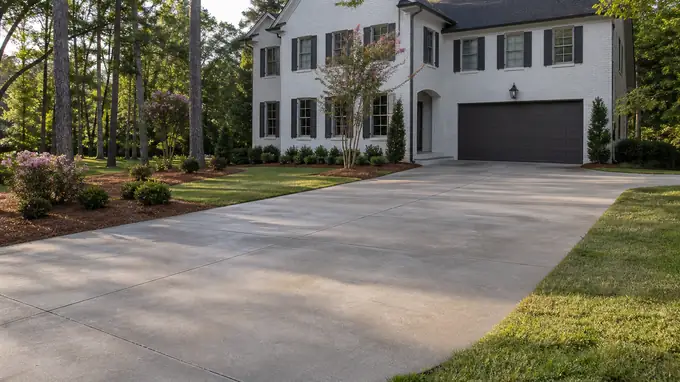
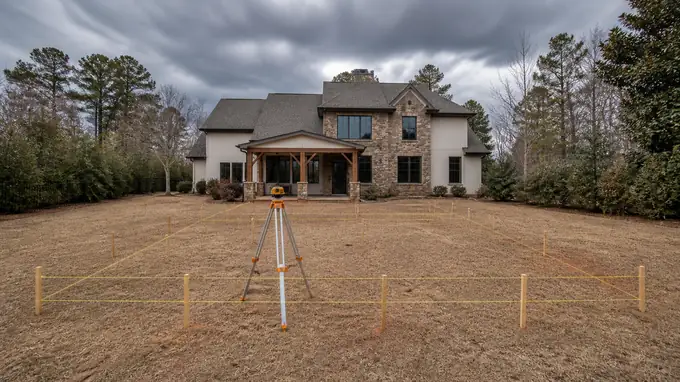
String lines and grade stakes laid out across a yard before a pour at a painted-white-brick two-story home in Sandy Springs, GA, in clear late-morning sun.

Step 1: Site Evaluation

We walk the slab with you and look at what the old pour is telling us. Settlement cracks, a driveway apron pulling away from the street, spalling where a hose bib drips: each one points to a different cause. We check drainage, tree roots, and where water sits after rain. We measure the existing thickness at a broken edge, note access for a truck, and mark anything that has to move.

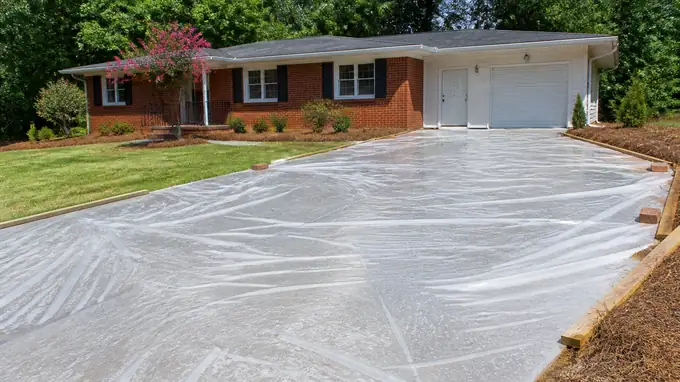
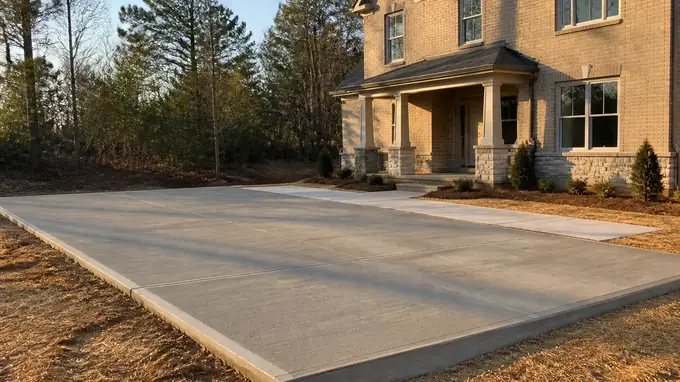
Concrete driveway and walk at a home, the kind of job an estimate covers at a stacked-stone and stucco home in Sandy Springs, GA, in early morning light.

Step 2: Written Estimate and Permits

You get the scope in writing: square footage, slab thickness, reinforcement, finish, jointing plan, and how we handle the old concrete. Decorative work gets the color and pattern named, since stamped and integral color are chosen before the pour, not after. Permit requirements depend on what you are replacing and whether the footprint changes. We handle that paperwork and tell you what it covers.

Broken-out concrete removed and the base rebuilt before a new pour at a charcoal farmhouse-modern home in Sandy Springs, GA, after a rain shower.

Step 3: Demolition and Base Prep

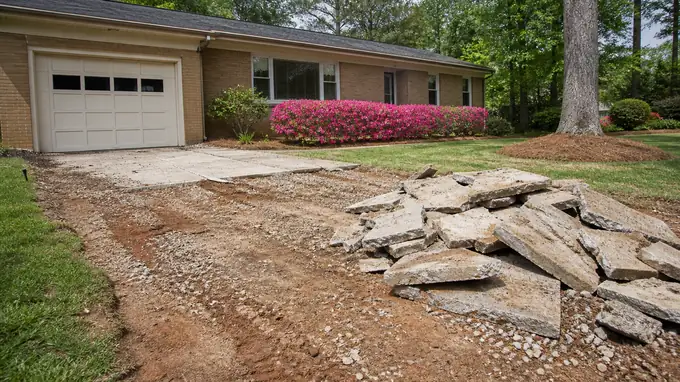
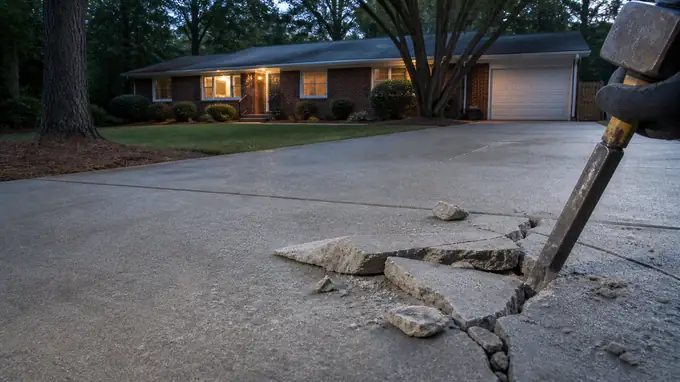
Old concrete comes out in sections, gets loaded, and leaves the site. Then the real work starts. We excavate to grade, cut out soft spots, and bring in compacted crushed stone as a base, usually four inches under residential flatwork. Compaction happens in lifts, not one dump and a quick pass. Bad base is why concrete driveways crack in the same place twice.

Wooden forms and rebar grid set and tied, ready for concrete at a brick-and-siding two-story home in Sandy Springs, GA, under an overcast sky.

Step 4: Forming, Steel and the Pour

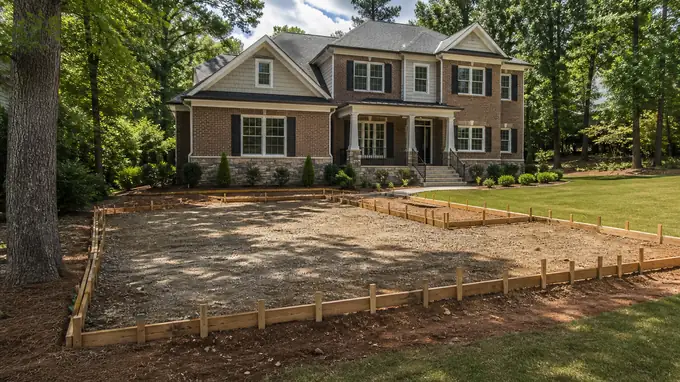
Forms get set to a slope that carries water away from the house, staked straight, and checked before anything arrives. Driveways get rebar on chairs, typically number three or number four on a grid; sidewalks and lighter flatwork often take wire mesh instead. We pour four inches for walks, five or more where vehicles run. Concrete goes in continuously, screeded, then bull floated.

Freshly finished concrete slab curing under a clean broom texture at a grey split-level home in Sandy Springs, GA, under bright midday cloud.

Step 5: Finishing, Curing and Final Walkthrough

Finish depends on what you picked: broom for traction, exposed aggregate washed at the right window, or stamped mats pressed while the slab is still open. Control joints get cut early so the slab cracks where we put the line. Curing compound goes down, and we tell you when to walk it and when to drive it. We come back and check the joints, edges, and drainage with you.

Decorative Concrete We Install Across metro Atlanta

Polished concrete floor with a satin sheen in a finished interior room at a red-brick ranch home in Sandy Springs, GA, under an overcast sky.

Polished Concrete Floors

We grind an existing slab through progressive diamond grits, densify it, then bring it up to whatever gloss you want, matte through mirror. Basements, garages and finished shop space take it well. Trouble shows early: a slab troweled too hard closes off the surface, old adhesive telegraphs through, and shallow conduit or rebar can appear under the first cut. We open a corner and read it before committing the whole floor.

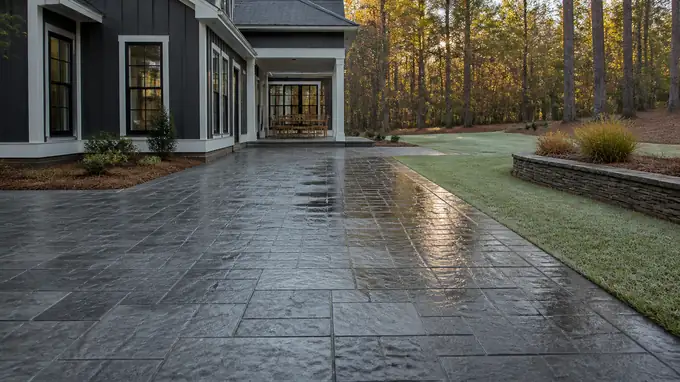
Stamped concrete patio in a running-bond brick pattern at a painted-white-brick two-story home in Sandy Springs, GA, in late afternoon light.

Stamped Concrete Patterns

Ashlar slate, seamless stone and running bond all come off mats pressed into a four inch pour reinforced with fiber or wire mesh. Integral colored concrete carries the base tone, and a release powder shades the relief. Timing decides the whole job. Stamped too late, the pattern reads flat and shallow. Too early and the texture smears under the mat. Resealing every few years keeps the color from going chalky.

Acid-stained concrete patio in mottled earth tones at a painted-white-brick two-story home in Sandy Springs, GA, under bright midday cloud.

Stained Decorative Concrete

Acid stain reacts with the lime in the slab and gives mottled, variable color that never repeats exactly the same way twice. Water based dyes hold closer to a specified tone. Either way, prep decides the outcome: old patches, tire marks and leftover sealer all read through the finish. Houses around here tend to get money spent on the surfaces people actually look at, so we sample on your slab first.

Exposed aggregate concrete driveway showing washed river-rock stone at a stacked-stone and stucco home in Sandy Springs, GA, in late afternoon light.

Exposed Aggregate Finishes

Pea gravel or a river rock blend, washed back with a surface retarder until the stone stands proud of the paste. It grips underfoot when wet, which is why it turns up on so many driveways and on concrete sidewalk installation work around metro Atlanta. Four inches over compacted base, with rebar or wire mesh depending on what drives across it. Over-wash and you lose stone. Under-wash and the exposure goes patchy.

Sandy Springs and the Towns Around It

We work across Sandy Springs and the streets running out toward Dunwoody, on rolling, wooded lots where much of the original flatwork has outlived the slab poured under it.

  • Full tear-out and concrete slab installation for driveways, patios and sidewalks
  • Wire mesh or rebar set up off the grade, never laid flat and hoped for
  • Broom, exposed aggregate and stamped finishes on the same pour schedule

Most of this is replacement work. Old slab out, base regraded, steel set, then pour. The address changes. How we build the slab does not.

What You Can Expect to Pay in Sandy Springs

Price on a concrete job comes down to square footage, slab thickness, what has to come out before anything goes in, and how hard it is to get a truck close to the pour. This is a high-income area, median home value $732,100, and that tends to pull work toward the better spec rather than the thinnest one that will pass. Replacement carries tear-out and haul-off. Rolling, wooded lots add slope and roots.

Ask every bid to put these in writing:

  • Slab thickness, and whether reinforcement is rebar or wire mesh
  • Whether demolition, haul-off and disposal of the old concrete are inside the number
  • Subgrade prep: what gets dug out, what gets brought in, how it gets compacted
  • Formwork for curves, steps and grade changes, which is labor rather than material
  • Finish: broom, exposed aggregate, or decorative concrete, each priced on its own
  • Control joint layout and how long the slab sits before it takes weight

Two bids for the same concrete slab installation can land far apart and both be honest. One is pouring thin slabs over whatever base is already there. The other is starting at dirt, forming clean, and setting steel. Read the scope line by line before you read the total, because the cheaper number almost always explains itself somewhere in the middle of the page.

Decorative work spreads widest of all. Stamped and colored finishes mean more forming, more hand labor, more days on site. Call us for a free estimate and we will walk the site with you.

What Happens After You Call Us

A visit starts at the slab itself. We measure the driveway or the footprint of the concrete patios you want, look at where water leaves the site, and check what the old flatwork is sitting on, because residential concrete under houses from the early 1960s boom often hides a base that has been moving quietly for decades.

From that we write up a scope: thickness, rebar or wire mesh, joint layout, finish, and whether the pour is plain gray or decorative concrete with color or a stamped pattern. Almost nothing in concrete construction is reversible once the truck pulls away, so we would rather answer your questions before the forms go in. Call for a free estimate.

Concrete Problems We See Around Sandy Springs

Most of the concrete we look at around Sandy Springs is old. Suburban development here began in the 1950s, the early 1960s brought a housing boom after highway construction, and infill continued through the 1980s. A driveway poured in that stretch has carried vehicles for decades, and it was built to a lighter standard than what we pour today. So the work is mostly replacement rather than new construction. We see original flatwork failing on its own schedule, not because anyone mistreated it.

Cracking is the common call, though a crack by itself tells us little. What matters is whether the slab has moved. A concrete driveway that has dropped at one panel has usually lost its subgrade, often to water running along an edge, which happens easily on rolling, wooded lots where grade and downspouts send it the wrong direction. Concrete patios fail differently. They sit tight against the house, and when the slab tips back toward the foundation, water follows. Roots lift sections of concrete sidewalk. Many older pours have no rebar and no wire mesh at all.

Getting it right is mostly what happens before the truck shows up. We take out the old slab and look hard at what it was sitting on, because new concrete over a failed base buys a few years at best. Compacted subgrade, full thickness, rebar or wire mesh through the field, joints cut where the slab already wants to crack. Concrete mixes get picked for the pour in front of us. Most concrete projects here replace something that stood for a long time, and a concrete project built this way should do the same.

Sandy Springs Concrete FAQs

What is the difference between repairing and replacing concrete in Sandy Springs?

Repair makes sense when the slab is sound underneath and the damage sits on the surface: spalling, a single lifted joint, a corner that broke off. Replacement is the answer when a slab has settled unevenly, cracked in several directions, or lost the base holding it up. We look at what the concrete is sitting on before we decide, because a patch over a failed base fails again.

What does concrete cost per square foot around Sandy Springs, Georgia?

Cost depends on the size of the pour, the thickness, the reinforcement, how much old concrete has to come out, and the finish you want. A plain broom-finished driveway and a stamped patio with color are different jobs. We walk the site, measure, and put a number in writing for your project rather than quoting from a rate that would not hold up once we saw the work.

What concrete services do you offer in Sandy Springs, Georgia?

Driveways, patios, walkways, steps, retaining walls, garage and basement slabs, and sidewalk installation, plus repair and resurfacing of concrete that is still worth saving. We do flatwork for homes and commercial concrete for businesses. Tear-out and haul-away of the old slab is part of the job. If you have concrete that needs pouring, cutting, or replacing, that is what we do.

How do I book a free walkthrough and get a fixed-price quote from Sandy Springs Concrete Pros?

Call us and describe the project. We come out, look at the site, measure, and ask what you want the finished concrete to do. Then you get a written quote with the scope spelled out: square footage, thickness, reinforcement, finish, and what we remove. The walkthrough is free and you are not committed to anything by having us look.

How do you keep concrete from cracking or settling in Sandy Springs's ground conditions?

Most cracking and settling traces back to the base, not the concrete. We excavate to solid ground, compact the sub-base in lifts, and pour on a surface that will not move under load. Rebar or wire mesh goes in depending on what the slab has to carry. Control joints get cut at the right spacing so the concrete cracks where we put the joint instead of somewhere you will see it.

What maintenance or sealing will my new concrete need in Georgia?

New concrete needs time to cure before anything goes on it, and we tell you how long to stay off it. After that, a sealer helps a driveway or patio shed water and resist staining from oil, leaves, and grill spills. Reapplication depends on sun exposure and traffic. Keeping joints clear of debris and directing downspouts away from the slab does more good than most people expect.

What decorative finishes can I choose for a project in Sandy Springs?

Stamped concrete takes a texture from a mat while the slab is still workable, so you can get stone, slate, brick, or plank patterns in a single pour. Colored concrete comes from integral pigment mixed through the batch or a broadcast hardener on the surface. Exposed aggregate washes back the top layer to show the stone. Broom finish is plain, durable, and easy to keep footing on.

How do you protect my lawn and landscaping while you work in Sandy Springs?

We plan the route in before the first truck arrives: where the mixer parks, where the wheelbarrows run, where the debris goes. Plywood and boards go down over turf on the paths we use. Plants near the work get covered or, where they are in the way, dug and set aside. Concrete washout happens in a contained spot, never on your beds or grass.

Does Sandy Springs Concrete Pros handle the Sandy Springs permits and inspections?

Yes. We identify what your project requires, pull the paperwork, and schedule the inspections that go with it. Some concrete work needs a permit and some does not, and that depends on what you are building and where it sits on the lot. We sort that out during the walkthrough so nothing stops the pour after the crew shows up.

Does Sandy Springs Concrete Pros take on commercial work as well as residential?

Yes. Loading areas, parking lot repair, walkways, ADA ramps, dumpster pads, and sidewalk work around retail and office property are all in our range, alongside the residential driveways and patios. Commercial jobs often need staged pours and off-hours scheduling so a business keeps operating, and we plan the work around that rather than shutting your site down.

How long does a typical concrete job in Sandy Springs take from start to finish?

Demolition and base prep usually take a day or two, and the pour itself is often a single day. Curing is the long part. Foot traffic comes first, vehicle traffic later, and we give you the actual dates for your slab. Larger projects, retaining walls, or work broken into sections run longer. Weather moves the pour date, since we do not place concrete into rain.

How far in advance should I book concrete work in Sandy Springs?

Sooner gives you more choice of dates. Spring and fall fill up because that is when most homeowners think about a new driveway or patio, and steady rain pushes pours back, which shifts everything behind them. If you know you want the work done before an event or the end of a season, get on the schedule early rather than waiting for the weather to turn.

Tap to call +1 470-740-7099