+1 470-740-7099
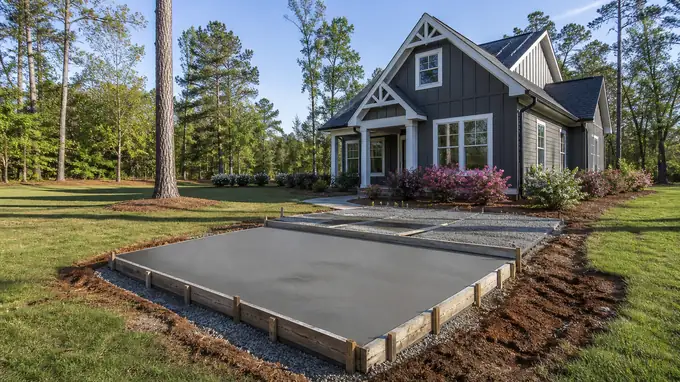
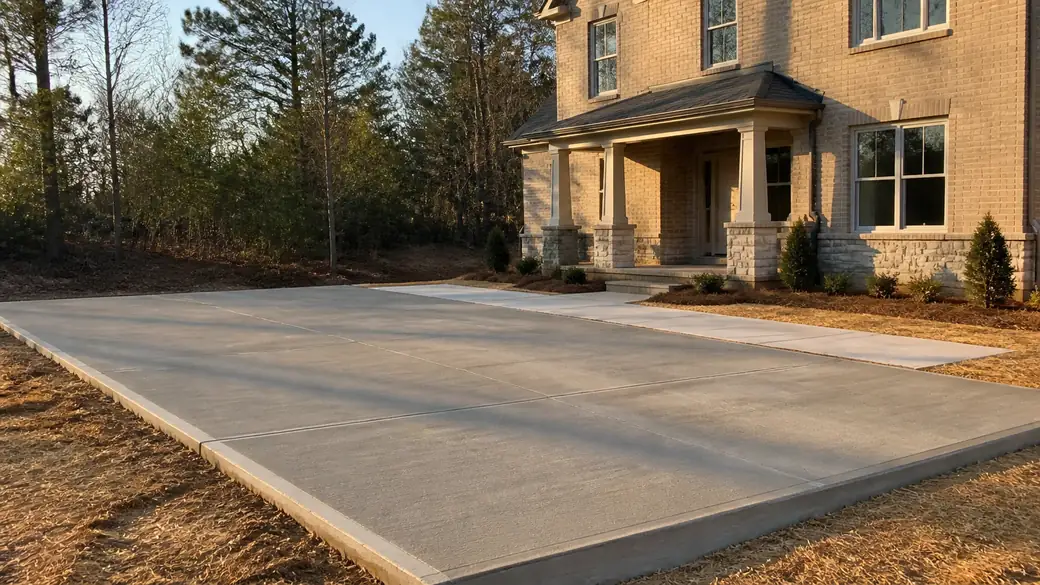
concrete slab installation completed by a local contractor at a brick-and-siding two-story home in Sandy Springs, GA, in late afternoon light.

Concrete Slab Installation in Vinings, Georgia

A concrete slab is the flat, load-bearing surface everything else sits on: a garage floor, a patio, the base for a shed or an addition, the pad under an HVAC unit. We pour residential and commercial slabs in Vinings, and we treat each one as a structural job first. How it looks matters. Whether it stays flat and whole over the years matters more, and that gets decided long before the concrete truck arrives.

The work starts with the ground. Every site is tested individually before we set a single form, because what sits under a slab is what holds it up. From there we grade and compact the base, lay in a gravel sub-base, and place reinforcement sized to the load: rebar for a slab that carries vehicles, wire mesh or fiber where the demand is lighter. Forms get checked for level and pitch before any concrete goes in. Then we pour, screed, float and finish.

Most slab failures trace back to water or a thin base. Our area sees about 50 inches of rain a year, so a slab with even a slight low spot will pond, and water that finds its way underneath keeps working at the base. We pitch each slab to shed water away from the house, cut control joints so any cracking happens where we planned it, and keep the surface damp while it cures. None of that shows on the day we finish. It shows years later.

Call +1 470-740-7099

Get FREE Estimates

Concrete Services in Vinings

Concrete Slab Installation Cost

The number for a slab comes from the ground it sits on. Footprint is the start, but grading, how much compacted stone the base needs, slab thickness and the reinforcement all move it. A pad for a garden shed and a slab under a workshop full of machinery are different jobs, even at the same size. Access matters too: a pump truck costs more than a chute off the back of a mixer. Call us for a free estimate.


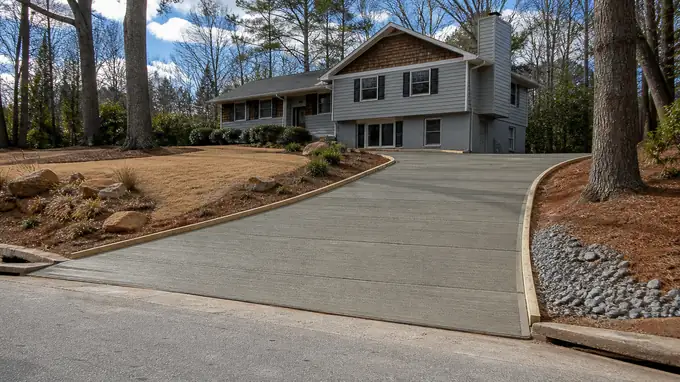
concrete driveway installation completed by a local contractor at a buff-brick ranch home in Sandy Springs, GA, under a hazy afternoon sky.

Concrete Driveway Installation

Driveways fail from underneath first. We strip the organic topsoil, compact a stone base in lifts, and set rebar on chairs so the steel ends up mid-slab instead of lying in the dirt. The apron, where tires turn and brake, gets extra thickness. With about 50 inches of rain a year, every driveway is pitched to shed water off the surface. Control joints are cut early, so cracks form where we choose. Finish is broom texture, stamped, or exposed aggregate.

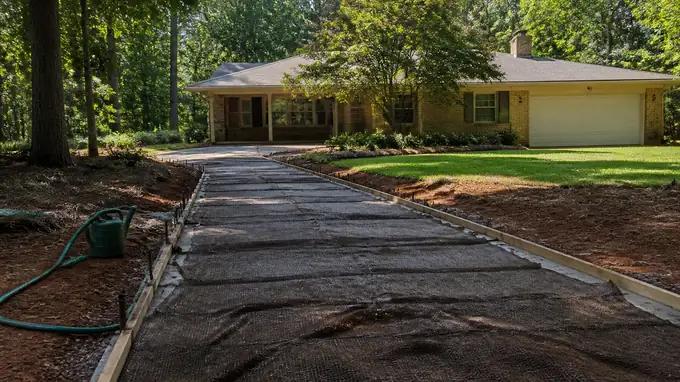
concrete flooring installation completed by a local contractor at a painted-white-brick two-story home in Sandy Springs, GA, under low winter sun.

Concrete Flooring Installation

Inside a garage, basement or shop, the slab is the floor, so flatness and moisture matter more than looks. A heavy vapor barrier goes down over the base before we pour, because moisture coming up through concrete is what lifts epoxy and cups wood laid over it. We power-trowel for a hard, dense surface. From there it can be ground and polished, sealed, or left ready for coatings. Either way, we test moisture before anything goes on top.

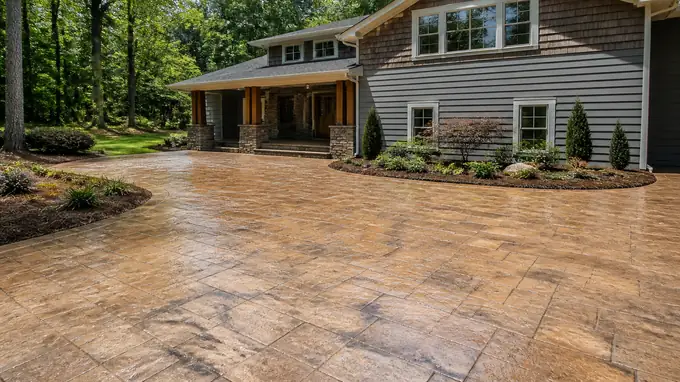
concrete slab repair completed by a local contractor at a stacked-stone and stucco home in Sandy Springs, GA, in raking morning side light.

Concrete Slab Repair

Not every crack needs a new slab. Hairline shrinkage cracks are normal and can be routed and sealed to keep water out. A crack with one side higher than the other is a different story: something moved underneath, usually a washed-out or poorly compacted base. Sunken sections can often be lifted with polyurethane foam injected through small holes. Broken or spalling panels get saw-cut out and repoured, doweled into the concrete around them.

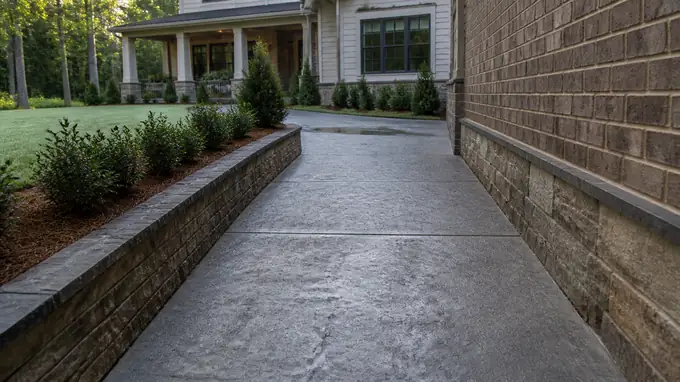
concrete sidewalk installation completed by a local contractor at a brick-and-siding two-story home in Sandy Springs, GA, in early morning light.

Concrete Sidewalk Installation

Sidewalks look simple, which is why so many heave. Tree roots and a thin, loose base do most of the damage, so we dig down, compact a stone base, and route the walk around big roots where we can. Control joints go in close together, spaced to the walk's width. Each walk gets a slight cross slope so rain runs off to the side instead of pooling at the door. Where it meets a driveway or step, an expansion joint lets each piece move on its own.

Why Choose Sandy Springs Concrete Pros

We pour slabs, and we treat each one as the base for something that has to stay flat and dry for a long time. A slab under a garage, a shed, a patio or a home addition carries weight every day, so the work under the surface matters more than the finish on top. That means compacted base, the right thickness for the load, and reinforcement sized to the job rather than to habit. Residential or commercial, the standard stays the same.

Soil across Fulton County is mostly well-drained Rion, but it varies across the county, so we test every site before we set a form. The results tell us how much base to bring in and how hard to compact it. We set grade so water runs off the slab and away from the building, which counts in a place that sees about 50 inches of rain a year. Forms get checked for level before the truck arrives. Nothing is poured on a guess.

Most slab failures trace back to a short list: a soft base, steel left lying at the bottom of the pour, joints cut too late, or a surface that dried too fast. None of them show on the day the concrete goes in. They show later, as cracks that wander and corners that settle. We cut control joints where the slab would crack anyway, keep reinforcement up in the middle of the slab, and cure every surface properly. Call for a free estimate.

What to Expect on a Vinings Concrete Job

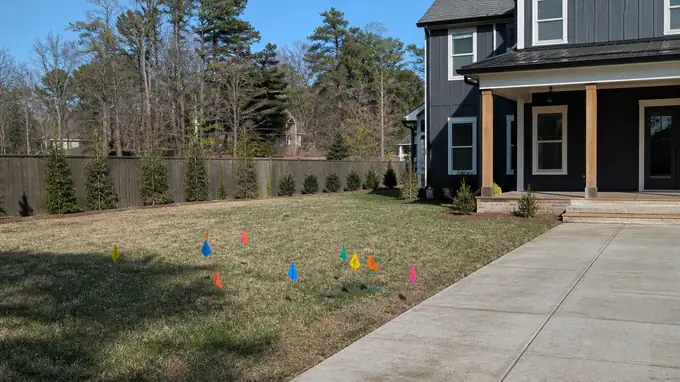
Utility flags mark buried lines before digging starts. at a charcoal farmhouse-modern home in Sandy Springs, GA, in full afternoon sun.

Step 1: Site Assessment

We walk the property with you and look at where water goes now, where it will go once the slab is down, and what sits underneath. Rion soil, which drains well, is the most common type in Fulton County, but it changes from lot to lot, so every site is tested individually before work starts. We also check for buried lines, tree roots, old fill and the access a concrete truck needs.

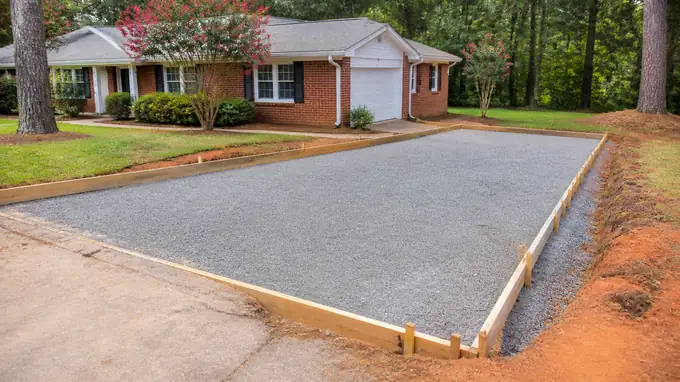
Crushed stone base is raked level inside driveway forms. at a red-brick ranch home in Sandy Springs, GA, under bright midday cloud.

Step 2: Site Preparation

Grass, roots and topsoil come out until we reach firm, undisturbed ground. Soft spots get dug out and replaced rather than covered over, because a slab will follow whatever is beneath it. We lay a gravel base, compact it in lifts rather than all at once, and set the grade so water sheds away from the house. With about 60" of rain a year in the area, that slope matters as much as the concrete.

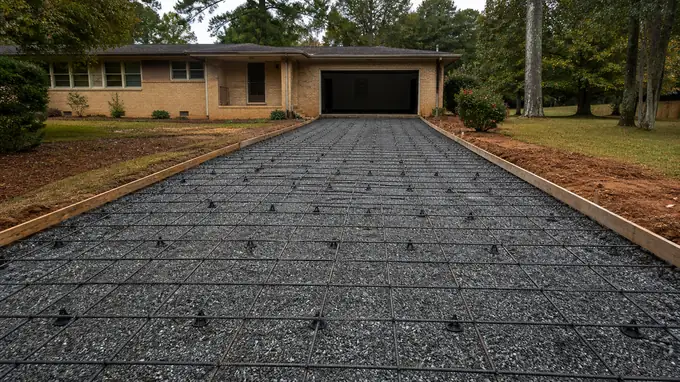
A worker ties rebar into a grid before a residential pour. at a buff-brick ranch home in Sandy Springs, GA, after a rain shower.

Step 3: Forming & Reinforcement

Forms go in next: straight lumber staked tight, set to finished height and checked for pitch along their whole length. Inside them goes the reinforcement. For most driveways and patios that means rebar in a grid, tied at the crossings and held up on chairs so it sits in the middle of the slab. Rebar lying on the gravel does nothing. Where the slab meets the house or an existing surface, we add expansion joint material.

A screed board levels fresh concrete on a small patio. at a charcoal farmhouse-modern home in Sandy Springs, GA, under low winter sun.

Step 4: Pouring

Concrete arrives ready-mixed to the strength the project calls for, and we check it before it goes down. Water added on site to make it spread easier is one of the most common reasons slabs crack and dust later, so we do not do it. Pours are planned around the forecast. The crew places the concrete, works it into the corners and around the steel, and strikes it off level with the forms.

A broom drags across a driveway creating a slip-resistant texture. at a grey split-level home in Sandy Springs, GA, under broken cloud.

Step 5: Finishing

Once the surface firms up, it gets bull floated, edged and jointed. Control joints are cut deep enough that the slab cracks along a straight line we chose, not a random one. A broom finish gives driveways grip in the rain. Stamped and decorative finishes happen here too: color, pattern and texture pressed in while the concrete is still workable, which leaves a short window and no room for guessing.

Damp burlap covers a small slab section during curing. at a buff-brick ranch home in Sandy Springs, GA, in raking morning side light.

Step 6: Curing

Fresh concrete gains strength slowly, and only while it holds its water. If the surface dries too fast, it can craze, dust or scale for years afterward. We keep the slab moist or cover it with a curing compound so the full depth cures evenly. Foot traffic comes first. Cars wait longer, until the slab can carry them, and driving on it too early is the most common way a new driveway gets marked or cracked.

A finished stamped surface shows a glossy sealed sheen. at a grey split-level home in Sandy Springs, GA, in full afternoon sun.

Step 7: Sealing

Sealer is the last coat, applied only after the slab has cured enough to take it. A penetrating sealer soaks into the surface and blocks water and oil stains without changing the look. Stamped and decorative work usually gets a film-forming acrylic that deepens the color and adds a slight sheen. Neither lasts forever. Resealing every few years, depending on sun and traffic, keeps the surface protected, and it is simple maintenance to plan for.

What Decides the Price of Concrete in Vinings

Two slabs of the same size can land far apart on price, and nearly all of the difference sits in the ground under them and the route to get there. Most of it you can check yourself. Walk the spot with this list in hand.

What changes the priceWhich wayWhy
An old slab, pavers or asphalt where the new slab goescosts moreIt has to be broken up, loaded and hauled away before we can dig for the base.
A clear path for a ready-mix truck to back up to the formscosts lessWhen the chute reaches, concrete goes straight in. Fences, tight side yards or a steep drive mean a pump or wheelbarrows.
Ground that falls away across the slab areacosts moreA slope takes more digging, taller forms and more compacted fill to give the slab a level base.
Water that pools or runs toward the spot after a stormcosts moreWith about 50 inches of rain a year, the slab needs a pitch, a deeper stone base and sometimes a drain beside it.
What the slab will carry: a patio table, a car, a shed, a camperheavier loads cost moreMore weight calls for a thicker slab and a deeper excavation.
Rebar in place of wire meshcosts moreRebar is tied on a grid and set on chairs, which takes more steel and more hours. Under real weight, it is the right call.
Soft ground, old fill or roots under the areacosts moreRion soil drains well and is the most common type in Fulton County, but it varies. We test every site before work starts, and weak spots get dug out and replaced.

When bids come in, set them side by side on the same points: slab thickness, reinforcement type, depth of the stone base, whether removal and haul-off are included, and how each one handles drainage. A low number usually means one of those lines is missing. Or thinner.

Vinings Questions

What specific areas and neighborhoods do you serve outside of Vinings?

Our work runs across metro Atlanta, from office parks and retail corridors to the residential streets between them. That covers quiet cul-de-sacs, busy commercial lots, and everything in between. Every town on our service list gets the same crew, the same materials and the same process, whichever one you live in. The full list sits elsewhere on this page. If your street is close to it, ask.

Do I need permits for foundation work in Vinings?

Yes. Foundation work is structural, and structural concrete in Vinings generally goes through a building permit and inspection before the pour. The permit review looks at footing depth, reinforcement and how the slab ties into the structure above it. We work to the approved plans and keep inspections ahead of the concrete, not behind it. Soil conditions vary from site to site, so every site is tested individually before work starts.

What's the difference between acid stain and water-based stain?

Acid stain is a chemical reaction, not a coating. It reacts with the lime in cured concrete and leaves a mottled, variegated color in browns, tans and blue-greens, so no two slabs finish quite alike. Water-based stain settles into the top of the surface and offers a much wider range of colors, with a more even and predictable result. Acid suits decorative patios where variation is the point. Water-based suits matching a specific color.

Can commercial driveways in Vinings be repaired while staying open to traffic?

Yes, in most cases. We split the driveway into sections and work one at a time, so part of the entrance stays open while the rest is torn out, reinforced and poured. Cones, barricades and clear signs route cars around the work zone. New concrete needs time to cure before it carries vehicle weight, so the phases are sequenced to keep a usable lane at every stage. A tight single-lane entrance takes more planning.

What is the standard width for commercial sidewalks in Vinings?

There isn't one width that covers every Vinings property. Commercial sidewalk width comes from the local building code, accessibility rules for wheelchair clearance, and the approved site plan for that property. Busier frontages often call for more than the minimum. Where a walk meets a parking lot, curb ramps and grade change the layout as well. We build to what the approved plans call for and confirm the width before any forms go down.

Do you only serve Vinings, or do you work in surrounding areas too?

No, we work well beyond it. Vinings is one part of a wider map across metro Atlanta, and a driveway in Brookhaven gets the same crew, the same reinforcement and the same finishing work as one here. We take residential and commercial projects throughout the area, from a single stamped patio to the slab under a new building. Not sure your property falls inside our coverage? Call for a free estimate and ask.

Get a Free Estimate

Get FREE Estimates

Tap to call +1 470-740-7099