+1 470-740-7099
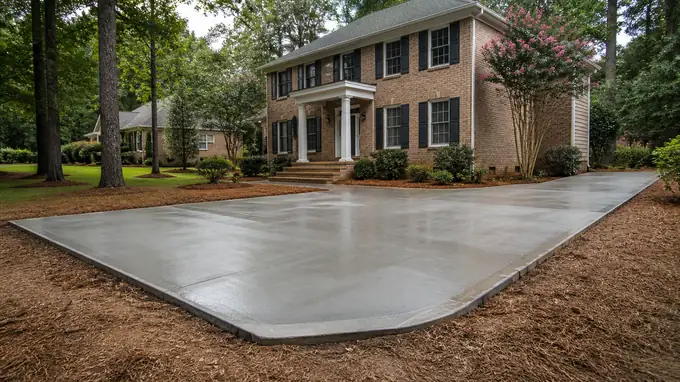
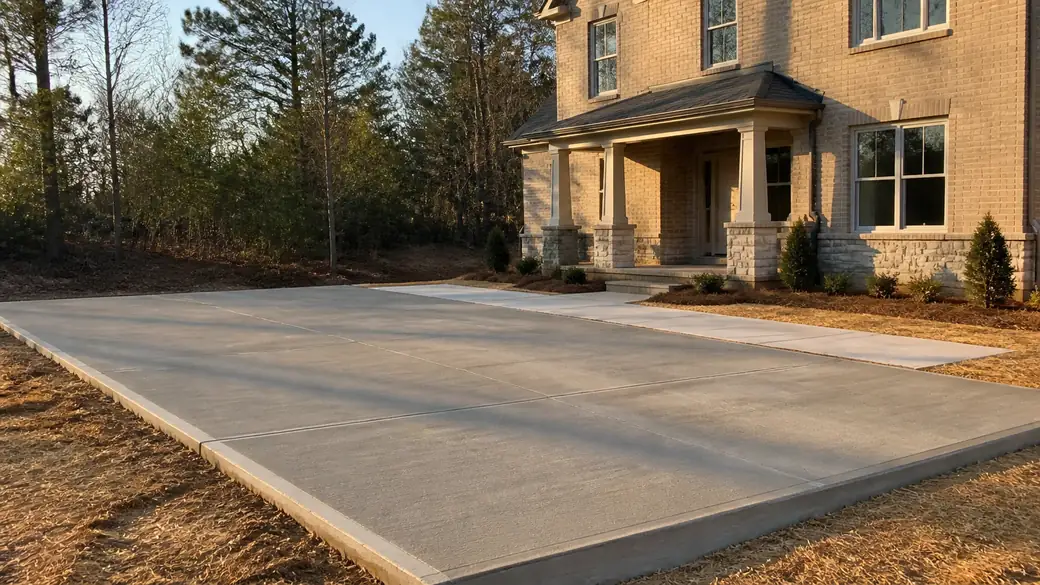
concrete slab installation completed by a local contractor at a brick-and-siding two-story home in Sandy Springs, GA, in late afternoon light.

Concrete Slab Installation in Druid Hills, Georgia

A concrete slab is the flat, load-bearing base that everything else sits on: a garage floor, a patio, a shed pad, the footprint of a home addition. We pour slabs across Druid Hills for residential properties, and the work that matters most happens before the truck arrives. The ground gets cleared, graded and compacted. A gravel base goes down to carry water away from the underside. Reinforcement sits at the right height in the slab, not lying on the dirt. Get those steps right and the surface you see on top has something solid under it. Skip them and the slab tells you within a few seasons.

Every site gets its own soil test before we set a single form board. What we find there decides how deep we dig, how thick the slab runs, and how much steel goes into it. Control joints get cut on a planned spacing so the concrete cracks where we choose, in a straight line, instead of wherever it likes. Curing gets its full time before anyone drives or builds on the surface, because a slab loaded too early carries that damage for good. None of this is complicated. It just has to be done in order, on every job. If you have a slab project in mind, call for a free estimate.

Call +1 470-740-7099

Get FREE Estimates

Concrete Services in Druid Hills

Concrete Slab Installation Cost

What moves the number on a slab is mostly underground: how much the grade has to be cut or filled, how thick the slab needs to be, and what reinforcement goes in it. A 4-inch patio slab on compacted gravel is a different job from a 6-inch pad built to carry a vehicle. We walk the site, test the soil, take measurements, and write the estimate from what we find. Call for a free estimate.


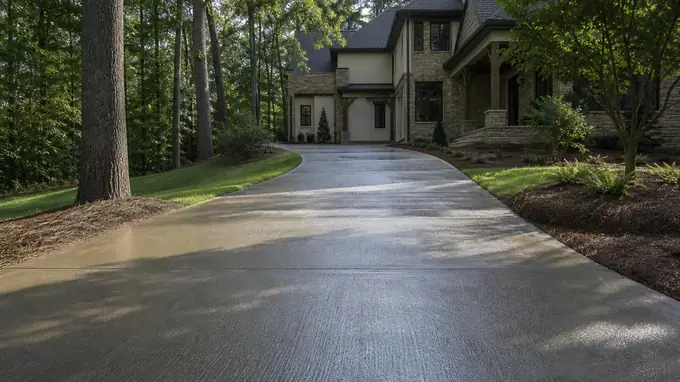
concrete driveway installation completed by a local contractor at a buff-brick ranch home in Sandy Springs, GA, under a hazy afternoon sky.

Concrete Driveway Installation

Most driveways crack where the car turns or where water sits. We pour them 5 inches thick over a compacted gravel base, with rebar set on chairs so it ends up in the middle of the slab rather than pressed into the dirt. Control joints go in every 10 feet or so, which lets the cracks land where we choose. With about 50 inches of rain a year, every driveway gets pitched to shed water away from the house.

concrete flooring installation completed by a local contractor at a painted-white-brick two-story home in Sandy Springs, GA, under low winter sun.

Concrete Flooring Installation

Interior floors in basements, garages and workshops start with what goes under them. We lay a 10-mil vapor barrier beneath the slab so ground moisture doesn't wick up into whatever gets installed on top later. The finish depends on the room: a hard steel-trowel surface for garages and shops, ground and sealed concrete for living space, or a flat pour ready for tile or epoxy. Joints get saw-cut the day after the pour, before shrinkage picks its own lines.

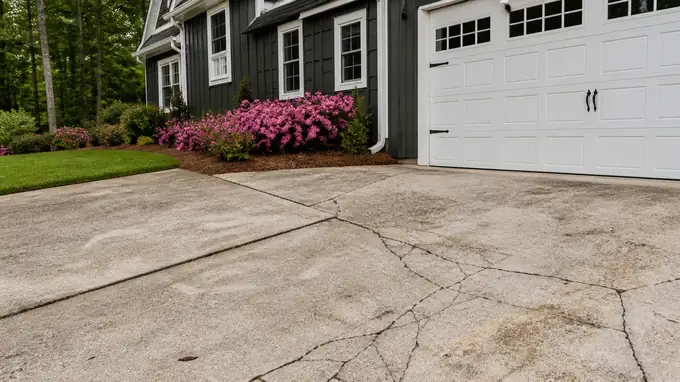
concrete slab repair completed by a local contractor at a stacked-stone and stucco home in Sandy Springs, GA, in raking morning side light.

Concrete Slab Repair

Not every cracked slab needs to come out. Hairline shrinkage cracks can be routed and sealed. Where a section has sunk, the cause is usually a washed-out or poorly compacted base, and patching the surface won't fix that. We look underneath before recommending anything: sometimes that means lifting and leveling, sometimes cutting out a panel and repouring it with dowels drilled into the sound concrete on either side. Flaking surfaces can often be resurfaced.

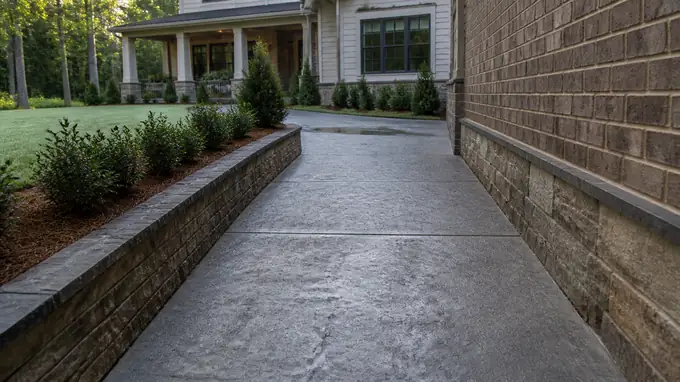
concrete sidewalk installation completed by a local contractor at a brick-and-siding two-story home in Sandy Springs, GA, in early morning light.

Concrete Sidewalk Installation

Walkways carry less load than a driveway, so a 4-inch slab over compacted gravel is usually right. The details that matter are pitch and joints. We slope the walk slightly to one side so water runs off instead of pooling, and tool control joints at roughly the walk's width. Where a sidewalk meets a driveway or a step, we set expansion joint material so the two slabs can move on their own. Broom finish is standard, with stamped borders available.

What to Expect on a Druid Hills Concrete Job

A worker examines an old driveway before replacement. at a charcoal farmhouse-modern home in Sandy Springs, GA, in full afternoon sun.

Step 1: Site Assessment

Before any form goes in, we walk the property and look at how water moves across it, where the slab meets the house, and what the existing surface is hiding. Rion soil (well drained) is Fulton County's dominant type, but it varies across the county, so every site is tested individually before work starts. We mark utilities, check grade, and talk through what the slab has to carry: a patio table or a loaded truck.

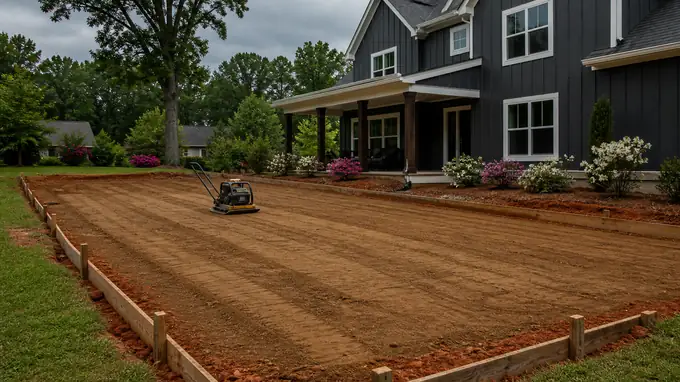
A plate compactor tamps down soil in a small excavated area. at a charcoal farmhouse-modern home in Sandy Springs, GA, under a darkening storm sky.

Step 2: Site Preparation

Old concrete comes out first, broken up and hauled away. Then we cut to grade, strip out topsoil and roots, and compact the subgrade in lifts with a plate compactor so it does not settle unevenly later. A crushed stone base goes on top, graded and compacted again. With about 50 inches of rain a year here, slope matters, so we pitch the base away from the foundation. Soft spots found now get dug out and replaced, not covered over.

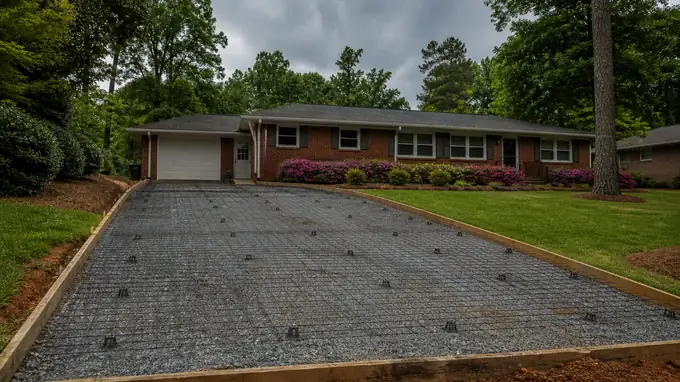
Wire mesh is unrolled across a driveway base before pouring. at a red-brick ranch home in Sandy Springs, GA, under a darkening storm sky.

Step 3: Forming & Reinforcement

Forms are straight lumber staked on the outside, set to string lines and checked for pitch. Inside them goes the steel. For driveways and structural slabs that usually means rebar tied in a grid; lighter patios may take welded wire mesh. Either way it sits on chairs so it ends up in the middle of the slab, where it does its work. Mesh left lying on the stone, then yanked up with a rake, is one of the most common mistakes in the trade.

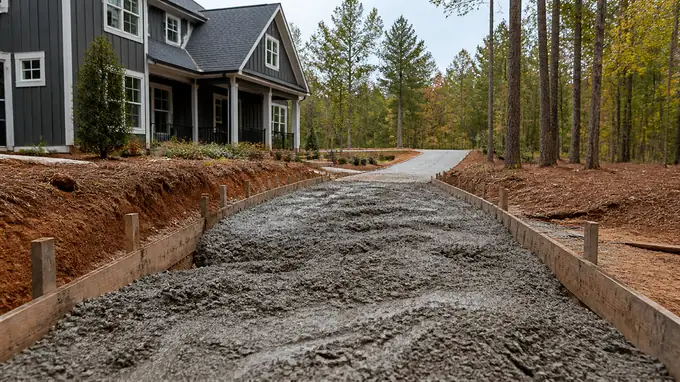
A ready-mix truck discharges concrete into a driveway form. at a charcoal farmhouse-modern home in Sandy Springs, GA, under a hazy afternoon sky.

Step 4: Pouring

Truck timing drives the whole day. Once the mix arrives, it has to be placed, spread and struck off before it starts to set, so the crew is ready at the forms before the drum turns. We place concrete as close to its final position as we can, because dragging it across the slab separates the stone from the paste. A straightedge screeds it flat to the forms, and a bull float closes the surface right behind it.

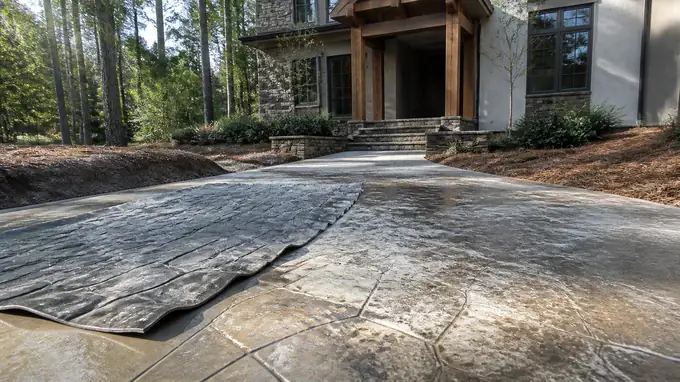
Stamping mats are pressed into a patio surface to imprint a pattern. at a stacked-stone and stucco home in Sandy Springs, GA, under low winter sun.

Step 5: Finishing

Patience is most of this step. Finishing too early, while bleed water still sits on the surface, traps it under a weak top layer that scales off later. Once the sheen is gone, we edge the perimeter, cut or tool control joints so the slab cracks where we choose, and apply the finish: a broom texture for grip on driveways, a smooth trowel for garages, or a pattern and color for stamped and decorative work.

A hand sprayer applies curing compound to a finished patio. at a tan-brick colonial in Sandy Springs, GA, under an overcast sky.

Step 6: Curing

Concrete gains strength slowly, and it needs moisture to do it. A slab that dries too fast ends up with a weak, dusty surface and a web of fine cracks. We keep it damp or apply a curing compound right after finishing, then keep traffic off it: foot traffic after a short wait, vehicles considerably longer. Pulling a car onto a new driveway too soon is how edges crack and corners break off.

A sprayer applies sealer across a driveway. at a stacked-stone and stucco home in Sandy Springs, GA, under low winter sun.

Step 7: Sealing

Sealer goes on once the slab has cured and dried enough to take it. It slows the water, oil and grime that stain a surface and work into it, and it brings out the color in stamped and decorative concrete. We apply it in thin, even coats, because a heavy coat traps moisture and turns cloudy. Resealing every few years keeps it working, and we explain which product suits your slab and why.

The Concrete Options Available in Druid Hills

A plain broom-finished slab is where most residential work in Druid Hills starts, and for a driveway, a shed base or a garage floor it is often the right answer. The brushed texture gives tires and shoes grip when it rains. From there the options widen. Stamped concrete presses a pattern into the surface while it is still wet, so a patio can read as slate, brick or cut stone. Integral color runs through the whole slab. Exposed aggregate washes back the top layer to show the stone underneath.

What sits inside the slab matters as much as what shows on top. We choose reinforcement by the load the slab will carry: steel rebar on a grid for driveways and anything a vehicle crosses, welded wire or fiber mix for lighter patios and walkways. Thickness follows the same logic. Before any of that, we test the site, because we do not assume what is underneath any property. The forms, the base and the steel all get set to what that test shows.

When a slab fails, the cause is usually the base, not the finish. A stamped patio poured over soft, poorly compacted fill will crack along the pattern no matter how clean the stamping was. Decorative work also asks more of the schedule. Stamping has a short window while the surface is still workable, and color and sealer need dry conditions to set evenly. We plan the pour around those limits rather than rushing it. Call for a free estimate to talk through which option suits your project.

What Decides the Price of Concrete in Druid Hills

Two slabs of the same size can come in far apart on an estimate. The difference is nearly always the site: what is already in the ground, how close the truck gets, and what the slab has to carry once it cures. Most of it you can walk out and check yourself before anyone measures.

What changes the priceWhich wayWhy
Old concrete, asphalt or pavers in the footprintcosts moreBreaking out and hauling away an old surface is its own labor and disposal before any new work starts.
Tree roots under the slab areacosts moreRoots have to be cut back and the base rebuilt, or they lift and crack the slab later.
Distance from the street to the formscosts more the farther it isA narrow side yard, a gate or a long carry means a pump or wheelbarrows instead of pouring straight off the truck.
Slope across the sitecosts moreA sloped yard needs cut, fill and taller forms to get a level slab.
Thickness and reinforcement the slab needscosts more as both go upA pad for a shed and a slab under a vehicle are different builds; extra depth and rebar add material and tying time.
Where water sits after a stormcosts more if it poolsWith about 50 inches of rain a year, a slab has to shed water, which can mean grading, a deeper gravel base or a drain first.
Irrigation, gas or sewer lines under the areacosts moreLines have to be located, then protected or rerouted before we dig.

When you compare bids, line them up on the same points: slab thickness, the reinforcement named (rebar or mesh, and at what spacing), base depth, and whether removal, haul-off and grading are included. A lower number that leaves one of those out is quoting a different slab.

Druid Hills Questions

Do you coordinate ready-mix delivery and placement for Druid Hills job sites?

Yes. We order the concrete ourselves and time the delivery to the moment the forms, base and reinforcement are ready, not before. We also plan where the truck will sit before it arrives. On a tight residential lot that can mean a pump or a buggy instead of chuting straight from the drum. The same crew places, finishes and cures the pour, so one team answers for it from first load to last.

How does the crew minimize downtime and maintain commercial site safety during active business operations in Druid Hills?

Phasing does most of the work. We split the property into sections so one part stays open while another is poured and cured. Work zones get barricades, marked walkways and clear signage, and truck routes and staging areas are agreed with the property manager before we mobilize. Loud or dusty steps, like saw cutting and demolition, can be scheduled outside business hours where the site allows. Customers and staff always keep a safe way in.

Do you only serve Druid Hills, or do you work in surrounding areas too?

No, Druid Hills is one of a number of communities we cover across metro Atlanta. The work does not change with the address. Every job gets the same crew, the same site testing before anything is dug, and the same standard of finish. A driveway in Tucker gets exactly the attention a slab in Druid Hills does. If you are not sure whether your property falls inside our area, call and ask.

How much does it cost to install a 4-footconcrete retaining wall in Druid Hills?

Height is only one part of the number, so we price a wall after seeing the site. Length, footing depth, the amount of steel, drainage stone and pipe behind the wall, and how easily equipment reaches the spot all move it. Soil varies from one property to the next, which is why every site is tested before work starts. With about 50 inches of rain a year, the drainage behind a wall matters as much as the concrete in it. Call for a free estimate.

Can you provide custom wire mesh sizes for specific projects?

Yes. Reinforcement is chosen for the slab, not pulled off a default. A backyard patio, a driveway that carries a pickup every day and a commercial slab under steady traffic each call for different mesh gauge and spacing, and some work is better served by rebar. We set the mesh on supports so it sits in the middle of the slab. That is where it does its job, rather than pressed into the dirt underneath.

What types of commercial projects does Sandy Springs Concrete Pros handle?

Slabs on grade for office and retail buildings, sidewalks and curb, dumpster and equipment pads, and sections of parking area that have cracked or settled. Entry walks and outdoor seating areas are good places for decorative or stamped concrete, where appearance matters as much as strength. Every commercial project starts with the same site testing we do on residential work. The mix and reinforcement are then specified for the loads and traffic that surface will actually carry.

Get a Free Estimate

Get FREE Estimates

Tap to call +1 470-740-7099