+1 470-740-7099
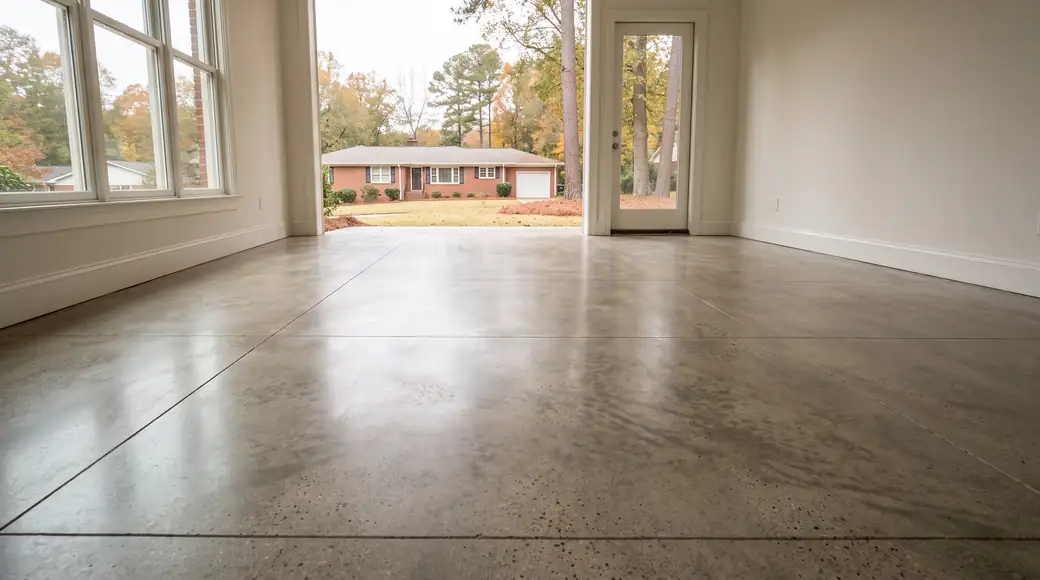
Polished concrete floor with a satin sheen in a finished interior room at a red-brick ranch home in Sandy Springs, GA, under an overcast sky.

Polished Concrete Floors in Sandy Springs, GA

We polish concrete floors in Sandy Springs homes, offices and shops, working on slabs that are already in the ground. Most of what we touch is not new. A garage floor, a finished basement, a retail space off Roswell Road: the concrete is there, and the real question is whether it can be ground, honed and sealed into a floor worth looking at. Sometimes it can. Sometimes the slab is too far gone, and we say so before anyone spends money on it. We are a concrete contractor first, and floors are one part of the flatwork we do.

Sandy Springs housing stock runs old enough for that to matter. Suburban development started in the 1950s, an early-1960s boom followed the highway construction, and infill kept going through the 1980s. That means slabs poured across four decades, sitting under carpet, under tile, under whatever the last three owners put down. Pours from different eras behave differently under a grinder. Older slabs carry patched plumbing trenches, cold joints and staining that will never fully come out. We pull the covering up, look at what is underneath, and tell you what the finished floor is honestly going to look like.

Floors are rarely the only concrete on a property, and most jobs turn up more than one. A driveway that has heaved on a rolling, wooded lot. A front sidewalk that has settled at the joints and now catches a toe. A back patio someone wants in stamped concrete or exposed aggregate instead of bare gray. We do that flatwork too, on Sandy Springs and Dunwoody properties, with rebar or wire mesh sized to what the slab actually has to carry. Call for a free estimate on any of it.

Call +1 470-740-7099

Licensed, Bonded, and Insured ยท A combined 15 years of experience

Get FREE Estimates

We warranty all of our work because we believe in what we do.

What Polished Concrete Floors Involves

Polished concrete floor with a satin sheen in a finished interior room at a red-brick ranch home in Sandy Springs, GA, under an overcast sky.

Polished concrete

Polished concrete starts with the slab you already have. We grind through the top layer with progressively finer diamond tooling, work a densifier into the surface, then polish up to the sheen you want, from a soft matte to a near mirror. Old slabs hide things: patched plumbing trenches, stained edges, cracks that need routing and filling first. Any concrete contractor can pour new flatwork. Reading a forty-year-old floor before grinding is the harder part, and it decides how the finish lands.

Polished Concrete Floors in metro Atlanta

Polished concrete floors start with the slab already under your house. We grind it with diamond tooling, run through finer grits until the surface takes light, and treat it with a densifier so it hardens instead of wearing. There is no new floor going down on top. The slab is the floor, which is why the result depends so much on what was poured in the first place. We do this work in Sandy Springs, Atlanta, Dunwoody, Roswell and Brookhaven, and across metro Atlanta generally, mostly in basements, garages, sunrooms and kitchens where somebody has pulled up carpet or tile and looked at what was underneath.

The housing stock here dates back to the 1950s, when suburban development began, and to the early-1960s boom that followed highway construction. Infill kept going through the 1980s. So the slabs we polish are rarely new. A slab from that era has settled, been drilled into, been covered by two or three generations of flooring, and it carries the marks of all of it. That history is not a problem to hide. Ground and polished, an old slab shows more character than anything poured last month.

Old slabs hide things. Plumbing trenches cut and repatched with a different mix take polish differently than the concrete around them, and that line stays visible. Carpet adhesive soaks in. Additions poured against the original slab sit at their own height, so a floor that reads flat to the eye is not flat to a grinder. Control joints and cracks get filled and ground flush, though a filled crack still reads as a line. We find these before we commit to a finish, not after, because grinding is subtraction and there is no putting the surface back once it is open.

Getting one of these floors right is mostly a matter of matching the finish to what the slab will actually give. Grind shallow and you keep the cream, a smooth surface with almost no stone showing. Go deeper and the exposed aggregate comes up, which some people want and some do not. A slab with wire mesh or rebar sitting high limits how far down we can go. We test a small area first, look at it in daylight, and decide from there. Call for a free estimate.
How the Work Runs

String lines and grade stakes laid out across a yard before a pour at a painted-white-brick two-story home in Sandy Springs, GA, in clear late-morning sun.

Step 1: Site Evaluation

We walk the whole area first, measuring, checking slope, and looking at where water goes once it leaves the surface. On a rolling, wooded lot that matters more than people expect. We probe the subgrade where we can, note soft spots and old fill, and read what the existing slab is telling us: corner cracks, settled panels, roots lifting sidewalks. Access counts too, since a truck has to reach the pour.

Concrete driveway and walk at a home, the kind of job an estimate covers at a stacked-stone and stucco home in Sandy Springs, GA, in early morning light.

Step 2: Written Estimate and Permits

The estimate comes in writing, broken out by area, thickness, reinforcement and finish, so you can see exactly what changes if you change something. Most replacement work needs a permit, and we handle that paperwork and schedule any required inspection before anyone breaks ground. Houses from the early-1960s boom often have utilities running in odd places, so we call for locates on every job regardless of how simple it looks.

Broken-out concrete removed and the base rebuilt before a new pour at a charcoal farmhouse-modern home in Sandy Springs, GA, after a rain shower.

Step 3: Demolition and Base Prep

Old concrete comes out in full. We break it up, haul it off, then cut the subgrade to depth and compact it in lifts, plate or roller depending on the size of the area. Four inches of compacted crusher run under a slab is our standard. Bad base is why driveways crack in the first place, and no amount of steel above it will fix soft ground below.

Wooden forms and rebar grid set and tied, ready for concrete at a brick-and-siding two-story home in Sandy Springs, GA, under an overcast sky.

Step 4: Forming, Steel and the Pour

Forms get set to the grades we measured, with fall built in so water runs off instead of standing. Rebar on chairs for a concrete driveway, wire mesh pulled up into the wet pour on lighter flatwork, dowels where new work ties into old. Concrete installation runs four inches on walks and patios, five or six where vehicles turn. We pour continuously and screed as it comes.

Freshly finished concrete slab curing under a clean broom texture at a grey split-level home in Sandy Springs, GA, under bright midday cloud.

Step 5: Finishing, Curing and Final Walkthrough

Finish depends on the surface: broom texture for traction on sidewalks, exposed aggregate, stamped or colored where you want a pattern to carry through. Control joints go in early and spaced to the slab thickness, because concrete cracks and joints decide where it happens. Curing runs slow and wet under cover or sealer. We walk the finished work with you, point out the joint lines, and say when to put weight back on it.

What Decides the Price

Two floors of the same size can price far apart, and most of that gap sits in the slab you already own. Before we give a number, we look at what is under the existing covering, how machines reach the room, and how much has to come off before any polishing starts. Houses from the early-1960s boom and the infill that followed often have slabs that have moved. Work that goes past polishing into pouring new concrete runs through the City of Sandy Springs for permits.

What changes the priceWhich wayWhy
Cracks, patches and settlement in the existing slabcosts moreEvery crack gets filled and the high side ground down before a polish will take evenly.
Old tile, adhesive or carpet glue on topcosts less if the slab is bareCutback adhesive loads diamonds fast, and removal is its own day of work.
A wide ground-floor door onto the work areacosts lessMachines roll straight in, slurry goes straight out, and setup is short.
Basement rooms, tight stair turns, narrow hallwayscosts moreSmall equipment covers less ground per pass, so the grind takes longer.
Slab thickness and the rebar or wire mesh in itcosts moreThis only applies where we pour new instead of polishing the old, and both material and labor climb with it.
Moisture moving up through the slabcosts moreVapor from below clouds a polish and lifts anything sitting on top, so it gets handled first.
Grade and drainage just outside the doorcosts moreWater running toward the slab keeps it wet, and on a sloped lot that shows up fast.
How deep we cut for aggregate and how high the final gloss goescosts moreA cream finish takes fewer passes than a full aggregate cut polished out.

Compare bids on the grit sequence and the gloss level each one ends at, whether densifier and joint fill are in the number or added later, who hauls out the old covering, and what happens to the price if the slab turns out worse once it is open.

Questions About Polished Concrete Floors

How long does polishing a Sandy Springs floor take?

Most residential floors run three to five working days, depending on square footage and how much repair the slab needs first. Grinding is the slow part. Each pass takes the whole floor down through progressively finer grits, and the densifier needs time to soak in and cure between steps. Larger open plans take longer than the same footage broken into rooms, because edges and corners get worked by hand.

How is a polished Sandy Springs floor maintained day to day?

Dust mop it and damp mop with a neutral cleaner. That is the whole routine. No wax, no sealer stripping, no annual recoating. Skip acidic cleaners and anything with ammonia, since both eat at the polished surface over time. Grit tracked in from a driveway or walkway is the real wear, so a mat at the door does more for the finish than anything you buy in a bottle.

Is polished concrete practical for a Sandy Springs shop floor?

Yes. Polished concrete handles rolling loads, jack stands and dropped tools better than coatings, which chip and peel at the edges once they take a hit. The densified surface resists oil absorption, so spills wipe up rather than staining down into the slab. It reflects overhead light well, which matters in a garage or shop where you are working under a car and want to see what you are doing.

How much gloss can a polished Sandy Springs floor take?

Gloss runs from a matte satin at around 400 grit up to a mirror finish at 3000. Higher is not automatically better. A high-gloss floor reads beautifully in a finished basement or a living space, but it shows dust and footprints faster and needs more frequent dust mopping. Shops and utility spaces usually look right somewhere in the middle, where the sheen is clean without demanding attention.

Can my existing Sandy Springs slab be polished, or does it need replacing?

Usually it can be polished. Slabs in this housing stock, much of it built during the early-1960s boom and the infill that followed, are generally sound under whatever covering came off. What matters is thickness, flatness and how badly the surface was damaged by tile mastic or carpet tack strips. We grind a test patch to see what is under there before quoting anything. Replacement is the exception.

Does polished concrete show every crack in a Sandy Springs floor?

Cracks stay visible, though polishing does not make them worse. We fill them with a semi-rigid epoxy that grinds flush and takes polish alongside the surrounding slab, so a filled crack reads as a thin line rather than a gap. Older floors carry some map cracking and cold joints. Colored concrete or a dye can pull attention away from them, but honest expectations serve better than any patching claim.

Get a Free Estimate

Get FREE Estimates

We warranty all of our work because we believe in what we do.

Tap to call +1 470-740-7099