+1 470-740-7099
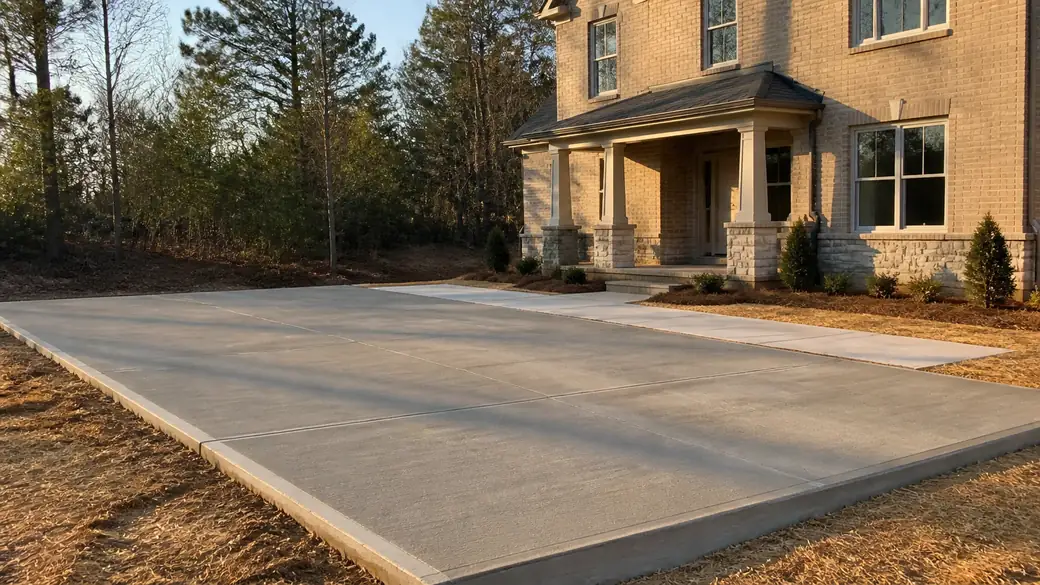
concrete slab installation completed by a local contractor at a brick-and-siding two-story home in Sandy Springs, GA, in late afternoon light.

Concrete Slab Installation in Peachtree Corners, Georgia

A concrete slab is the flat, load-bearing surface everything else sits on: a garage floor, a shed base, a patio, the pad under an addition or an outbuilding. On a residential property in Peachtree Corners it tends to be the part nobody thinks about again, which is exactly how it should be. We pour slabs that stay flat, shed water where they are meant to, and carry the weight they were designed for. When a slab is right, you park on it, build on it, and forget it is there. When it is wrong, you notice it every time it rains.

Most slab failures start below the concrete, not in it. Soft or poorly compacted subgrade settles, and the slab cracks along the line where it lost support. Water finds the low side of a pad and works under the edge. Reinforcement left lying on the dirt does nothing once the concrete cures around it. With about 50 inches of rain a year in this part of metro Atlanta, drainage is never an afterthought. Ground also changes from one lot to the next, so we test every site individually before work starts rather than guess at what sits under the grass.

Getting a slab right costs time more than anything else. The pour itself goes quickly. The preparation is where the job is won or lost: excavating to firm ground, building and compacting a proper base, setting forms to grade so water runs off, holding the reinforcement up in the middle of the slab where it can do its work, and cutting control joints where the concrete would crack on its own. Skip any of those and you save a day now, then pay for a tear-out later. We would rather spend the day. For a new slab on your property, call for a free estimate.

Call +1 470-740-7099

Get FREE Estimates

Concrete Services in Peachtree Corners

Concrete Slab Installation Cost

What a slab costs depends on what sits under it and what goes into it. Thickness, reinforcement, how much ground has to be cut or filled, and whether a truck can reach the pour or we have to pump it all move the number. A stamped or decorative surface adds labor that a plain broom finish does not. We walk the property, test the site, and price the actual job. Call for a free estimate.

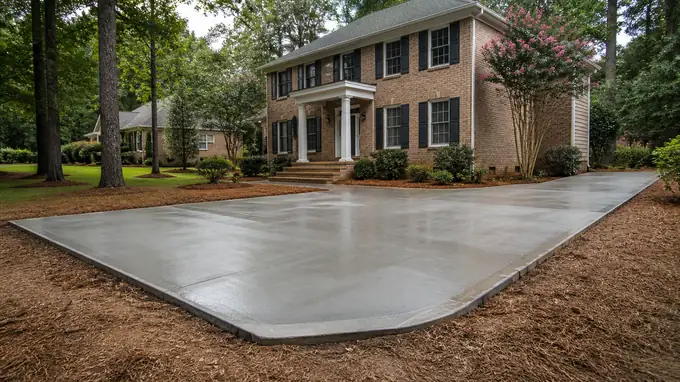
concrete driveway installation completed by a local contractor at a buff-brick ranch home in Sandy Springs, GA, under a hazy afternoon sky.

Concrete Driveway Installation

A driveway fails from the bottom up. We strip out the organic soil, compact a crushed stone base, and set rebar on chairs so the steel sits inside the slab instead of lying in the dirt. Aprons and turning areas, where tires scrub and heavy vehicles stop, get extra thickness. Control joints go in before the concrete picks its own crack lines. With about 50 inches of rain a year, we grade every driveway to shed water away from the garage.

concrete flooring installation completed by a local contractor at a painted-white-brick two-story home in Sandy Springs, GA, under low winter sun.

Concrete Flooring Installation

Interior floors for basements, garages, workshops and commercial space start with a vapor barrier under the slab. Moisture coming up through concrete ruins whatever is laid on top of it. From there the finish is your call: a hard steel-troweled surface, ground and polished concrete, or a sealed floor ready for epoxy. We test for moisture before any coating goes down. Coatings that peel usually trace back to a skipped moisture test or poor surface prep.

concrete slab repair completed by a local contractor at a stacked-stone and stucco home in Sandy Springs, GA, in raking morning side light.

Concrete Slab Repair

Not every cracked slab needs to come out. Hairline shrinkage cracks can be routed and sealed. A slab that has settled but stayed in one piece can often be lifted with polyurethane foam injected through small holes. Spalled or scaled surfaces can take a bonded resurfacing layer. When a slab has broken into sections that move on their own, or the base underneath has washed out, repair only buys time. Replacing that section is the honest answer.

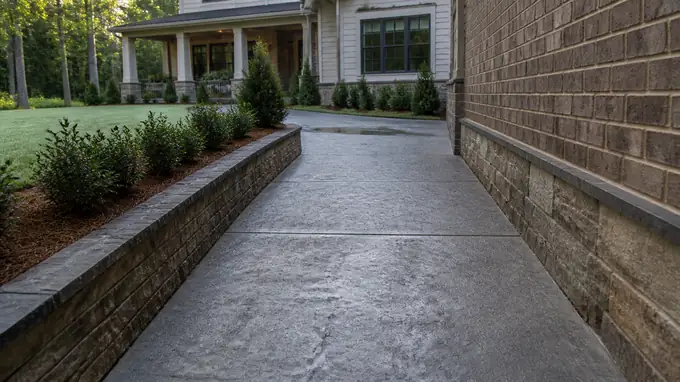
concrete sidewalk installation completed by a local contractor at a brick-and-siding two-story home in Sandy Springs, GA, in early morning light.

Concrete Sidewalk Installation

Sidewalks and walkways look simple, which is why so many are poured badly. We set forms to a steady cross slope so water runs off instead of pooling at the door, and we tool joints close enough together that cracks land in them. Tree roots are the usual cause of heaved panels, so we look at what is growing nearby before we pour. A broom finish gives grip in wet weather. Exposed aggregate or stamped borders suit front entries.

Why Choose Sandy Springs Concrete Pros

A slab is only as good as what sits under it, and that is where most of our attention goes. We pour residential and commercial slabs: garage floors, shed and workshop pads, patios, and the flat base a home addition stands on. We do not hand the ground work to someone else and show up for the pour. The same crew that grades and compacts the base also places the reinforcement, sets the forms and finishes the surface. That keeps every decision about your project in one set of hands, from the first stake to the last pass of the trowel.

Work starts with the site, not the truck. Soil varies from one property to the next, so every site is tested individually before we settle on a thickness or a base. From there we size the reinforcement to the load. A patio carries people and furniture, while a garage slab carries vehicles and a workshop floor may carry heavy machines. Forms go in square and to grade. Control joints are laid out before the pour, not guessed at afterward. With about 50 inches of rain a year to shed, we set a slope that moves water off the surface and away from the foundation.

Most slab failures trace back to a handful of shortcuts. Base material left loose settles, and the concrete cracks over the soft spot. Reinforcement lying flat on the dirt instead of held up inside the pour does very little. Joints cut too late let the slab choose where it breaks. Water steered toward the house finds its way somewhere nobody wants it. None of this is hard to prevent. Each step simply takes time that a rushed crew skips, and the cost shows up years later. Call for a free estimate on your Peachtree Corners slab.

What to Expect on a Peachtree Corners Concrete Job

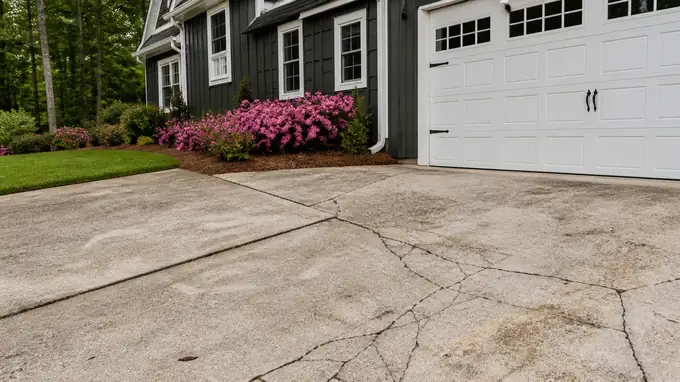
A worker examines an old driveway before replacement. at a charcoal farmhouse-modern home in Sandy Springs, GA, in full afternoon sun.

Step 1: Site Assessment

We start by walking the property and watching where water goes, because this area sees about 50 inches of rain a year and a slab has to shed all of it. We check grade, old concrete, tree roots, downspouts and anything buried under the footprint. Soil is not the same on every Peachtree Corners lot, so every site is tested individually before work starts. That tells us how much base the slab needs.

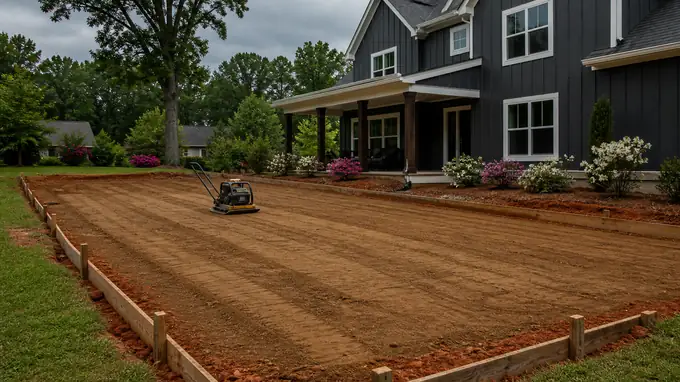
A plate compactor tamps down soil in a small excavated area. at a charcoal farmhouse-modern home in Sandy Springs, GA, under a darkening storm sky.

Step 2: Site Preparation

Excavation comes next. We strip topsoil and organic material down to firm ground, then bring in a gravel base and compact it in lifts rather than all at once. Soft spots get dug out and replaced, not covered over. Most cracked or sunken slabs trace back to this stage: a base that was never properly compacted, or one that holds water under the concrete instead of letting it drain away.

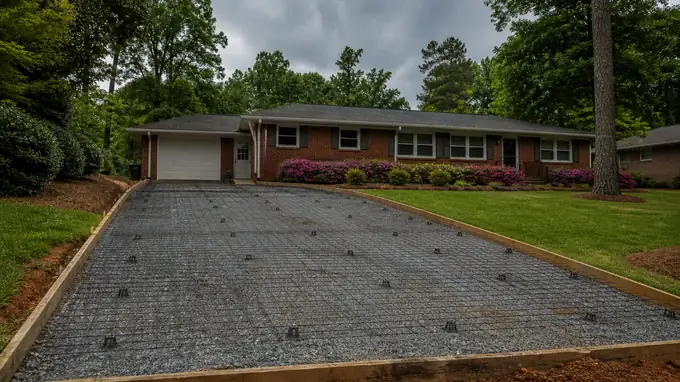
Wire mesh is unrolled across a driveway base before pouring. at a red-brick ranch home in Sandy Springs, GA, under a darkening storm sky.

Step 3: Forming & Reinforcement

Before any concrete arrives, forms are set to line and grade with enough pitch to carry water away from the house. Reinforcement is steel rebar on chairs, welded wire mesh, or both, depending on what the slab has to carry. A driveway takes loads a patio never sees, so its edges get thickened. The steel must sit mid-slab. Mesh left lying on the gravel does nothing, and it is a common shortcut.

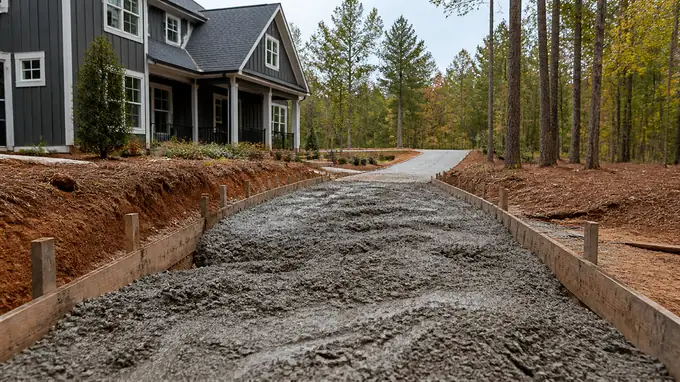
A ready-mix truck discharges concrete into a driveway form. at a charcoal farmhouse-modern home in Sandy Springs, GA, under a hazy afternoon sky.

Step 4: Pouring

Weather decides the pour date, since rain on fresh concrete ruins the surface. The mix arrives ready to the strength the project calls for, and we place it continuously so one section never sets up against another and leaves a cold joint. It is screeded off the forms and bull floated flat. Adding water at the truck makes concrete easier to spread and weaker once it cures, so we don't do it.

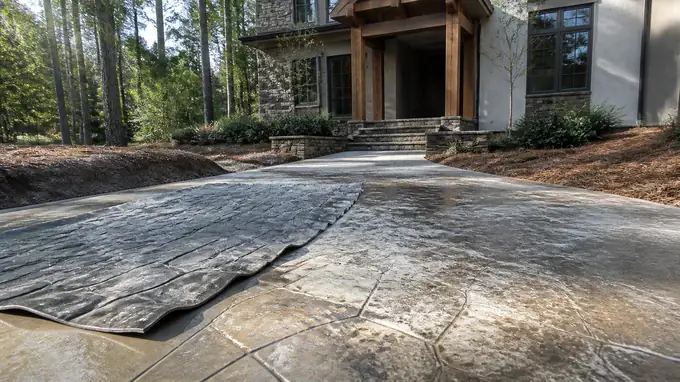
Stamping mats are pressed into a patio surface to imprint a pattern. at a stacked-stone and stucco home in Sandy Springs, GA, under low winter sun.

Step 5: Finishing

Once the bleed water leaves the surface, the finishing starts and timing is everything. We edge the slab, set control joints, and apply the finish: broom texture for traction on driveways and walks, a smooth trowel for garage floors, stamped patterns and color for decorative patios. Control joints give the slab a planned place to crack in a straight line. Without them, shrinkage cracks still come, just wherever they want.

A hand sprayer applies curing compound to a finished patio. at a tan-brick colonial in Sandy Springs, GA, under an overcast sky.

Step 6: Curing

Concrete keeps gaining strength for weeks after the pour, and how it is treated early decides how hard the surface ends up. We keep the slab moist with a curing compound or covering so the top doesn't dry faster than the concrete beneath it. Hot, windy days are when this matters most. Foot traffic can come within a few days. Cars stay off longer, and we say when the driveway is ready.

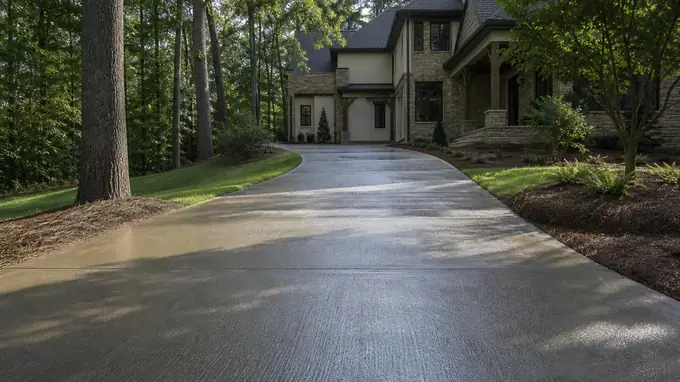
A sprayer applies sealer across a driveway. at a stacked-stone and stucco home in Sandy Springs, GA, under low winter sun.

Step 7: Sealing

Sealing is the last step, done once the slab has cured enough to take it. A penetrating sealer soaks in and protects plain concrete from water and staining without changing its look. Stamped and decorative surfaces usually get an acrylic sealer, which deepens the color and adds some sheen. Neither lasts forever. Resealing every few years keeps driveways and patios shedding water rather than soaking it up.

The Concrete Options Available in Peachtree Corners

Most of the slab work we pour in Peachtree Corners falls into a few plain categories: broom-finished driveways, patios, walkways, garage floors, and slabs under commercial property. Past plain gray, we offer stamped concrete patterned like stone or brick, exposed aggregate that shows the stone in the mix, and integral color that runs through the whole pour instead of sitting on top. Each surface has a different job. A driveway carries weight, a patio mostly carries furniture and people, and we build each one for what it holds.

The choice shapes the installation more than people expect. Before we form anything, we test the ground at the site, because soil changes from lot to lot and the base has to suit what is actually there. Then comes grading, a compacted gravel base, forms, and reinforcement sized to the load: rebar for driveways and structural slabs, wire mesh or fiber where the demands are lighter. Decorative work adds steps after the pour. Stamping happens on a tight clock while the surface is still workable, so we put more hands on those days.

Water causes most of the trouble we see. With about 50 inches of rain a year, a slab pitched the wrong way sends runoff toward a foundation or leaves it standing in low spots, and a base that was never compacted properly settles unevenly under all of it. Cracking is the other complaint. Concrete shrinks as it cures, so it will crack somewhere; control joints cut at the right spacing decide where. Skip them and the slab picks its own lines. Stamped surfaces left unsealed also fade and scale sooner.

Getting it right costs time more than anything else. A proper base means digging and compaction that nobody sees once the slab is down. Curing takes patience: we keep foot traffic off at first and vehicles off longer, and we do not rush a pour into weather that works against it. Decorative finishes run higher than a broom finish because of the extra labor, the sealer, and the resealing a stamped surface needs over the years. For a figure on your own project, call for a free estimate.

Get a Free Estimate

Get FREE Estimates

Tap to call +1 470-740-7099