+1 470-740-7099
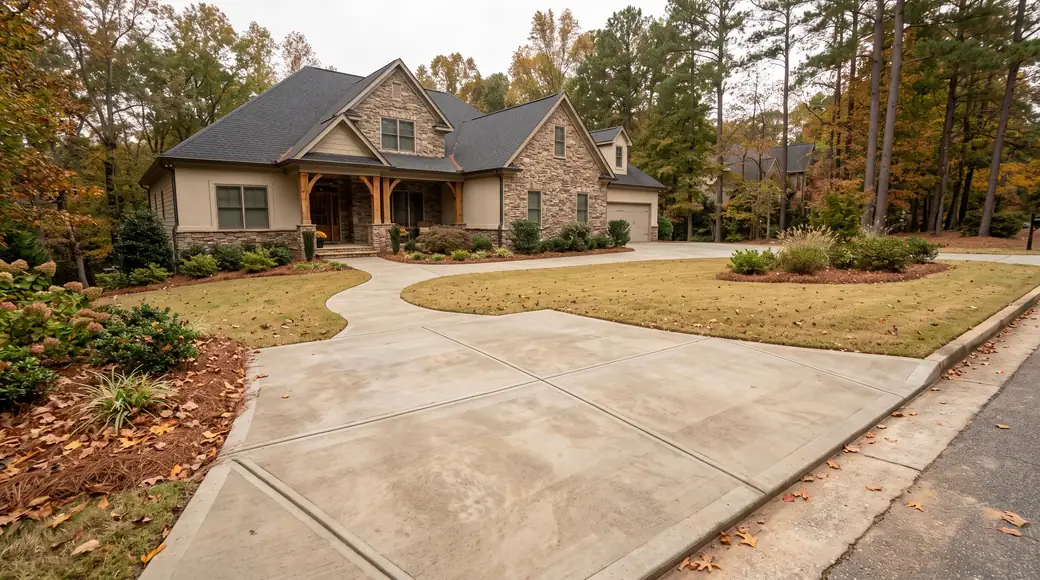
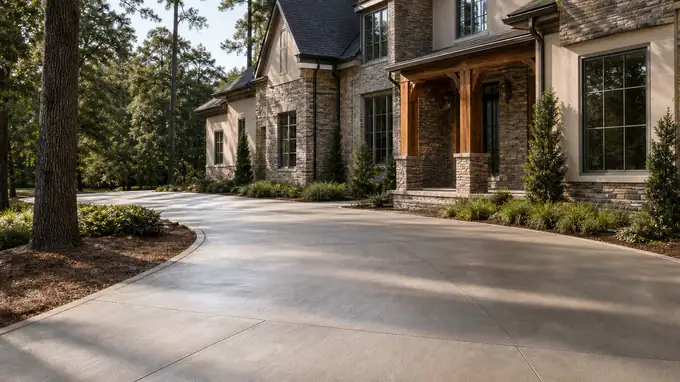
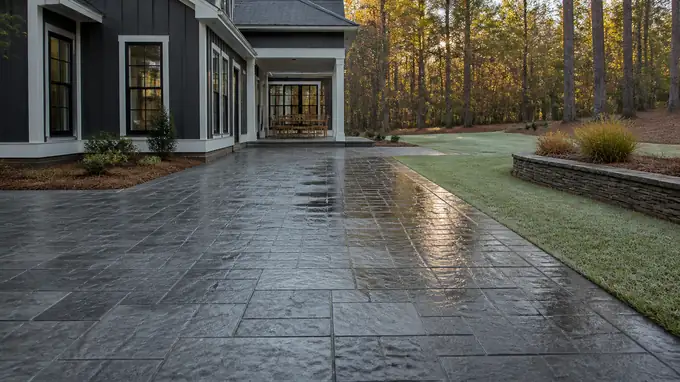
Wide view of finished concrete flatwork across the front of a home at a stacked-stone and stucco home in Sandy Springs, GA, under an overcast sky.

Stamped Concrete Patterns in Brookhaven, Georgia

Stamped concrete is a poured slab that takes its pattern from mats pressed into the surface while the concrete is still soft enough to hold an impression. Ashlar slate, running bond brick, seamless stone, wood plank: the mat sets the texture, and the color comes from pigment in the mix along with a release worked across the top. Done properly, a stamped patio reads as stone from the walk and behaves like a slab underfoot. We are a concrete contractor, so this is flatwork first and decoration second.

Most of our stamped work in Brookhaven replaces something. The suburban building here started in the 1950s and kept going, which means the patio, driveway apron or concrete sidewalk we are pulling out has had a long time to move. What turns up under the breaker is usually the same story: a thin pour, no rebar or wire mesh anywhere in it, and a base nobody bothered to compact. A pattern pressed into a slab built that way fails exactly the way the old one did.

Getting it right is mostly decided before the truck shows up. We dig down to ground that holds, compact the base, set reinforcement, and pour thick enough that the slab carries its own weight rather than leaning on the dirt. Stamping itself has a window. Too early and the mats sink and smear, too late and the pattern comes out shallow and thin, and it will look washed out within a season. After that it is joints, cure time, and sealer, in that order and not rushed. Call us for a free estimate on a stamped patio, driveway or sidewalk.

Call +1 470-740-7099

Licensed, Bonded, and Insured ยท A combined 15 years of experience

Get FREE Estimates

We warranty all of our work because we believe in what we do.

What We Do in Brookhaven

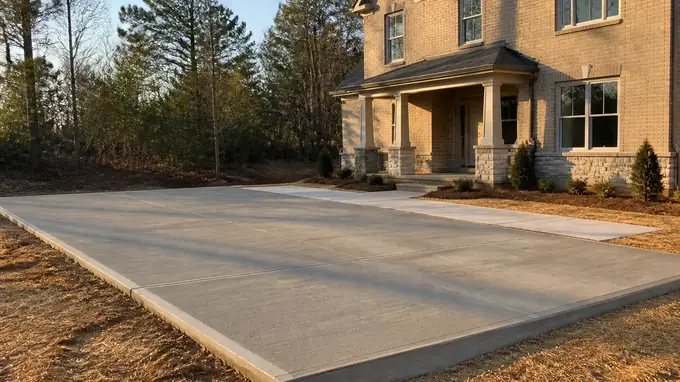
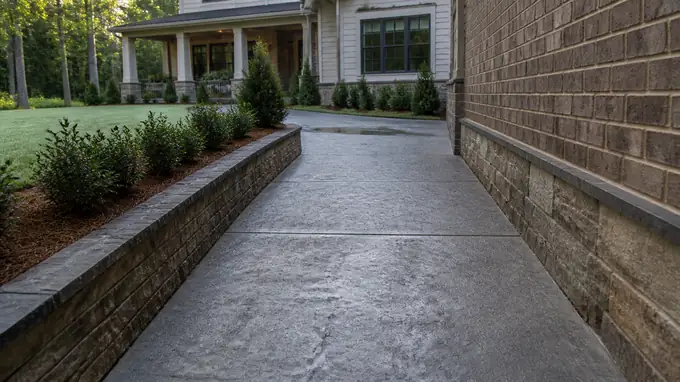
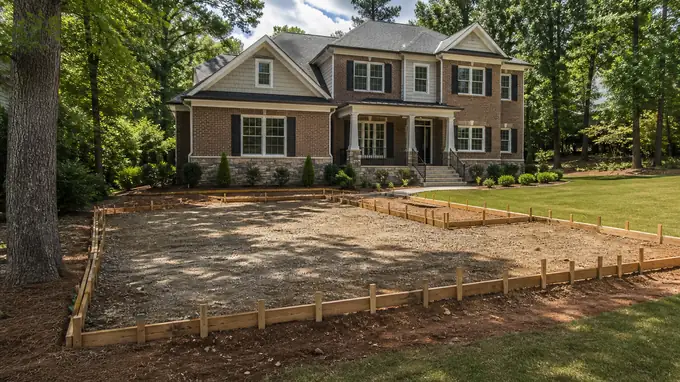
Replaced concrete driveway panel with clean saw-cut edges at a charcoal farmhouse-modern home in Sandy Springs, GA, in late afternoon light.

Repair, Leveling & Resurfacing

Most slabs we look at are not failing everywhere, just at the joints and the edges. Settled sections can be lifted back to grade, and sound concrete with surface scaling takes an overlay. What we will not do is resurface a slab that has cracked through its full depth or lost its base support, because the topping will telegraph the crack within a season and you have paid for a repair twice.

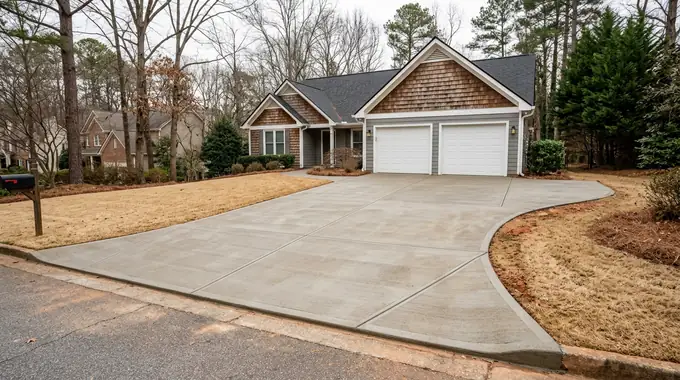
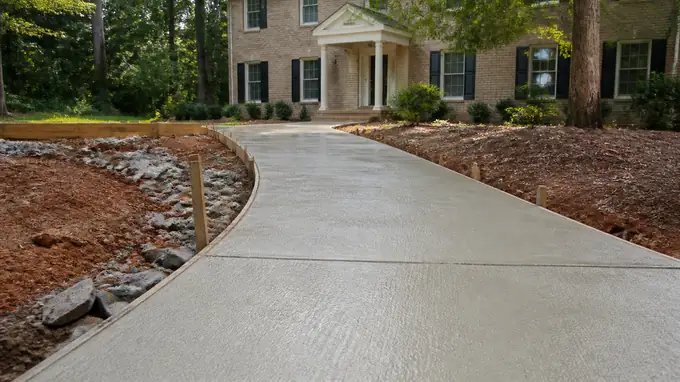
Broom-finished concrete driveway running up to a two-car garage at a grey split-level home in Sandy Springs, GA, under bright midday cloud.

Driveway Installation & Replacement

Replacement starts with taking the old driveway out, not pouring over it. We grade and compact the base, set rebar or wire mesh depending on the slab, and pour at four inches for cars, thicker where a truck parks or turns. Control joints go in at spacings that decide where the concrete cracks, since it will crack. The apron and the sidewalk crossing get poured to the same section.

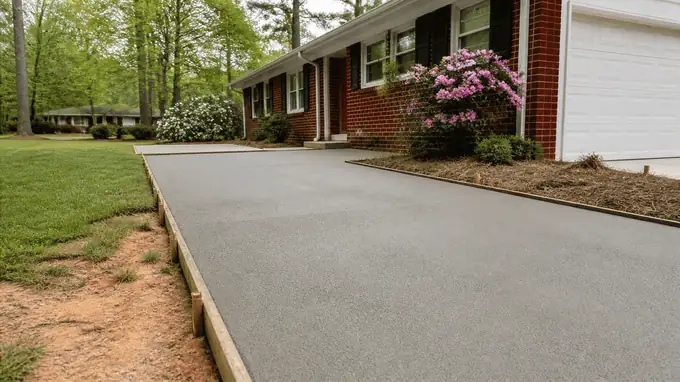
Rectangular concrete patio with a low step up to the rear door at a buff-brick ranch home in Sandy Springs, GA, in late afternoon light.

Patio Construction & Outdoor Living

Patios are where stamped concrete earns its keep, and pattern selection matters more than most people expect: large ashlar slate and seamless textures hide joint lines, while tight brick patterns show every one. Colored concrete goes in integrally with a release for depth, then gets sealed. On a rolling, wooded lot we set the slope away from the house first and work the pattern layout around that, never the reverse.

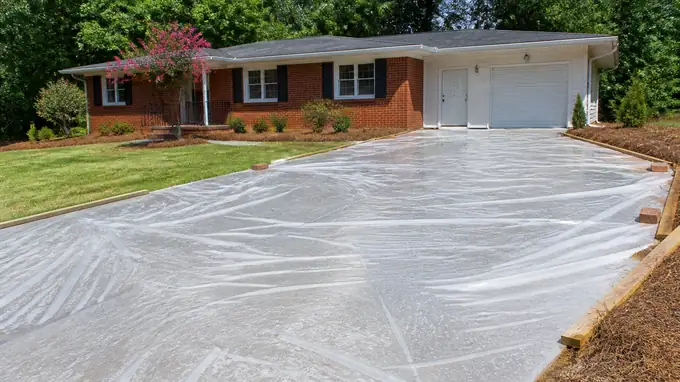
Board-formed concrete retaining wall holding a raised lawn at a red-brick ranch home in Sandy Springs, GA, in early morning light.

Retaining Wall Construction

A wall holding back a grade is a drainage problem before it is a masonry problem. Gravel backfill, filter fabric and a drain line at the base keep water pressure off the back face, which is what pushes walls out of plumb and opens the joints. We set a compacted leveling pad, batter the courses into the hill, and tie in geogrid where the height calls for it. Bulging walls are almost always drainage failures.

Square-edged concrete slab pad with a storage shed on it at a brick-and-siding two-story home in Sandy Springs, GA, under an overcast sky.

Concrete Slabs & Pads

Shed foundations, generator pads, HVAC pads, garage floors and equipment slabs for commercial concrete work all come down to the same details: a compacted base, the right thickness, and reinforcement sized to the load. Exposed aggregate and broom finishes both work here depending on traffic. As a concrete contractor we would rather spend the time under the slab, because a thin or soft base cracks concrete no amount of rebar can save.

Working in Brookhaven

Brookhaven's lots roll. Most of the yards we pour on sit on a grade, with trees over them, and that shapes a stamped patio more than any pattern book does. The houses here started going up in the 1950s, with the big push in the early 1960s and infill closing the gaps into the 1980s. Almost everything we do is replacement: a slab that has outlived its base, a patio poured before the trees around it got large. We are working around what is already there.

Grade decides the layout. On a sloped lot a stamped patio either steps down in sections or gets held at the low end by a wall, and choosing wrong leaves you with a pad that sheds water back toward the house. Mature trees decide the rest of it. A truck cannot always reach the back of these properties, so concrete moves by buggy or by line down a side yard, and that strip of ground has to be protected and put back the way we found it.

Roots are the usual culprit under a failed slab. A pattern telegraphs every flaw beneath it, so a heaved section or a soft spot in the base shows up in the joint lines long before anyone notices a crack. Older flatwork around here was often poured thin, straight over dirt, with no reinforcement in it at all. Water finds the low corner, sits, and works at the edge until something gives. Pulling that slab out tells us more about the site than standing on it ever will.

Getting a stamped pour right is mostly what happens before any color goes down. We dig to firm ground, compact the base, and set rebar or wire mesh so the slab moves as one piece instead of four. Then it becomes timing. Stamp too early and the texture smears, too late and the mats will not seat, and on a wooded lot with shade over half the pad the two ends set at different rates. Someone has to stand there and watch it.

Pattern choice follows the house. A 1960s ranch in brick takes a different stamp than a rebuilt two story, and we would rather walk you past concrete we have already poured than hand you a catalog. Exposed aggregate and colored concrete are on the table too, for anyone who wants texture without a repeating pattern in it. Brookhaven is one of the places we work across metro Atlanta, on the same terms as everywhere else we go. Call for a free estimate.

How a Job Runs

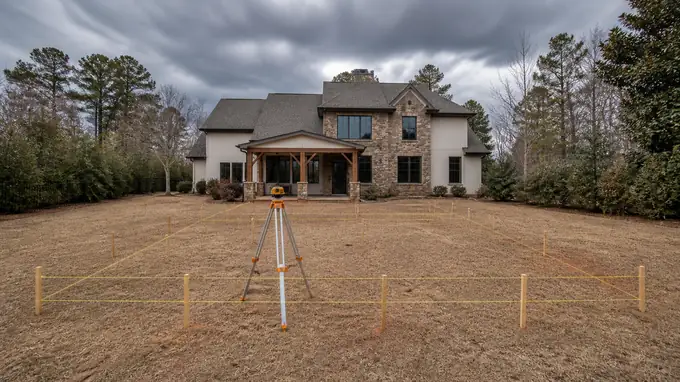
A job starts with a walk of the property. We look at where water goes, how the old slab failed, what a truck can reach, and how the new work has to meet the existing sidewalks and steps. Then we talk through pattern and color while standing on the spot, because stamped concrete reads differently in full sun than it does on a sample board. The layout goes in writing before anything gets scheduled.

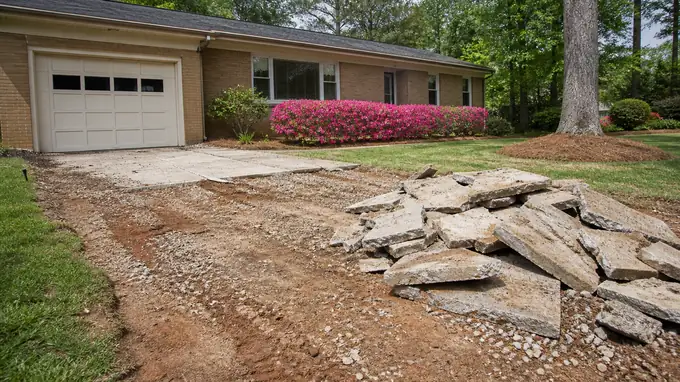
Demolition comes first. We break out the old slab, haul it off, then cut and compact the subbase until the grade is even and holds. Forms go in next, set to the fall we want for drainage. Rebar or wire mesh gets tied and chaired up off the ground so it sits inside the pour rather than under it. Concrete installation runs as one continuous placement wherever the shape allows, since cold joints in a stamped surface are hard to hide.

Trouble usually starts under the slab. Tree roots, soft fill from an old utility trench, and water running back toward the house will crack good concrete inside a couple of seasons. On a rolling, wooded lot, downspouts and grade changes matter as much as what comes off the truck. We would rather spend an extra day on the base than come back to a patio that has dropped at one corner. Stamping carries its own timing problem, because the mats have to go down in a window that moves with heat and humidity.

Permits go through the City of Sandy Springs on work inside those limits, and we pull them rather than handing that job to the homeowner. Scheduling turns on weather more than anything else. Rain landing in the middle of a stamped pour is a real problem, so we hold the date when the forecast turns rather than gambling on it. Driveways get sequenced to keep your access open as long as possible, and we tell you which days the car sits on the street.

Curing is the part people skip. A concrete driveway carries vehicle weight after about a week in ordinary weather, and the color keeps tightening for a good while past that. We seal once the slab has dried out, not before, and we say so even when someone wants it finished sooner. Efflorescence, the white haze that shows up on new stamped work, is normal and clears with time and a second coat. Call for a free estimate.

Brookhaven Questions

What is the ground like in Brookhaven, and does it change how you build?

Rolling and wooded, and yes, that changes things. We watch how water moves across a lot before we form anything, because a slab sitting below the fall of a yard collects everything the yard sheds. Grading, base depth and joint layout get decided on site, not in advance. Stamped concrete is flatwork first and pattern second, so the slab under the texture has to be right.

Who do I speak to about a Brookhaven job specifically?

Us. The people who walk your patio are the people who pour it, so nothing gets handed down a chain and reinterpreted along the way. Call about stamped concrete and you talk through pattern, color and joint placement with someone who has run a screed. Questions about rebar, wire mesh or slab thickness get a straight answer on the spot.

Can you match concrete you did not pour in Brookhaven?

Often, yes. Matching stamped or colored concrete depends on what is already sitting there: the pattern, the release color, how much sun the old slab has taken over the years. Cured concrete keeps shifting tone, so a new pour beside an old one starts close and settles closer. When a patch will always read as a patch, we say so before anyone orders concrete.

Do you charge more to work in Brookhaven than in Sandy Springs?

No. Brookhaven, Sandy Springs, Dunwoody, Roswell, Atlanta and the rest of metro Atlanta all get quoted the same way: the slab, the access, the prep, the pattern you pick. Where a truck can park matters far more than which side of a city line a house sits on. A tight backyard behind a narrow gate is a tight backyard anywhere.

How many jobs has Sandy Springs Concrete Pros done around Brookhaven?

We do not put a number on that. Job counts are easy to inflate and they tell you nothing about whether the patio outside your kitchen door will drain the way it should. Ask about the work instead. How we set the base, where the control joints land, which stamp pattern holds up on the square footage you actually have. Then come look at the concrete.

Get a Free Estimate

Get FREE Estimates

We warranty all of our work because we believe in what we do.

Tap to call +1 470-740-7099