+1 470-740-7099
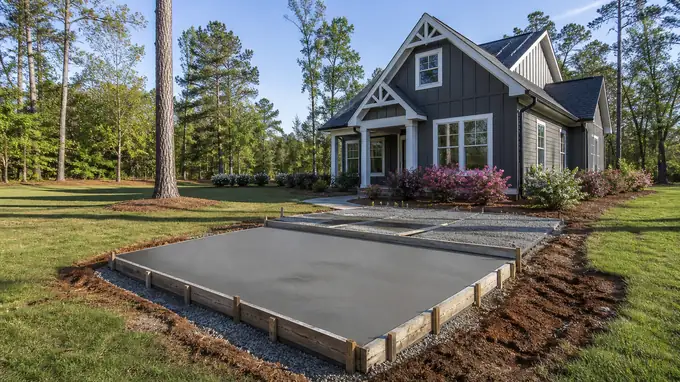
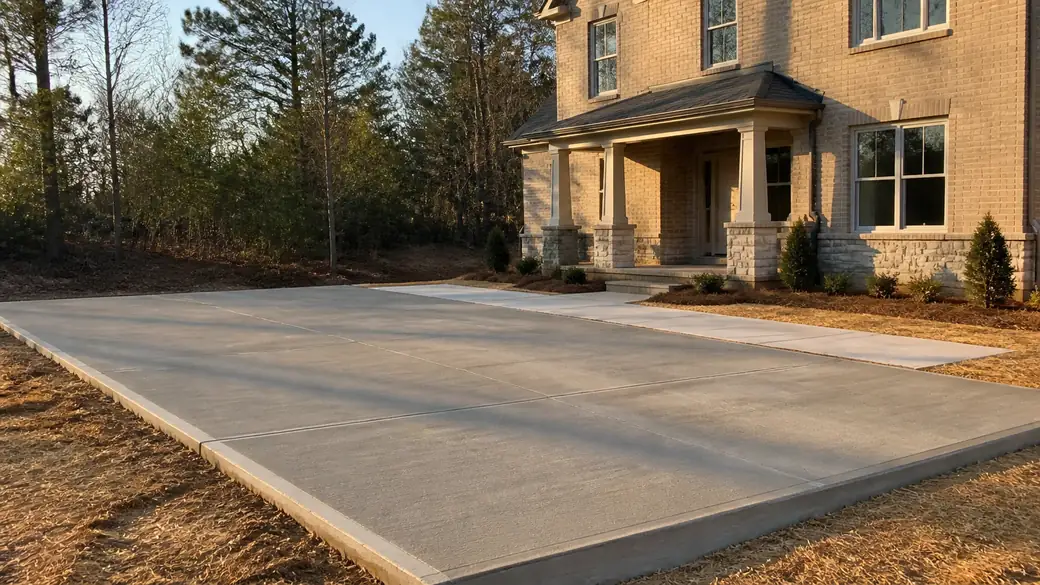
concrete slab installation completed by a local contractor at a brick-and-siding two-story home in Sandy Springs, GA, in late afternoon light.

Concrete Slab Installation in Atlanta, Georgia

A concrete slab is the flat, load-bearing surface everything else sits on: a garage floor, a shed pad, a patio, the base of a home addition or a commercial building. We pour residential and commercial slabs across metro Atlanta, and we size each one to what it will carry. A slab under a parked truck needs different thickness and reinforcement than one under a grill and four chairs. We work that out before any concrete is ordered.

Every job starts with the ground. Rion soil, which drains well, is the dominant type in Fulton County, but it varies from lot to lot, so we test each site individually before work starts. From there we grade and compact the subgrade, lay the gravel base, set the forms, and place rebar or wire mesh where it will do its job. Then we pour, screed, and finish the surface. We handle the permit when the project needs one.

Most slab failures start underneath, not in the concrete itself. A soft spot left in the subgrade settles, and the slab cracks right along it. With about 50 inches of rain a year, water that has nowhere to go ends up under the slab, so we build in slope and drainage from the start. Control joints go where they give the concrete a clean place to move. None of that shows once the slab is finished. It shows years later. Call for a free estimate.

Call +1 470-740-7099

Get FREE Estimates

Concrete Services in Atlanta

Concrete Slab Installation Cost

No two slabs cost the same, and a figure given over the phone is a guess. The price follows what goes into the ground: the footprint, how thick the slab needs to be for its load, whether it takes rebar or welded wire mesh, how much gravel base the site needs, and the finish on top. Soil matters too. Rion soil is the dominant type here but not universal, so we test every site before we pour. Call for a free estimate.


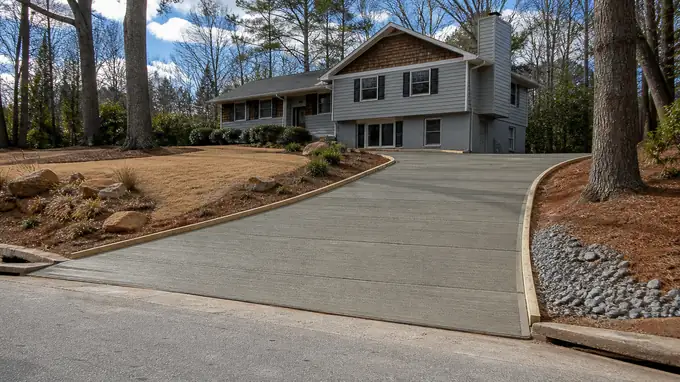
concrete driveway installation completed by a local contractor at a buff-brick ranch home in Sandy Springs, GA, under a hazy afternoon sky.

Concrete Driveway Installation

A driveway carries more weight than most people expect, from delivery trucks to a loaded moving van. We build it on a compacted gravel base, set rebar on chairs so it sits in the middle of the slab instead of on the dirt, and thicken the edges where tires roll off. Control joints go in before the concrete can crack on its own schedule. With about 50 inches of rain a year, we slope every driveway so water runs off rather than sitting on the surface.

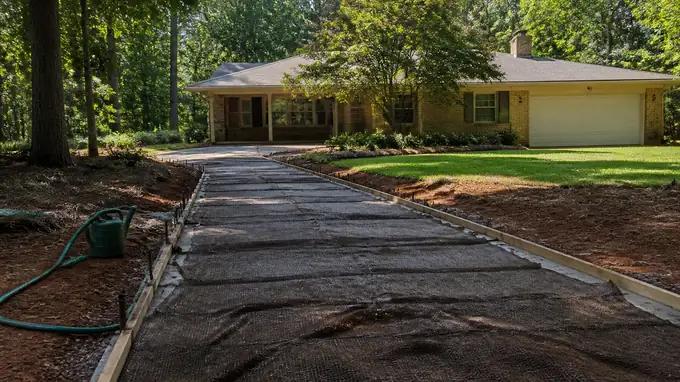
concrete flooring installation completed by a local contractor at a painted-white-brick two-story home in Sandy Springs, GA, under low winter sun.

Concrete Flooring Installation

Basements, garages, workshops and commercial spaces all take concrete floors, and each wants a different finish. Before placing, we lay a vapor barrier under the slab so ground moisture does not work up through it and ruin whatever flooring goes on top. A steel trowel gives a hard, smooth surface for a garage. Polished or stained finishes suit living space, or a retail unit along Roswell Road. We cut joints early, because a floor that cracks at random is hard to hide.

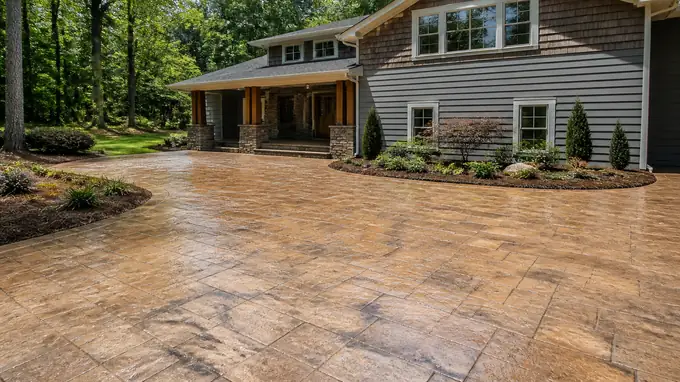
concrete slab repair completed by a local contractor at a stacked-stone and stucco home in Sandy Springs, GA, in raking morning side light.

Concrete Slab Repair

Most slab problems start underneath. A crack that opens wider on one side, or a section that has dropped, usually means the base washed out or was never compacted properly. Surface scaling and hairline shrinkage cracks are different: they look bad but rarely go deep. We work out which one we are looking at before recommending anything. Some slabs take crack injection or a resurfacing coat. Others need the failed section cut out, the base rebuilt, and new concrete doweled into the old.

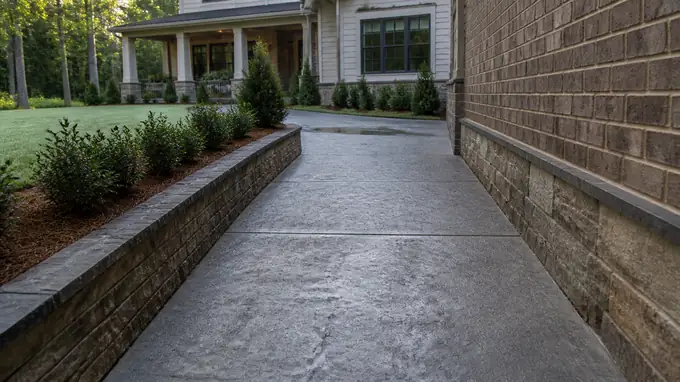
concrete sidewalk installation completed by a local contractor at a brick-and-siding two-story home in Sandy Springs, GA, in early morning light.

Concrete Sidewalk Installation

Walkways are simple until they are not. Tree roots, poor drainage and a thin base are what lift and break most sidewalks. We compact the base, form the walk with a slight cross slope so rain sheds off the edge, and add wire mesh or fiber reinforcement. Joints go in at regular spacing so cracks follow the lines we chose. A broom finish gives grip when the path is wet, and a stamped or exposed-aggregate border is there if you want something decorative.

Why Choose Sandy Springs Concrete Pros

A slab is only as good as what sits under it, so we start below the surface. Rion soil is the dominant type locally, and it drains well, but it varies from one property to the next. We test every site individually before any work starts, and the base, thickness and reinforcement follow from what that test shows. Nothing gets poured on an assumption. That habit is the main reason to hire us.

About 50 inches of rain falls here in a typical year, so drainage is part of the plan from the first stake. We set forms to carry water away from the house, compact the base in lifts, and place reinforcement on chairs so it ends up inside the slab rather than under it. We watch the forecast before a pour and reschedule rather than race the weather. The permit is ours to handle as well.

Most cracked or settling slabs trace back to the same few shortcuts: a base that was never compacted, control joints cut too late or not at all, and water left to pool along an edge. None of those show on the day of the pour. They show up a few seasons later, on a driveway or patio that looked fine when the crew left. We cut joints the same day, cure the surface properly, and leave the site graded to drain. Call for a free estimate.

What to Expect on a Atlanta Concrete Job

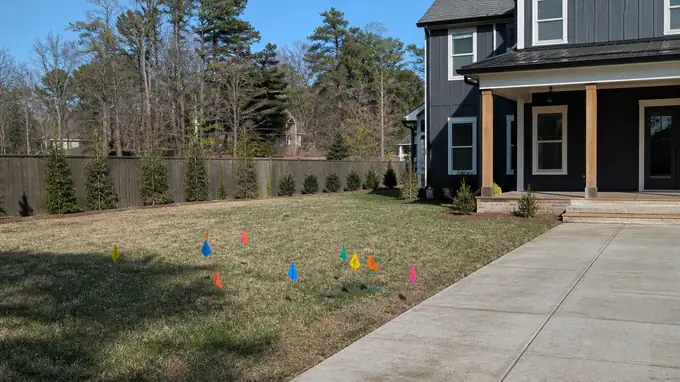
Utility flags mark buried lines before digging starts. at a charcoal farmhouse-modern home in Sandy Springs, GA, in full afternoon sun.

Step 1: Site Assessment

We walk the property, measure the area, and look at how water moves across it today. Grade, downspouts, tree roots and any old slab that has to come out all go into the plan. Rion soil, which drains well, is the most common type in the county, but it changes from lot to lot. So we test your site before any work starts. You get a written scope: what we pour, where, and how thick.

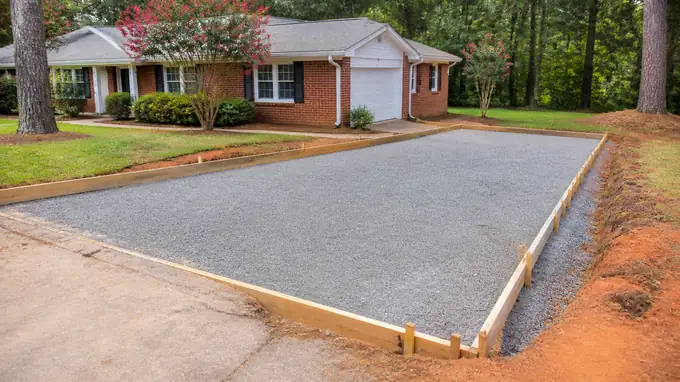
Crushed stone base is raked level inside driveway forms. at a red-brick ranch home in Sandy Springs, GA, under bright midday cloud.

Step 2: Site Preparation

Most cracked slabs failed underneath, not on top. We dig out topsoil and anything organic, then compact the subgrade until it stops moving under the plate. A layer of crushed stone goes down next and gets compacted again. We set the grade so water runs away from the house, which matters in a place that sees about 50 inches of rain a year. Where the project needs a permit, we handle the permit.

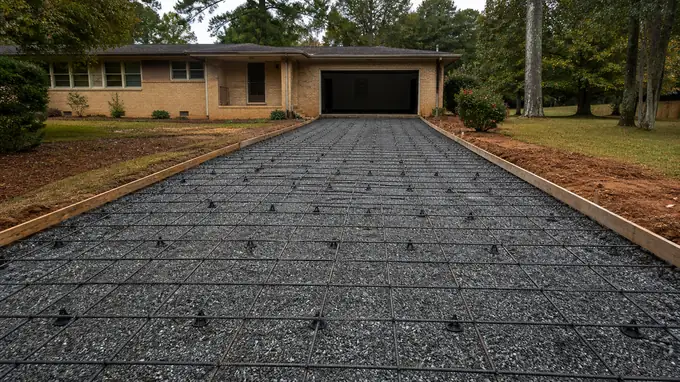
A worker ties rebar into a grid before a residential pour. at a buff-brick ranch home in Sandy Springs, GA, after a rain shower.

Step 3: Forming & Reinforcement

Forms go in straight, staked and checked against a string line, so the finished edge is true. Their height sets the slab thickness, and a driveway that carries a loaded truck gets more depth than a patio. Rebar is tied in a grid and raised on chairs so it sits in the middle of the slab, where it actually does its job. Wire mesh left lying flat on the stone does nothing. We see that often.

A screed board levels fresh concrete on a small patio. at a charcoal farmhouse-modern home in Sandy Springs, GA, under low winter sun.

Step 4: Pouring

The truck gets as close as the property allows. Where it can't reach, we pump or wheel the concrete in. We order a mix suited to the work and never add water at the chute to make it spread easier, because extra water weakens the surface. Concrete is placed, spread and struck off with a screed in one continuous run. That way there are no cold joints where one load has set before the next arrives.

A broom drags across a driveway creating a slip-resistant texture. at a grey split-level home in Sandy Springs, GA, under broken cloud.

Step 5: Finishing

Timing decides this step. We bull float right after screeding, then wait for the bleed water to leave before working the surface again. Troweling too early traps that water and the top flakes off later. Driveways and walks get a broom finish for grip. Patios can be smooth, exposed aggregate, or stamped with a decorative pattern and color. Control joints are cut or tooled in, so cracks form along the lines we chose.

Damp burlap covers a small slab section during curing. at a buff-brick ranch home in Sandy Springs, GA, in raking morning side light.

Step 6: Curing

Fresh concrete keeps gaining strength as long as it holds moisture, so we stop the slab from drying out too fast. That means a curing compound sprayed on after finishing, or wet coverings on hot days. With average daily highs around 72°F, most of the year is kind to new concrete, but summer afternoons and cold snaps both need watching. Keep foot traffic off at first and cars off longer. We tell you when it's ready.

A finished stamped surface shows a glossy sealed sheen. at a grey split-level home in Sandy Springs, GA, in full afternoon sun.

Step 7: Sealing

Sealer is the last coat, applied once the slab has cured enough to take it. On stamped and colored work it deepens the color and keeps stains from soaking in. On a plain broom-finished driveway it slows down the water, oil and grime that wear a surface over time. We pick a penetrating or film-forming sealer to match the finish, and we tell you how often it should be reapplied.

What Decides the Price of Concrete in Atlanta

Two slabs the same size can come back with very different quotes, and most of the reasons are things you can walk out and look at yourself. Before we price a slab, we look at what is in the ground now, how the truck gets to the work, what the slab has to carry, and where the water goes. Here is how each of those moves the number.

What changes the priceWhich wayWhy
Old concrete, asphalt or pavers where the new slab goescosts moreBreaking out the old surface and hauling it away is labor and truck time before any new concrete arrives.
A clear, firm path for the truck to reach the formscosts lessWhen the ready-mix truck can back up to the pour, the chute does the work. A slab behind a fence or down a slope may need a pump or wheelbarrows.
A yard that falls away across the footprintcosts moreSloped ground needs more base, taller forms, or a step to bring the slab level.
A slab that carries a vehicle, shed or hot tubcosts moreHeavier loads call for a thicker slab and rebar instead of lighter reinforcement, which means more concrete and more steel.
Tree roots, stumps or buried lines in the footprintcosts moreRoots come out, and anything underground gets located and worked around before we dig.
Soft or spongy spots in the groundcosts moreRion soil is Fulton County's dominant type and generally drains well, but it varies, so every site is tested. Soft ground is dug out and replaced with compacted base.
Downspouts or standing water near the slab areacosts moreWith about 50 inches of rain a year, water has to be sent away from the slab and the house, sometimes with grading or a drain before the pour.

Put competing bids side by side and check the same lines on each: slab thickness, type of reinforcement, depth of base, whether removal and haul-off are included, and who handles the permit. A low number that leaves out the base or the tear-out is not really a lower price.

Atlanta Questions

What are the warranty or guarantee terms for services provided by Sandy Springs Concrete Pros?

That is a conversation to have when you call for a free estimate, not something we reduce to a line on a website. What we can describe here is how the work goes in. Every site is tested before we start, since Rion soil is Fulton County's dominant type but it varies from lot to lot. The base is compacted, reinforcement is sized to the load, and control joints go where the slab would otherwise crack on its own.

What is the standard width for commercial sidewalks in Atlanta?

The width comes from the approved site plan and the code it was drawn to, and we build to those drawings rather than a number we carry around in our heads. Commercial walks also have to meet accessibility rules for slope and clearance, which is where most of the care goes. We handle the permit. On jobs around Perimeter Center or along Roswell Road, we also plan each pour around foot traffic and open storefronts.

What's the difference between acid stain and water-based stain?

Acid stain reacts with the lime in cured concrete, so the color becomes part of the surface itself. It gives mottled, marbled browns, tans and soft greens, and no two slabs come out alike. Water-based stain doesn't react. It soaks into the pores and settles in the top of the surface, which gives you a far wider range of colors and a more even, predictable finish. Both need a sealer, and both only look as good as the prep underneath.

Do you only serve Atlanta, or do you work in surrounding areas too?

No. Atlanta is one part of a wider area we cover, and the towns around it get the same crew, the same materials and the same way of doing things. A patio outside the city limits is formed, reinforced and finished exactly like one inside them. We don't keep a second standard for anywhere. If you're unsure whether your street falls inside our area, call and ask.

What areas beyond Atlanta do you serve?

A good share of metro Atlanta, from residential streets to commercial lots. The towns are listed together elsewhere on this page, so we won't repeat them here. Whether the project is a stamped patio in Tucker or a driveway replacement in Atlanta, it gets estimated, prepared and poured the same way. Decorative work, structural slabs and plain broom-finished surfaces are all part of what we do across that area.

How much does it cost to install a 4-footconcrete retaining wall in Atlanta?

It depends on the wall, so we price it after seeing the site rather than quoting a figure here. Length, what the wall holds back, how the footing sits and how much reinforcement the structural design calls for all move the number. Drainage is part of the job too. With about 50 inches of rain a year, water has to get out from behind the wall. We handle the permit. Call for a free estimate.

Get a Free Estimate

Get FREE Estimates

Tap to call +1 470-740-7099