+1 470-740-7099
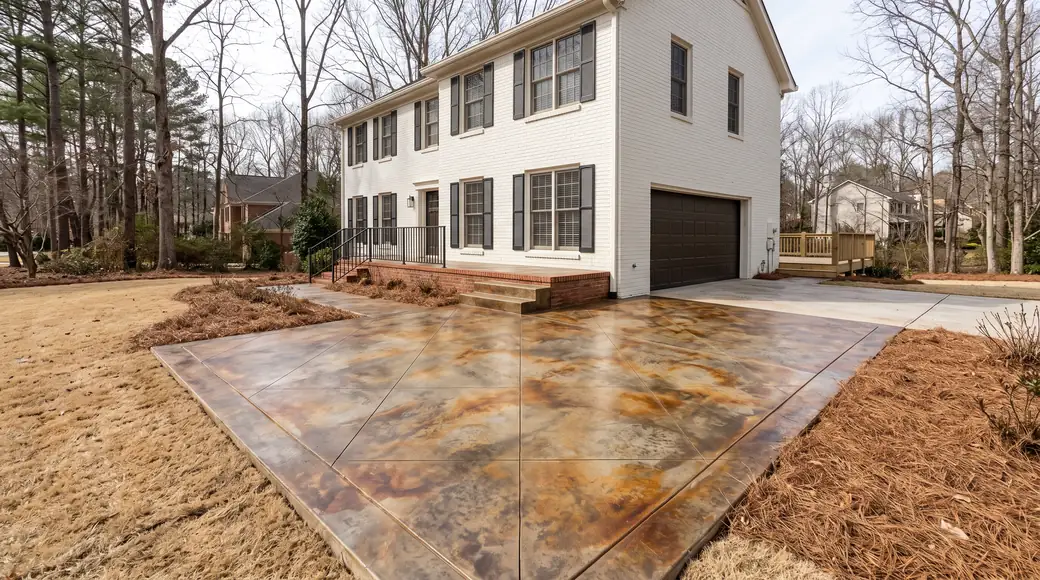
Acid-stained concrete patio in mottled earth tones at a painted-white-brick two-story home in Sandy Springs, GA, under bright midday cloud.

Stained Decorative Concrete in Sandy Springs, GA

We stain concrete that is already poured. A back patio, a front walk, a garage floor, a basement slab: the surface gets cleaned, opened, colored, and sealed, and the same slab stays underneath. People come to us as a concrete contractor rather than a flooring company because the questions that decide the outcome are concrete questions. How sound is the slab. How hard it was troweled. What has soaked into it over thirty years of cars, grills, and rain. Stain follows the concrete it lands on, so the concrete comes first.

Sandy Springs filled in early. Suburban development started in the 1950s, the housing boom arrived in the early 1960s after the highway construction, and infill kept going through the 1980s. That makes most of our work replacement and renewal rather than new build. We are usually staining a patio poured for a house older than the family living in it, or blending a new run of sidewalk into an old one so the seam does not announce itself. Stamped concrete comes up often in these conversations, and on a sound existing slab, stain frequently does more.

Coverage runs across Sandy Springs and into the metro Atlanta communities around it: Atlanta, Dunwoody, Roswell, and Brookhaven. Same crew, same standard, whichever address it is. Lots here are rolling and wooded, which shapes how a patio or a walk sits against the house and where the eye lands first. Send photos of what you have, or walk us around it in person, and tell us how you want it to read when the work is done. We look at the concrete before we say what it can do. Call for a free estimate.

Call +1 470-740-7099

Licensed, Bonded, and Insured ยท A combined 15 years of experience

Get FREE Estimates

We warranty all of our work because we believe in what we do.

What Stained Decorative Concrete Involves

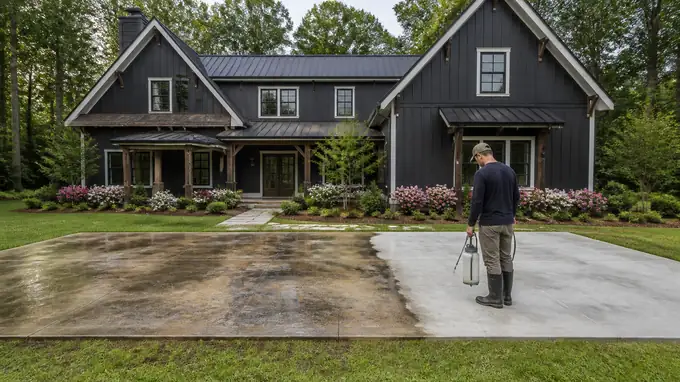
Acid stain being sprayed onto a concrete surface, half-applied at a charcoal farmhouse-modern home in Sandy Springs, GA, in early morning light.

Concrete staining

Staining colors concrete by soaking into the slab rather than sitting on top of it, so the finish wears the way the concrete wears. We use water-based stains for a broad color range and acid stains where a mottled, variegated look is wanted. Existing concrete has to be clean and open first: old sealer, mastic, paint and curing compound all block penetration, and anything left behind shows up as a blotch later.

Age matters. New concrete needs to cure before we stain it, and a slab that has been power washed to death takes color unevenly.
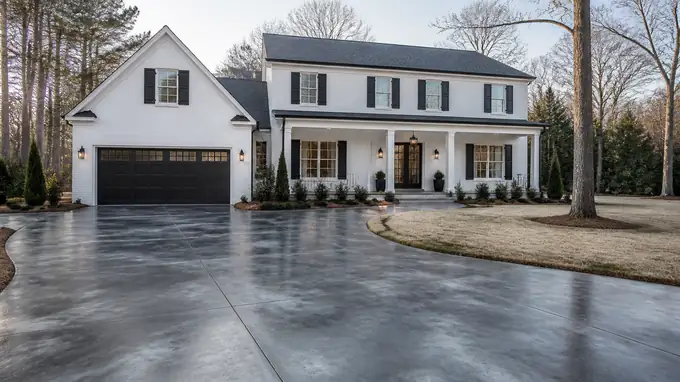
Acid-stained concrete floor in charcoal and blue-grey marbled tones at a painted-white-brick two-story home in Sandy Springs, GA, in early morning light.

Acid stained concrete

Acid stain reacts with the free lime in the concrete, so the color comes from a chemical change in the slab itself. The palette is limited to earth tones: browns, tans, rust, soft greens and blue-greens. Results vary across the same pour because the mix, the trowel work and the moisture at finish time all change how the acid reacts.

After the reaction stops, the residue gets neutralized and rinsed, then the slab is sealed. Skipping the neutralizing step is what causes sealer to peel a year later.

Stained Decorative Concrete in metro Atlanta

Stained decorative concrete across metro Atlanta is mostly a second life for slabs that are already in the ground. Suburban development here started in the 1950s, and the early-1960s housing boom that followed highway construction filled these neighborhoods with patios, walks and driveways that have been down for decades. Infill kept going through the 1980s. The flatwork we stain therefore varies widely in age, mix and condition, and the slab itself tells us most of what the job will take.

Work moves around the area rather than sitting in one subdivision. A back patio in Dunwoody on a rolling, wooded lot reads differently than a front walk on flat open ground, since shade and how water leaves the slab both change how stain takes and how the finished surface wears. We look at the concrete in person before anything else. Color comes after that, never before, and we set it against the house and its existing hardscape.

Most trouble on older concrete comes from what is already sitting on top of it. Old sealer, deck paint, thinset left behind from tile someone set over a patio years ago: any of that blocks stain and turns up as blotching once the surface dries out. Prior patches pull color differently than the slab around them. Cracks that are still moving will keep moving. We find all of it before staining rather than after, and we say plainly when a slab is past saving.

Getting the result right is mostly prep and patience. Grinding or stripping the full surface, testing color on the actual slab in daylight, letting each step cure on its own schedule instead of ours: that is the difference between a stained patio that holds for years and one that looks tired a couple of seasons in. Where we pour new concrete, it gets rebar or wire mesh and properly cut joints, so the finish has something sound underneath. Call for a free estimate.

How the Work Runs

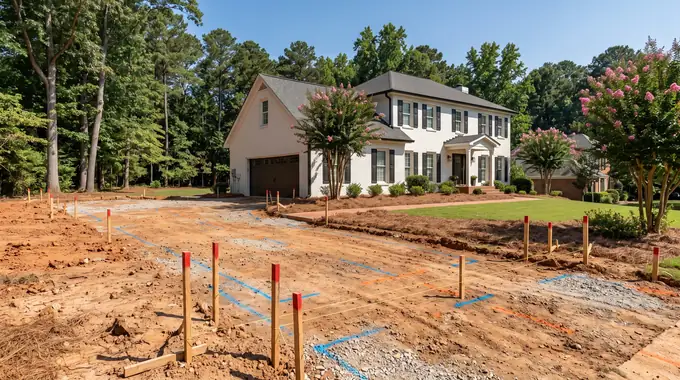
String lines and grade stakes laid out across a yard before a pour at a painted-white-brick two-story home in Sandy Springs, GA, in clear late-morning sun.

Step 1: Site Evaluation

We start on the slab itself. Old sealer, spalling, hairline cracks and rust staining all change how color behaves, so we read the surface before we talk about tone. Hard-troweled concrete drinks less than a lightly broomed finish. We check drainage, subgrade movement and joint spacing, then say plainly whether the existing pour is worth staining or worth replacing. Plenty of the flatwork on these 1950s and 1960s streets is on its second pour already.

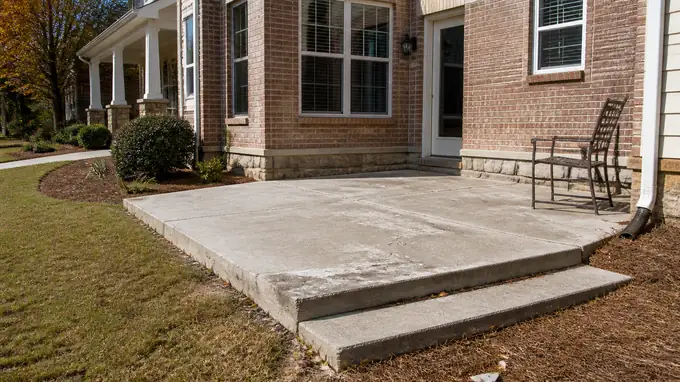
Concrete driveway and walk at a home, the kind of job an estimate covers at a stacked-stone and stucco home in Sandy Springs, GA, in early morning light.

Step 2: Written Estimate and Permits

The estimate is written and itemized: surface prep, stain type, joint work, sealer and square footage, line by line. Acid stain and water-based stain are quoted separately, because they behave differently on the same slab and are not interchangeable. Some replacement flatwork needs a permit and some does not, depending on the scope and where it sits on the lot. We pull what the job requires and handle that paperwork ourselves.

Broken-out concrete removed and the base rebuilt before a new pour at a charcoal farmhouse-modern home in Sandy Springs, GA, after a rain shower.

Step 3: Demolition and Base Prep

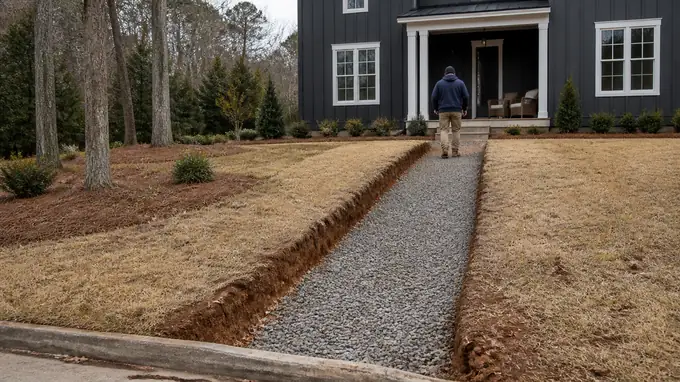
Demolition comes first when the old slab is past saving. We break it out, haul it off, cut the subgrade to depth and compact it in lifts. Four inches of crushed stone under a walk, and more under a concrete driveway that has to carry vehicle loads. On a stain-over-existing job there is no demo, but there is grinding: old sealer, curing compound and mastic have to come off or the color blotches.

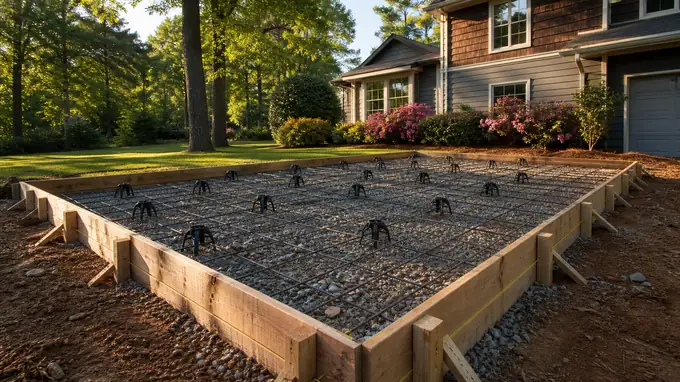
Wooden forms and rebar grid set and tied, ready for concrete at a brick-and-siding two-story home in Sandy Springs, GA, under an overcast sky.

Step 4: Forming, Steel and the Pour

Forms go in on grade and get checked for fall away from the house. Steel depends on the slab. Number four rebar on eighteen inch centers for driveways, wire mesh on chairs for lighter flatwork. Concrete installation runs as one continuous pour wherever the layout allows it, since cold joints telegraph straight through stain and never quite disappear. Control joints get cut early, at roughly a quarter of the slab depth.

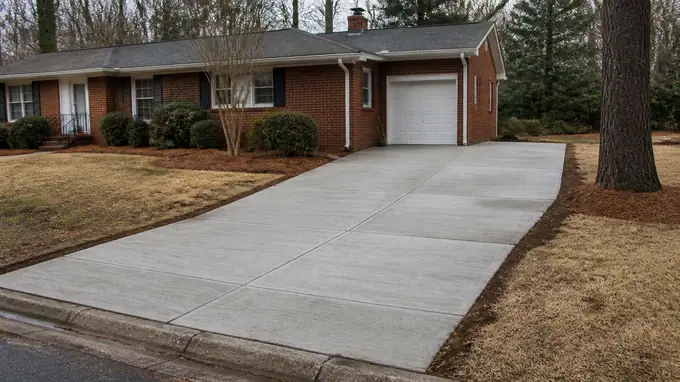
Freshly finished concrete slab curing under a clean broom texture at a grey split-level home in Sandy Springs, GA, under bright midday cloud.

Step 5: Finishing, Curing and Final Walkthrough

Stain goes down after the slab has cured, not before. Acid stain gets neutralized and fully rinsed, and the color keeps shifting until the surface is dry, so we do not judge it wet. Sealer follows, usually two coats. Foot traffic waits a day or so, vehicles longer. Then we walk the finished work with you, sidewalks and patio included, and show where joints and color will change with age.

What Decides the Price

Most of what sets the price on a stained concrete job is visible before anyone quotes it. You can walk your own driveway or patio and see it. Here is what we look at, and which way each one pushes the number.

What changes the priceWhich wayWhy
An existing slab that is sound, flat and cleancosts lessColor goes onto what is already there, with no tear-out, no forming and no pour.
Cracking, spalling or old patchwork in that slabcosts moreRepairs have to cure before stain goes down, and patched areas pull color differently than the original concrete.
Tear-out and haul-off of a slab we cannot savecosts moreBroken concrete is heavy, and rebar in an older pour has to be cut apart before any of it loads out.
Distance and grade between the truck and the formscosts moreWheelbarrowing concrete around trees and over rolling ground adds hours that a chute pour never spends.
Thickness and reinforcement the use calls forcosts moreA driveway carrying vehicles needs more depth and rebar than a patio sitting on wire mesh.
Water that stands on the work or runs toward the housecosts moreGrading and drainage go in before the flatwork, or the finish will not hold.
Borders, saw cut patterns and more than one stain colorcosts moreEach layer is its own masking, application and cure.

Compare bids line by line, not by the bottom number. Ask what thickness and what reinforcement each one includes, whether haul-off is in the price, how the concrete reaches the work, and which sealer goes on top.

Questions About Stained Decorative Concrete

Does acid stain or dye last better in Georgia?

Acid stain lasts longer outdoors. It reacts chemically with the lime in the concrete and becomes part of the slab, so it will not peel or flake off the surface. Dye sits differently. It gives brighter, more uniform color and a wider range, but it fades faster under direct sun. On a covered porch or a garage floor, dye holds up fine. In open exposure, we use acid stain.

What colors work best for a Sandy Springs home?

Browns, tans, warm greys and the range that reads like weathered stone. These sit well against brick and against the wooded lots common here, and they hide dirt and leaf staining better than anything pale. Houses from the 1950s and 1960s tend to carry earth-toned brick that a mid brown picks up neatly. We bring samples and lay them on your own slab before anything is committed.

Can you stain Sandy Springs concrete that has already been sealed?

No, not until the sealer is off. Stain needs to reach the concrete itself, and a sealed surface stops it cold. Whatever we put down will bead up, sit in patches, or wipe away. Removal means grinding or a chemical stripper, then a full rinse and dry. That adds a day or more to the job, and we tell you up front when we find sealer during the walkthrough.

How long does stained concrete last outdoors in Georgia?

The color itself is permanent in acid-stained work, since the reaction happens inside the slab. What wears is the sealer over it. Expect to reseal exterior flatwork every few years, sooner on a driveway that sees daily tire traffic and sun. Resealing is a clean, straightforward job: wash it, let it dry, roll on a fresh coat. Skip it too long and the surface dulls and picks up stains.

Will stain look the same on every part of my Sandy Springs slab?

No. Acid stain reacts with what is already in the concrete, so variation is built into it. Trowel marks, patches, cure differences, old repairs and the spot where a downspout ran for twenty years will all take color differently. That mottling is the look people want. If you need flat, even color with no movement in it, dye or a colored coating is the better answer.

Can you stain an existing driveway in Sandy Springs?

Yes, if the concrete is sound. We look at cracking, spalling, oil saturation and how the slab drains. Deep oil will not take stain and will keep bleeding through, and a slab breaking apart is worth replacing rather than dressing up. Sound concrete with normal age and surface wear stains well. Driveway work goes through City of Sandy Springs permitting where the scope calls for it, and we handle that.

Get a Free Estimate

Get FREE Estimates

We warranty all of our work because we believe in what we do.

Tap to call +1 470-740-7099