+1 470-740-7099
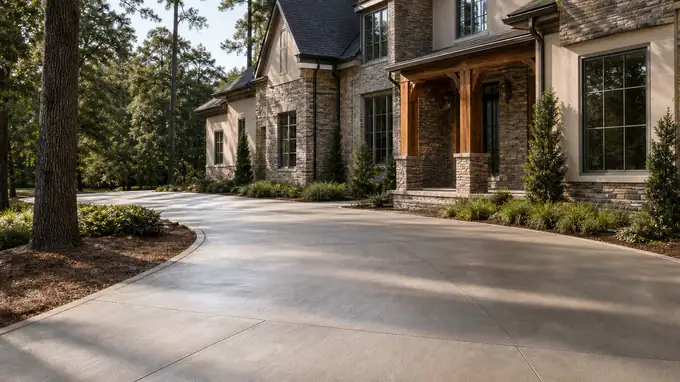
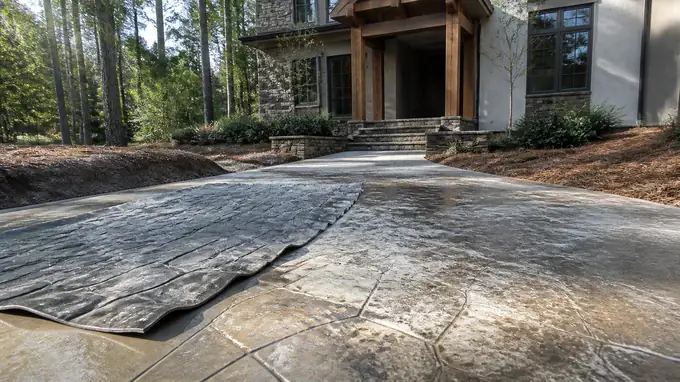
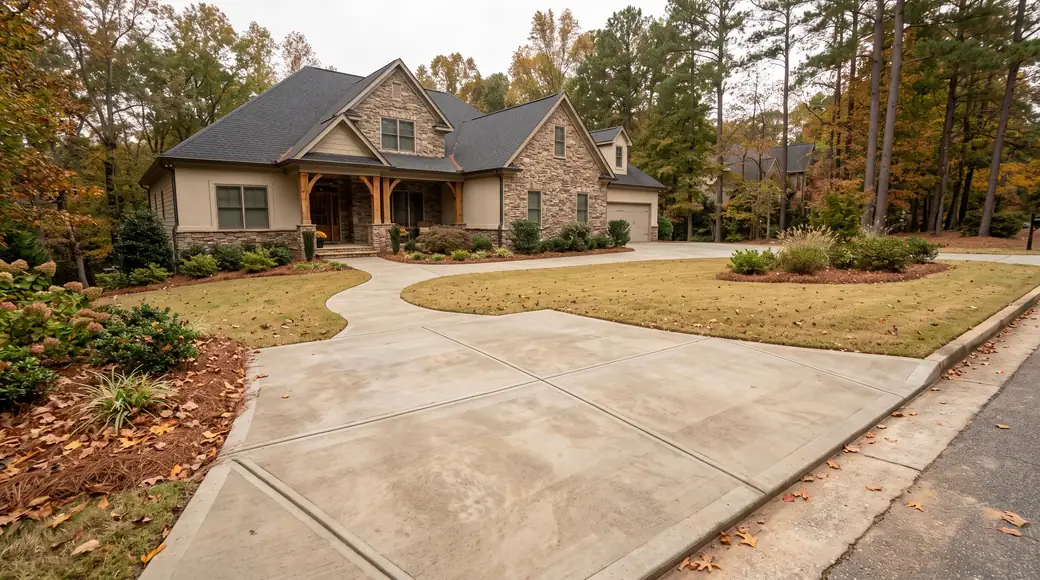
Wide view of finished concrete flatwork across the front of a home at a stacked-stone and stucco home in Sandy Springs, GA, under an overcast sky.

Commercial Concrete for Medical & Dental Offices in Sandy Springs, GA

We are a concrete contractor working with medical and dental practices in Sandy Springs, and most of what we do is replacement rather than new construction. Offices along the Roswell Road corridor and out near Perimeter Center sit in buildings that have been in service for decades, and the flatwork out front usually shows it. A cracked entry sidewalk matters more at a dental practice than it does at a house. The people crossing it are often unsteady on their feet, still numb from a procedure, or holding onto someone. We take out the failed slab and pour a new one that drains and sits flat.

Scope usually runs from the parking spaces to the front door: approach sidewalks, landings, the ramp, curb work, and the pads under a dumpster enclosure or a generator. Some practices want stamped concrete at the entry so the walk reads as part of the building instead of a gray strip bolted onto it. Others want a plain broom finish, poured correctly, and nothing more. Both are honest work. We pour over compacted base with rebar or wire mesh sized to what the slab carries, because a walkway crossed by wheelchairs and delivery carts all day is not a patio. Call for a free estimate.

Call +1 470-740-7099

Licensed, Bonded, and Insured ยท A combined 15 years of experience

Get FREE Estimates

We warranty all of our work because we believe in what we do.

What Commercial Concrete for Medical & Dental Offices Involves

A medical or dental office gets judged from the parking lot forward, so most commercial concrete on these buildings is flatwork people meet on foot. Approach aprons. The concrete sidewalk running from the stall to the door. Landing pads at entries, curb ramps, dumpster pads, and the slab under a rear service door. Some of it is plain broom finish. Some of it is stamped concrete or colored concrete at a front entry, where the walk reads as part of the building. All of it carries wheelchairs, walkers, rolling carts and delivery traffic daily.

We work on offices in Sandy Springs, Georgia, and across metro Atlanta: Atlanta, Dunwoody, Roswell and Brookhaven all get the same crew and the same terms. Practices stay open, so we pour in pieces and keep a walkable route to the door the whole time. One side of the lot goes first, then the other. On rolling, wooded sites we set grades so water leaves the walk instead of standing on it. Perimeter Center and the Roswell Road corridor both run tight on parking, so staging gets planned before any demolition starts.

Failures here are rarely mysterious. A walk poured on soft fill settles, a joint lifts, and a patient catches a toe on a lip that sits proud of the panel beside it. Thin slabs without rebar or wire mesh crack straight across under a delivery truck nobody accounted for. Patch work poured against old gray never quite matches. Sealed stamped concrete turns slick when someone skips the grit additive. Most of what we replace failed at the subgrade, not the surface, which is why we dig out and recompact instead of capping something already moving.

Doing it right takes time more than it takes anything else. Subgrade prep, formwork that holds a true line, reinforcement tied up off the ground, and concrete left to cure without traffic on it before it is ready. Rush the cure and you buy a slab that spalls. A good concrete contractor tells you which parts of the lot can wait and which are already a liability, then sequences the work so the office never loses access. That is the job: sound base, honest thickness, clean finish, a walk that stays flat.

Commercial Concrete for Medical & Dental Offices in metro Atlanta

Most of the medical and dental offices we pour for sit on ground that was subdivided decades ago. Suburban development here began in the 1950s, and the early-1960s housing boom that followed highway construction filled in much of what surrounds these buildings today. Infill kept going through the 1980s. A practice that opened in a converted house or an older low-rise inherits whatever flatwork came with it, and that concrete has been carrying patients and delivery carts ever since.

Replacement is the bulk of the job. Sidewalk sections lifted at the joints, an entry landing that no longer meets the door threshold cleanly, a slab breaking up where cars turn tight against a curb. We take out the failed concrete and put back flatwork sized for the traffic it actually sees, with rebar or wire mesh where the load calls for it. The finish matters as much as the pour on a walkway people cross in dress shoes.

Coverage is straightforward. We work across metro Atlanta, and a dental office in Dunwoody gets the same crew and the same sequence as one on the Roswell Road corridor. Buildings of this vintage tend to share a history, so what turns up under an old slab is rarely a surprise to us. Stamped or colored concrete at an entrance, plain broom-finished concrete sidewalks down the side of the lot, exposed aggregate where a designer asked for it: all of it is standard concrete work for us. Call for a free estimate on the concrete at your practice.

How the Work Runs

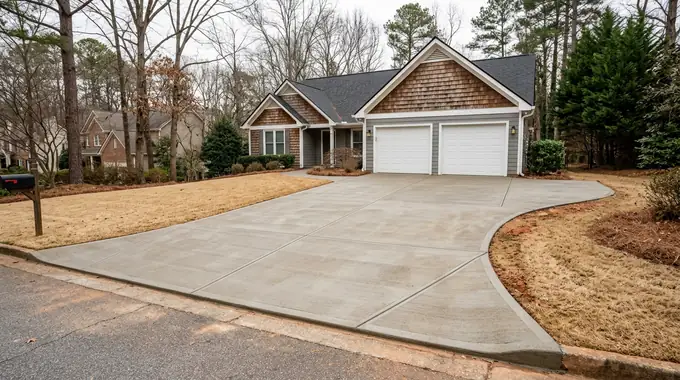
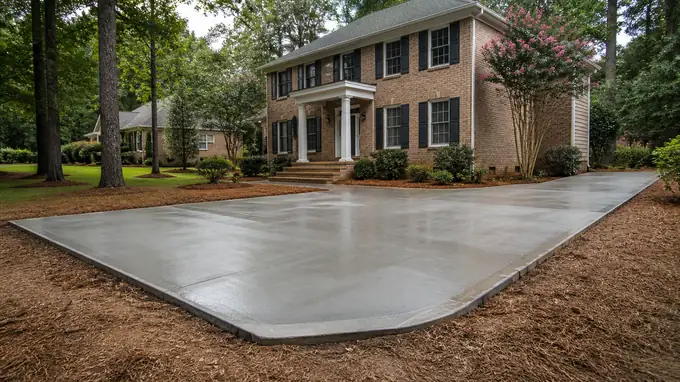
String lines and grade stakes laid out across a yard before a pour at a painted-white-brick two-story home in Sandy Springs, GA, in clear late-morning sun.

Step 1: Site Evaluation

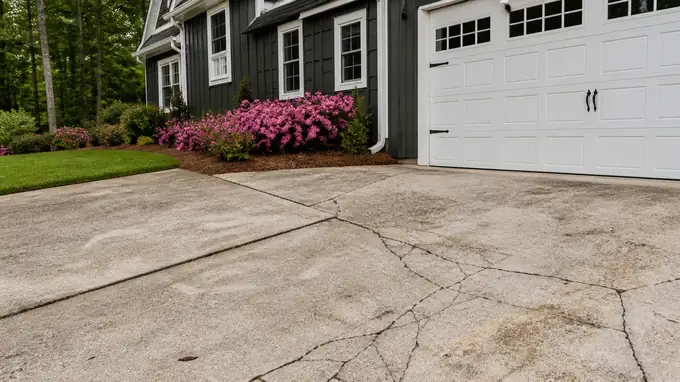
We walk the property with you and look at what is failing. Cracked panels, settled slab sections, standing water near an entrance, curb heights that no longer match the parking surface. We measure the area, check existing thickness at broken edges, and note where downspouts and irrigation discharge. Most trouble on an older medical lot traces back to drainage, not the mix. Knowing that early changes what we build.

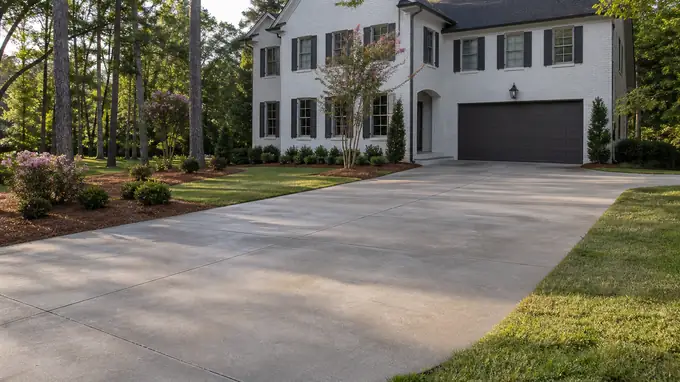
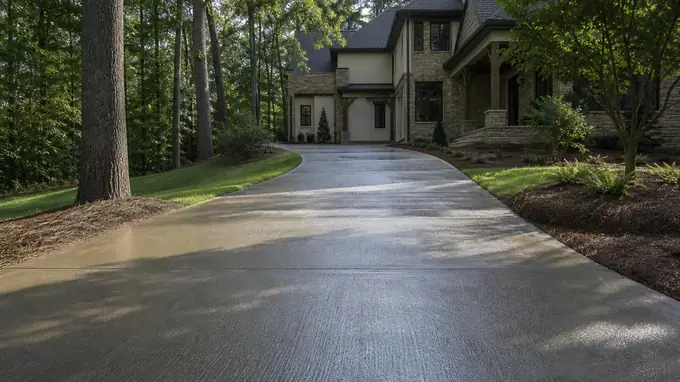
Concrete driveway and walk at a home, the kind of job an estimate covers at a stacked-stone and stucco home in Sandy Springs, GA, in early morning light.

Step 2: Written Estimate and Permits

You get the scope in writing: square footage, slab thickness, reinforcement, finish, jointing, and how we phase the work around your patient schedule. We pull the paperwork the job needs before mobilizing. Estimates are free. If the work touches a public concrete sidewalk or a curb cut, that gets called out separately, because the requirements there differ from a private lot.

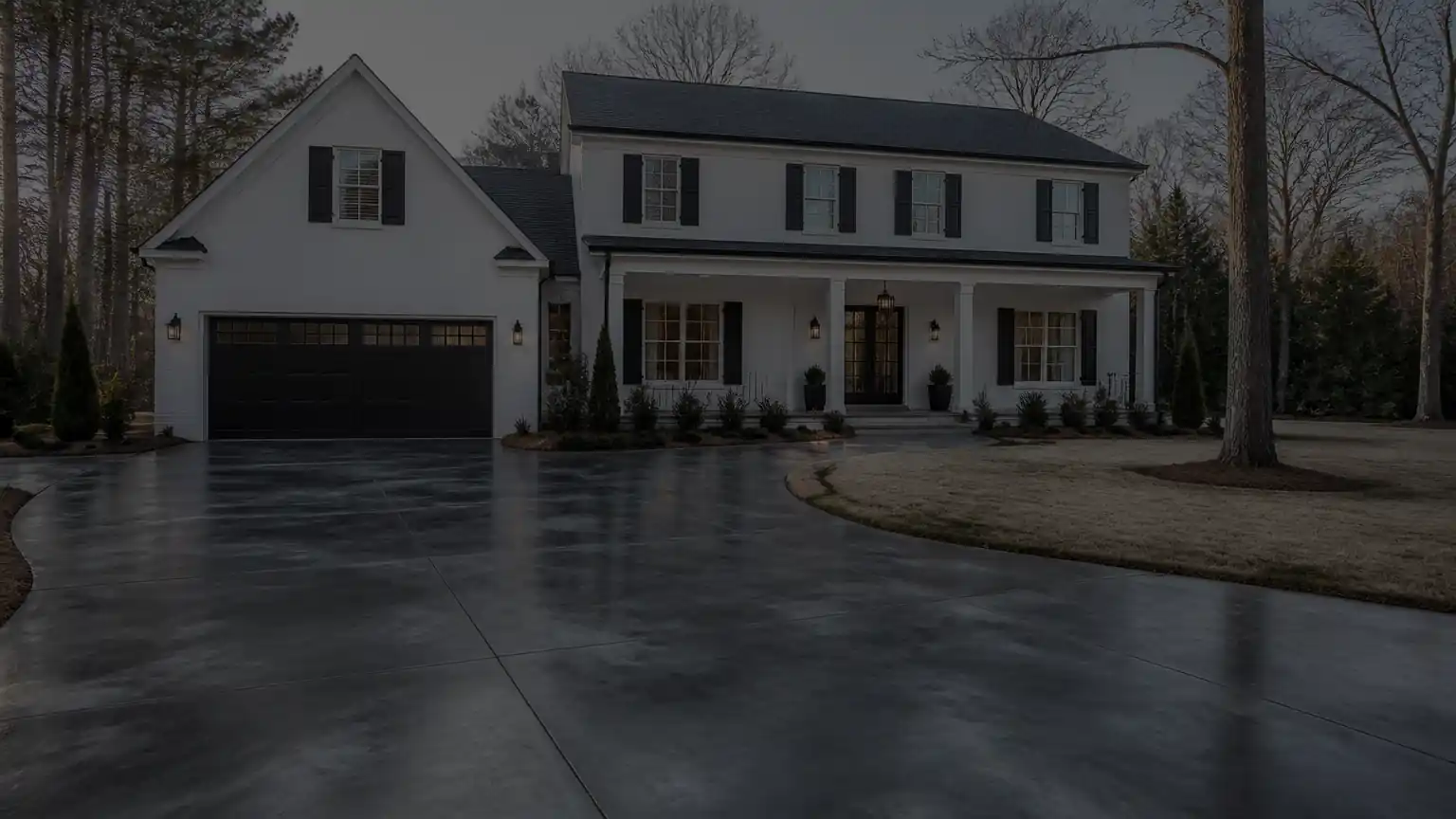
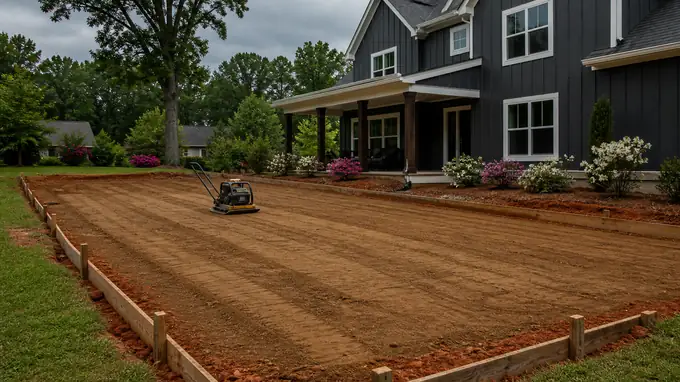
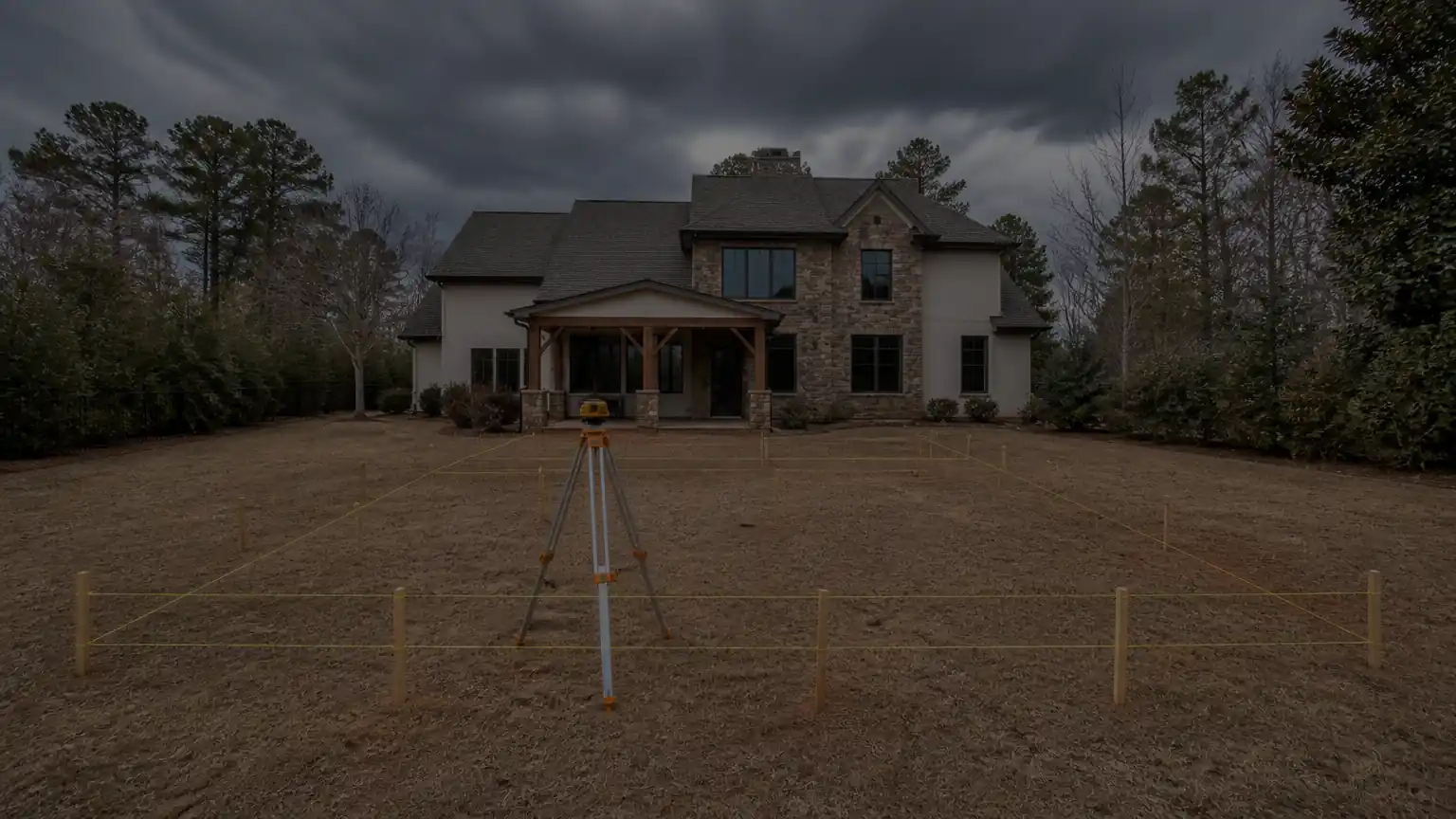
Broken-out concrete removed and the base rebuilt before a new pour at a charcoal farmhouse-modern home in Sandy Springs, GA, after a rain shower.

Step 3: Demolition and Base Prep

Saw cut, break out, haul off. We take the old slab down to subgrade, remove soft or organic material, and bring in graded aggregate base compacted in lifts. Base is where driveways and walks are won or lost. Concrete over loose fill will crack no matter how good the pour is. On wooded, rolling sites we regrade for positive fall away from doors and thresholds.

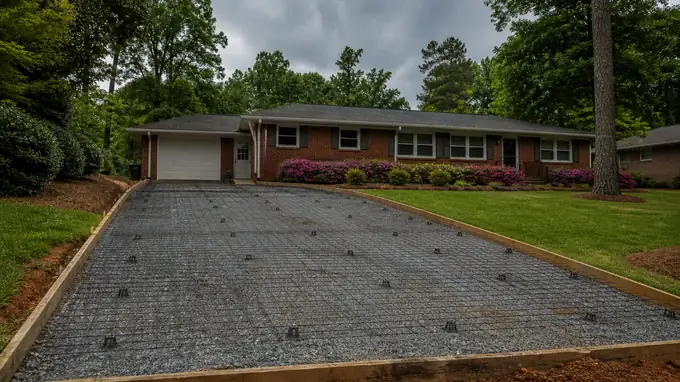
Wooden forms and rebar grid set and tied, ready for concrete at a brick-and-siding two-story home in Sandy Springs, GA, under an overcast sky.

Step 4: Forming, Steel and the Pour

Forms go in set to grade and slope, staked tight so nothing bellies under the load of wet concrete. Approach lanes and dumpster pads get rebar on chairs. Walks and lighter flatwork get wire mesh or fiber, depending on the section. Then the pour: 4,000 psi mix, screeded, bull floated, edged. Concrete installation on an occupied property means keeping one route open at all times.

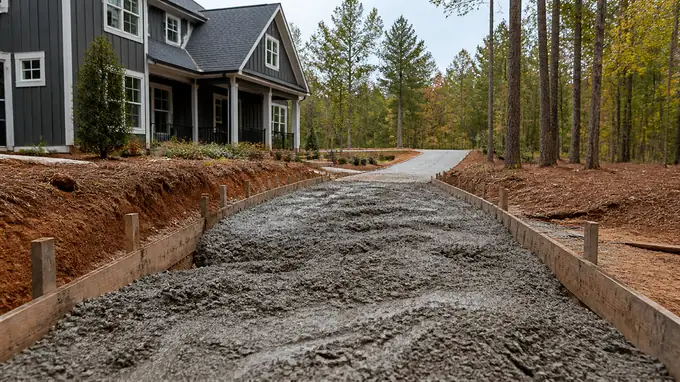
Freshly finished concrete slab curing under a clean broom texture at a grey split-level home in Sandy Springs, GA, under bright midday cloud.

Step 5: Finishing, Curing and Final Walkthrough

Broom finish on a concrete driveway and on walkways, since a slick trowel finish is a liability at a medical entrance. Control joints get cut on a spacing that matches slab thickness. We cure, keep traffic off, and tell you plainly when vehicles can return. At the walkthrough we check slope, joint layout, transitions at existing sidewalks, and anything that catches a wheel or a cane.

What Decides the Price

Two medical office lots of the same square footage can quote very differently, and most of the reasons are visible before anyone pulls a tape.

What changes the priceWhich wayWhy
An old slab still in the groundCosts moreIt has to be broken out, loaded and hauled off before new concrete goes down
A mixer can back within chute reachCosts lessPumping or wheeling concrete by buggy across a parking lot adds hours of labor
Ambulance and delivery lanesCosts moreDrive lanes carry loads a walkway never sees, so the slab gets poured thicker
Rebar instead of wire meshCosts moreHeavier steel, tied and chaired, on the sections that take vehicle weight
Soft or filled subgradeCosts moreStone base and compaction have to be built up before the flatwork is worth pouring
Water standing after rainCosts moreSlope, drains and regrading get built into the pour
Stamped, colored or exposed aggregateCosts moreMore finishing steps than a broom finish on the same slab
Sidewalk work at the streetCosts morePermitting runs through the City of Sandy Springs, and inspection sets the schedule

Compare bids line by line: slab thickness in inches, reinforcement type and spacing, base depth, whether demo and haul-off are included, and control joint layout. A low number usually means one of those got left out.

Questions About Commercial Concrete for Medical & Dental Offices

Can you keep a Sandy Springs medical practice open while you work?

Yes. Most of what we do at a working practice happens in phases, so one entrance or one section of lot stays usable while the other cures. We pour the smaller side first, tape it off, and shift the barricades once it takes traffic. Full closure is sometimes the cleaner option on a small footprint, and we will say so honestly rather than stretch a job out.

How do you control dust and noise near patients in Sandy Springs?

Saw cutting is the loud part, and it is wet cut, which knocks the silica down and keeps it out of the air intake. We schedule breaking and demolition in blocks rather than spreading it across the day, so exam rooms get long quiet stretches. Plastic and tarps go up at doors. Concrete work is never silent, but it can be predictable.

What accessibility standards apply to a medical entrance in Sandy Springs?

Medical entrances fall under ADA requirements, which govern slope, cross slope, landing size, and the transition between walk and threshold. A ramp run cannot exceed a 1:12 slope, and the landing at the top has to be level enough for someone to stop and open a door. We shoot grades before we set forms, and we check them again after the pour.

How do you keep ambulance and drop-off access open at a Sandy Springs clinic?

Emergency access stays open. We plan the pour sequence around the drop-off lane and the fire lane first, then fit the rest of the flatwork around what is left. Where a lane has to be cut, we bridge it with steel plate so a vehicle can still reach the door. Staff know the day's layout before trucks arrive on site.

What surfaces suit a Sandy Springs medical car park?

Reinforced concrete holds up well under the loads a medical lot sees: shuttle vans, delivery trucks, and constant turning at low speed, which chews up thinner surfaces. We use rebar in drive aisles and heavy approach areas, wire mesh in lighter stalls. Broom finish gives traction underfoot. Exposed aggregate reads well at entries where the surface is on display.

Can you work around a clinic's hours in metro Atlanta?

Yes. Evening and weekend pours are ordinary for us, and so are early starts that get the noisy work finished before the first appointment. Concrete sets on its own schedule regardless of the clinic calendar, so we build the plan backwards from cure time and tell you which days a surface is off limits. Practices in Dunwoody run the same way.

Get a Free Estimate

Get FREE Estimates

We warranty all of our work because we believe in what we do.

Tap to call +1 470-740-7099