+1 470-740-7099
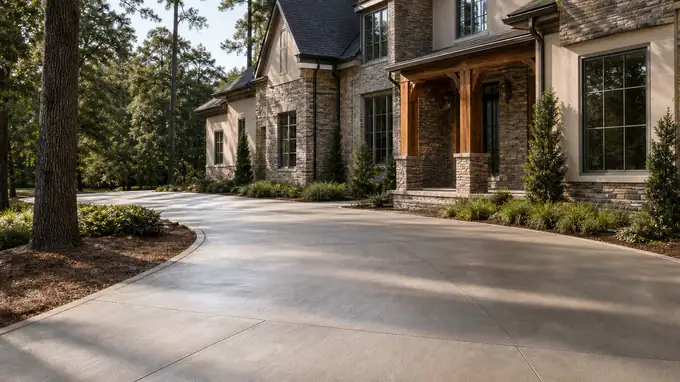
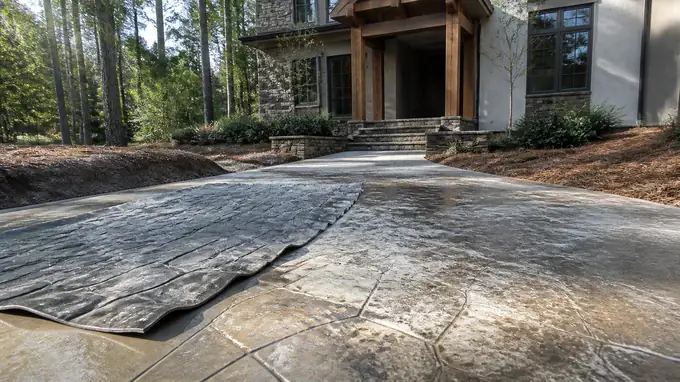
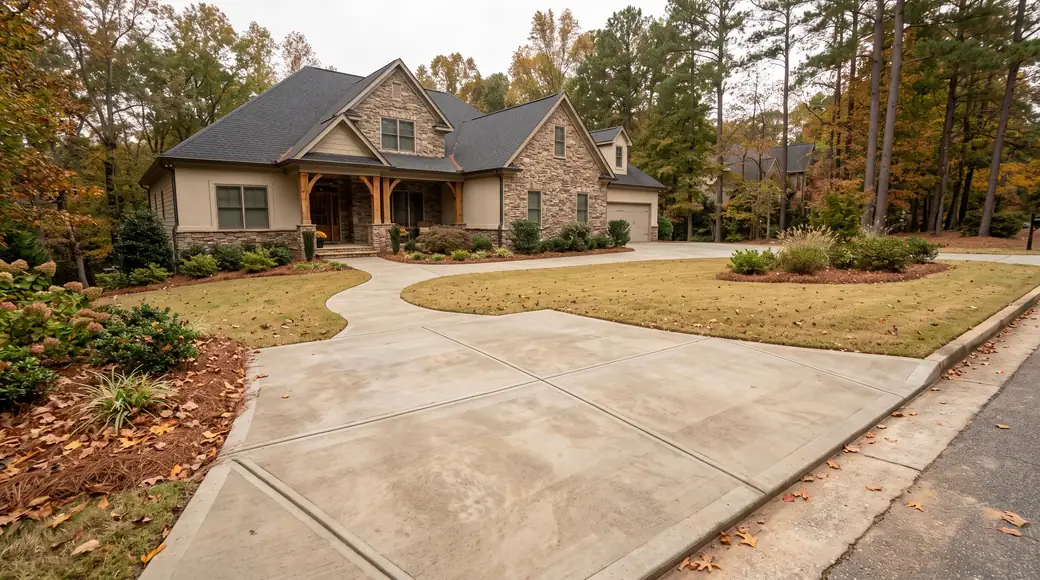
Wide view of finished concrete flatwork across the front of a home at a stacked-stone and stucco home in Sandy Springs, GA, under an overcast sky.

Commercial Concrete for Retail & Shopping Centers in Sandy Springs, GA

Most of the commercial concrete we do at retail centers here is replacement work, not new build. The shopping centers along the Roswell Road corridor were built to serve housing that went up in the early-1960s boom, and a lot of that flatwork is on its second or third life. A tenant changes. A sidewalk lifts at a tree root. A drive lane cracks under delivery trucks nobody was thinking about when the original slab went down. We come in as the concrete contractor for one section at a time, usually while the center stays open and the parking stays half full.

The hard part is rarely the pour. It is working around store hours, keeping a walkable path to every door, and matching what is already there closely enough that the repair does not read as a repair. Stamped concrete at an entry plaza has to pick up the existing pattern and color, or the new panels announce themselves for the next twenty years. These lots sit on rolling, wooded ground, and the grade decides where water ends up. So we walk the site first, look hard at where the old slab gave out, and build the replacement so the same thing does not happen again in the same spot.

Call +1 470-740-7099

Licensed, Bonded, and Insured ยท A combined 15 years of experience

Get FREE Estimates

We warranty all of our work because we believe in what we do.

What Commercial Concrete for Retail & Shopping Centers Involves

Commercial concrete for a retail center is the flatwork your customers walk and drive on before they ever reach a door. Entry aprons, loading areas, parking islands, curb cuts, trash enclosure pads, and the long runs of concrete sidewalk that tie one storefront to the next. Some of it is structural and some of it is finish, and most of it takes traffic every hour the center is open. We handle replacement more often than new pours, because Sandy Springs shopping centers along the Roswell Road corridor have been in service a long while and the slabs show it.

Scope on a retail job gets set by what the property can give up at one time. A grocery entrance cannot close for four days, so we take it in sections, saw clean joints at the boundary, and keep a walkable route open while the new concrete cures. Demolition, subgrade prep, forming, rebar or wire mesh depending on the load, then the pour and the finish. Stamped concrete and colored work run on the same schedule as plain gray, with more attention paid to matching what already exists on the property.

Failures usually trace back to what happened under the slab, not on top of it. A sidewalk that heaved or cracked in a spider pattern was often placed on subgrade that was never compacted, or without steel where a delivery truck now cuts the corner. Drainage is the other repeat offender: water that ponds against a curb line works its way beneath the slab and takes the support with it. Patching the surface on either problem buys a season, maybe two. We would rather dig it out once.

Getting it right costs time more than anything else. Proper subgrade compaction, correct slab thickness for the actual traffic, joints cut at the right depth before the concrete tells you where it wants to crack, and enough cure before the barricades come down. A concrete contractor who skips those steps finishes faster and comes back sooner. On a property where the tenants are paying rent on visible frontage, coming back sooner is the expensive outcome, so we build the schedule around doing each stage properly the first time.

Commercial Concrete for Retail & Shopping Centers in metro Atlanta

Retail concrete around metro Atlanta is mostly replacement work, and the reason is in the dates. Suburban development here began in the 1950s. An early-1960s housing boom followed highway construction, and infill kept going through the 1980s. The shopping centers went in alongside the houses. That means the sidewalks, aprons and parking lot flatwork we are asked to look at are usually a second or third generation of concrete sitting on an older footprint. Little of it is new build.

Roswell Road runs retail and mixed use along its length, and a good share of our commercial concrete sits on it: storefront walks, service aprons, dumpster pads, trash enclosure slabs. Perimeter Center is office towers with retail underneath, so the flatwork there lives under steady foot traffic and takes the wear you would expect. City Springs was built as a downtown, all of a piece. A strip center in Dunwoody gets the same crew and the same rebar.

Older properties hand you conditions to work around. Slab depths have to match what is already there, utilities run under the pour, and curbs have often been patched more than once before we see them. We pour concrete driveways and patios for homeowners in these same neighborhoods, and the flatwork carries across either way. Stamped and colored concrete, exposed aggregate, broom finished concrete sidewalks, plain gray slab over wire mesh or rebar. Call for a free estimate on any of it.

How the Work Runs

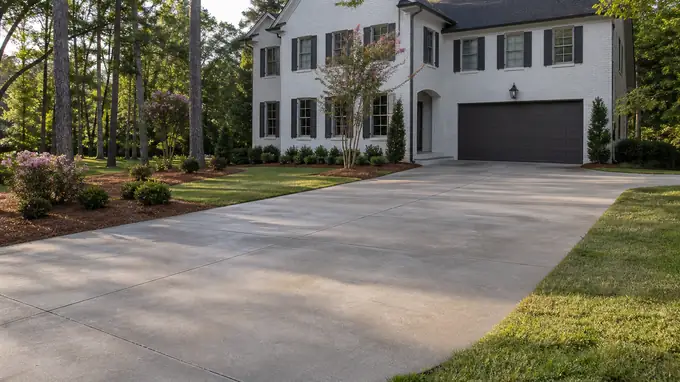
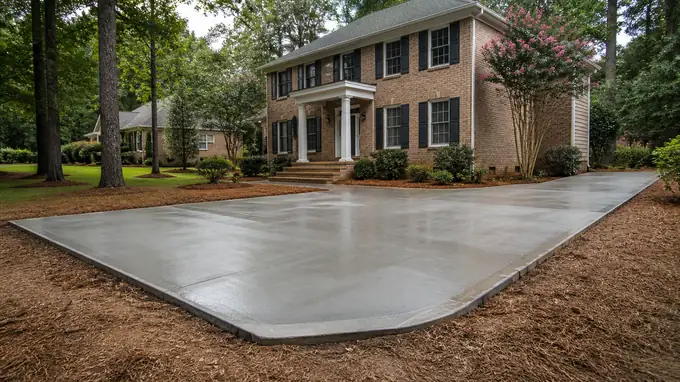
String lines and grade stakes laid out across a yard before a pour at a painted-white-brick two-story home in Sandy Springs, GA, in clear late-morning sun.

Step 1: Site Evaluation

We walk the property and look at what the existing slab is telling us. Cracking that follows a straight line usually means a control joint that never got cut deep enough. Settlement at one corner points to a base problem, not a concrete problem. We measure the pour area, check drainage and grade, note where trucks can reach, and figure out whether tearing out is genuinely necessary or whether the slab has years left.

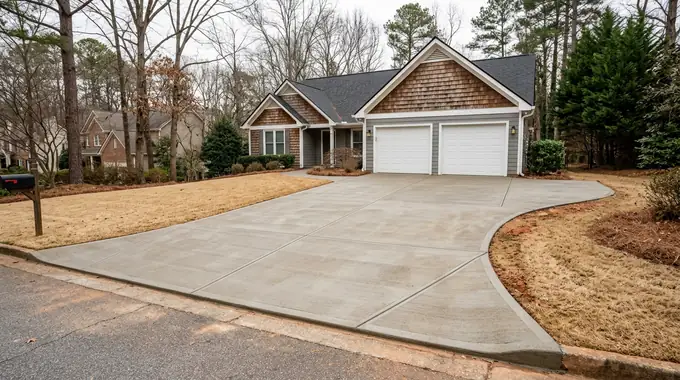
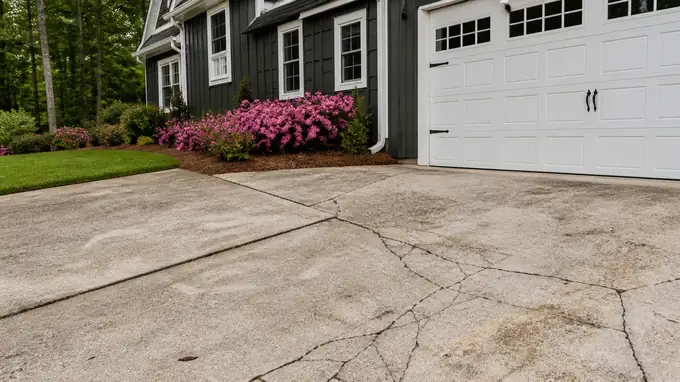
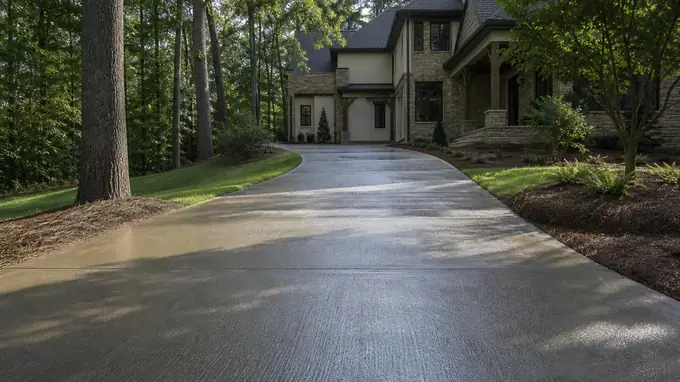
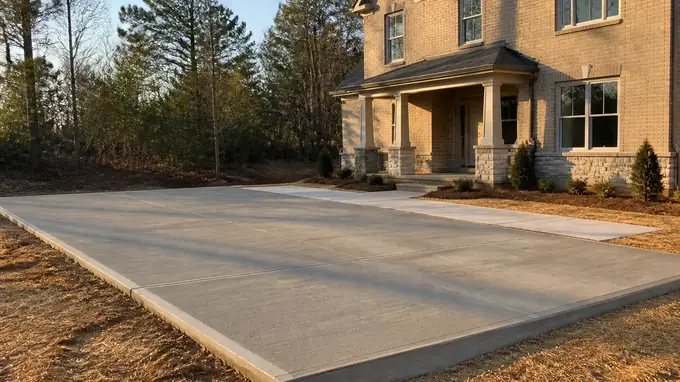
Concrete driveway and walk at a home, the kind of job an estimate covers at a stacked-stone and stucco home in Sandy Springs, GA, in early morning light.

Step 2: Written Estimate and Permits

You get the scope in writing: square footage, slab thickness, reinforcement, finish, joint layout and how we handle the tear-out. Nothing vague. Most flatwork replacement in kind does not require a permit, but new impervious surface, drainage changes or anything touching the right of way often does, and that goes through the City of Sandy Springs. We pull it and handle the inspection scheduling ourselves.

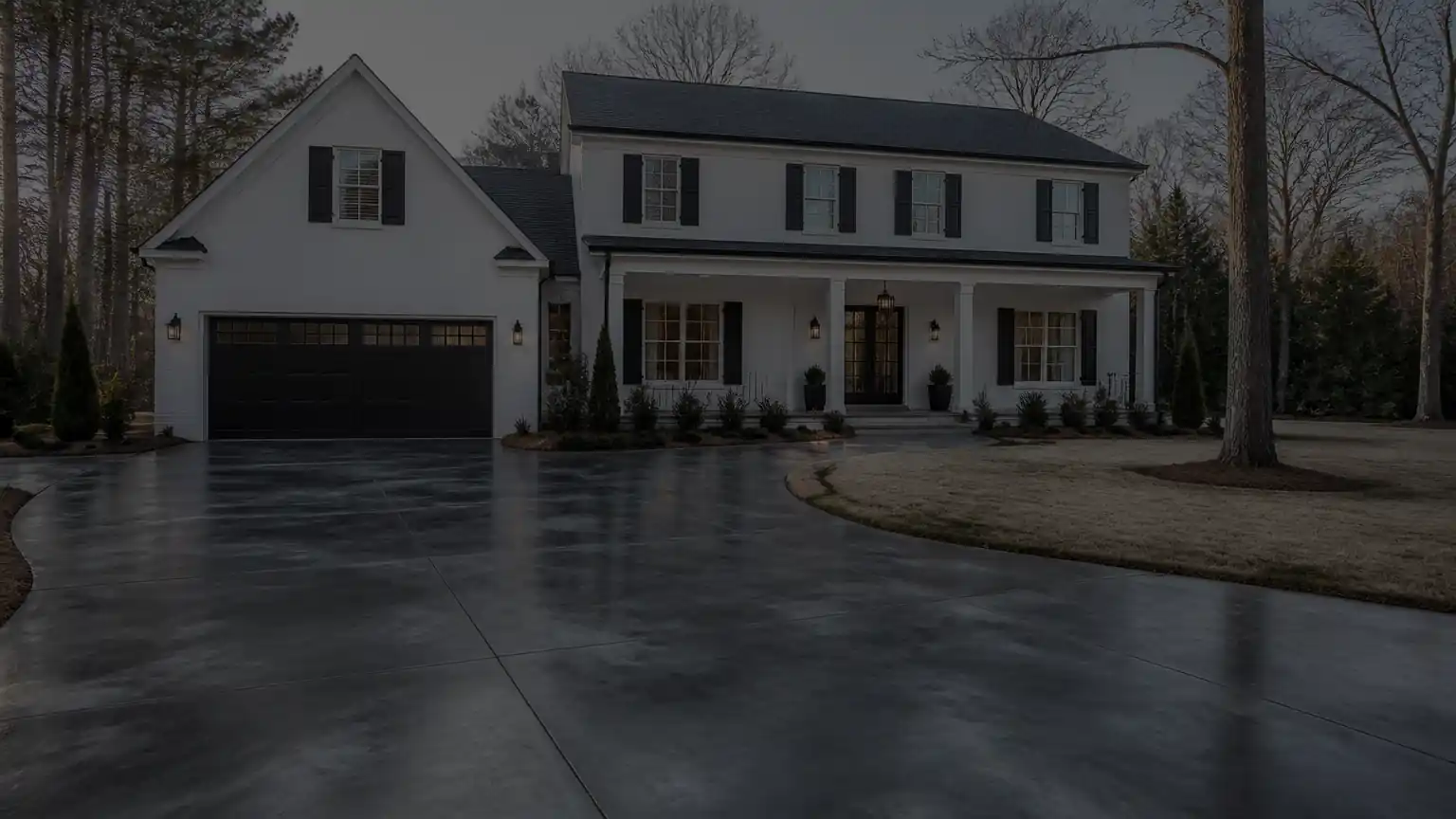
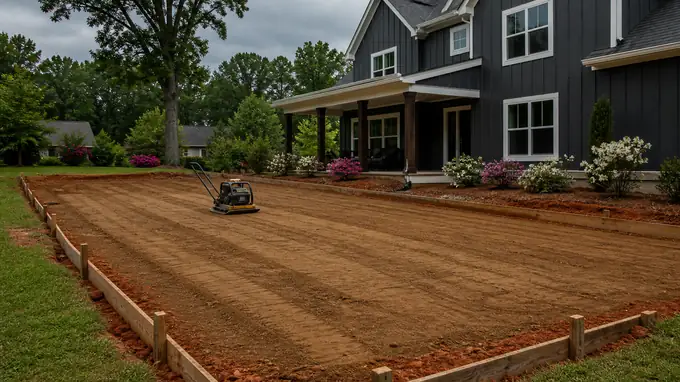
Broken-out concrete removed and the base rebuilt before a new pour at a charcoal farmhouse-modern home in Sandy Springs, GA, after a rain shower.

Step 3: Demolition and Base Prep

Old concrete comes out in sections, gets loaded and hauled off, and we do not bury the broken pieces as fill. Underneath is where jobs are won or lost. We excavate to depth, remove soft or organic material, then bring in graded aggregate base and compact it in lifts with a plate compactor. Base that is loose or uneven will crack a good slab within a couple of seasons.

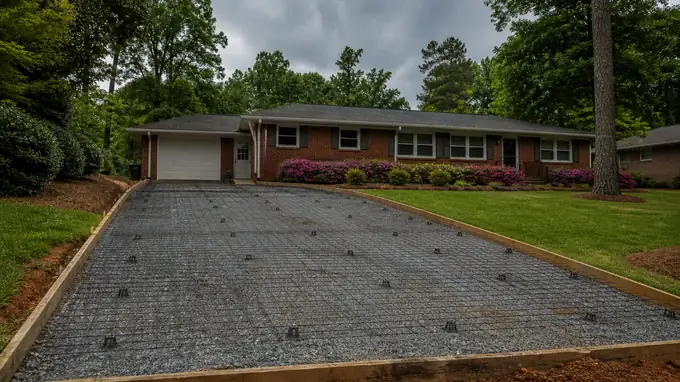
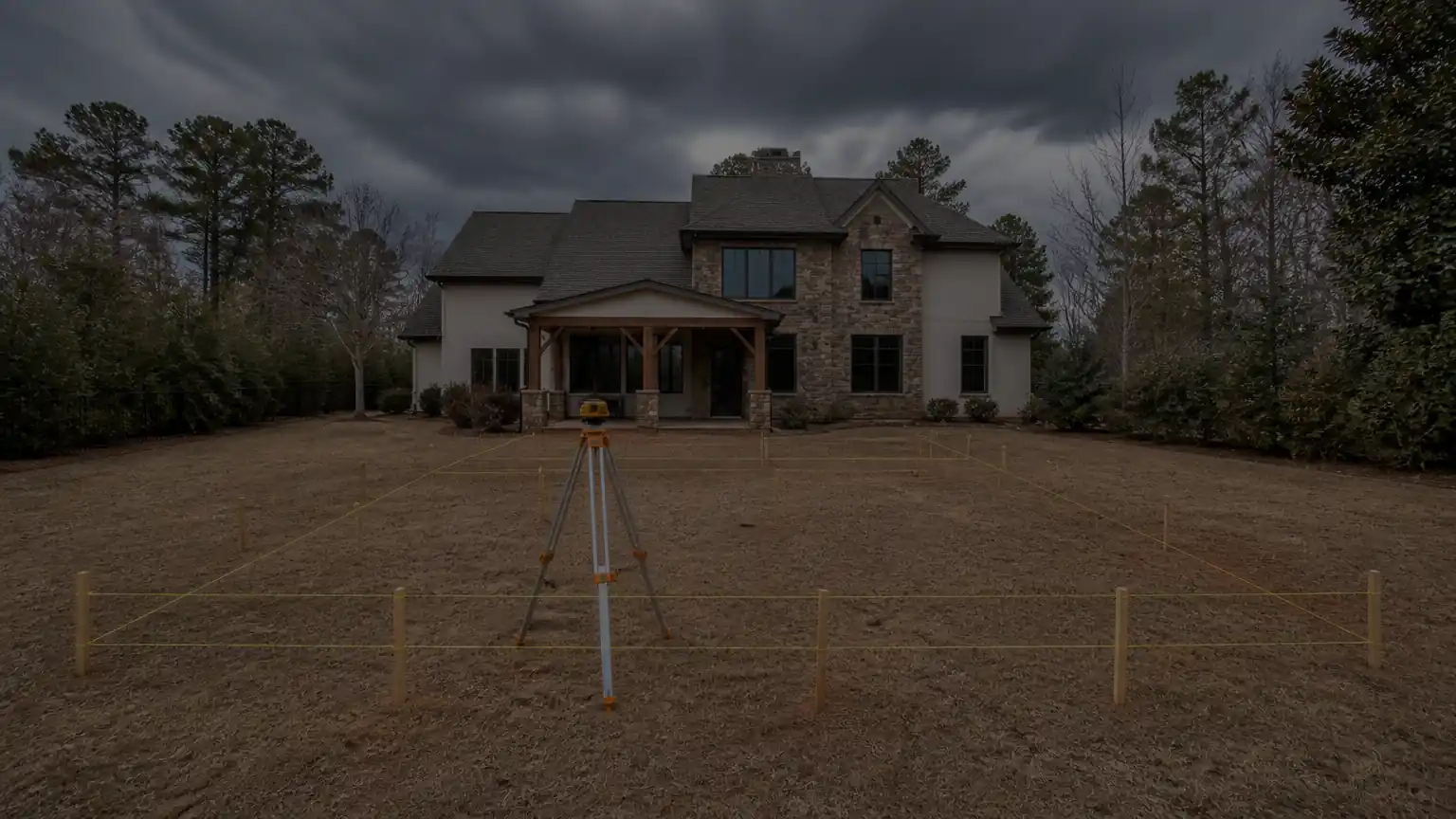
Wooden forms and rebar grid set and tied, ready for concrete at a brick-and-siding two-story home in Sandy Springs, GA, under an overcast sky.

Step 4: Forming, Steel and the Pour

Forms get set to the grade we established, with pitch built in so water runs away from the building instead of standing on the slab. Reinforcement depends on load: wire mesh for light-duty sidewalks, rebar on a grid for driveways and anything carrying delivery trucks. Steel sits on chairs at mid-depth, not thrown on the ground. We pour concrete continuously and keep the mix consistent truck to truck.

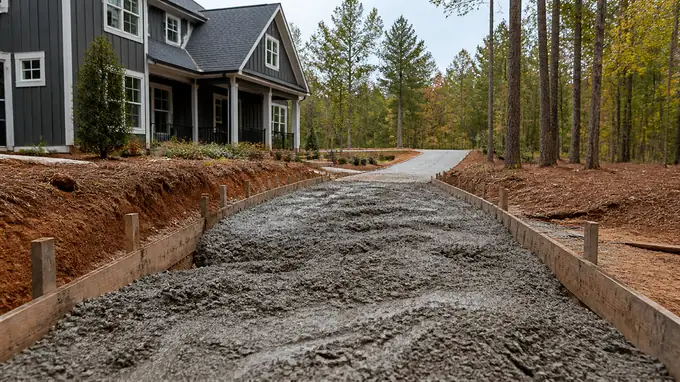
Freshly finished concrete slab curing under a clean broom texture at a grey split-level home in Sandy Springs, GA, under bright midday cloud.

Step 5: Finishing, Curing and Final Walkthrough

Finish depends on the surface. Broom finish gives sidewalks traction. Stamped or exposed aggregate goes on entries and courtyards. We cut control joints while the concrete is still green so it cracks where we decided, not where it wants to. Then curing compound, and the slab stays off limits: foot traffic after a day or so, vehicles considerably longer. We walk the finished concrete installation with you before we pull off site.

What Decides the Price

Every commercial concrete bid comes down to a handful of physical conditions you can walk out and look at yourself. Here is what moves the number.

What changes the priceWhich wayWhy
Old slab still in placeCosts moreIt has to be broken out, loaded and hauled off before anything gets poured.
Soft or wet subgradeCosts moreWeak ground needs stone base built up and compacted so the slab does not settle.
Truck can back to the formsCosts lessWheelbarrowing or pumping concrete across a lot adds hours and labor to the pour.
Rebar instead of wire meshCosts moreDrive lanes and dumpster pads carry truck loads and need heavier steel than a walkway.
Thicker slab for delivery trafficCosts moreMore concrete per square foot, and a deeper base underneath it.
Water sitting on the existing surfaceCosts moreFixing the fall means regrading, and sometimes a drain, not just replacing flatwork.
Stamped, colored or exposed aggregate finishCosts moreDecorative flatwork takes extra material and a longer finishing process than a broom finish.
Buried irrigation lines or conduitCosts moreLocating and protecting them slows the excavation down.

Comparing bids, check that each one names the same slab thickness, the same reinforcement, the same base depth, and who hauls the old concrete away. A lower number is usually thinner concrete or lighter steel.

Questions About Commercial Concrete for Retail & Shopping Centers

How fast can a Sandy Springs car park be back in use after repairs?

It depends on the pour and the weather. Concrete gains most of its strength in the first week, and vehicle traffic needs more cure time than foot traffic does. We tell you the expected reopening date for each section before we break ground, then we phase the work so the lot never closes all at once. Barricades come off section by section as each pour is ready.

How do you protect Sandy Springs shopfronts and stock while working?

Dust and slurry are the two things that reach inside a store, so we control both. Plastic goes over the glass and the entry, saw cuts run wet, and we sweep and wash the walk at the end of every shift. Deliveries need a path, so we keep one open. Anything we stage, we stage away from your doors and your display windows.

Can you pour a retail entrance without closing the shop in Sandy Springs?

Yes. We split the entrance and pour half at a time, running a temporary ramped walkway over the other half so customers keep coming through. It adds a day or two against a single pour, and it keeps the register open, which is usually the trade a tenant wants. Where the doorway is too narrow to split, we work overnight instead and hand it back by opening.

Do you take on multi-site retail work across metro Atlanta?

Yes. Several centers under one property manager is common work for us, and it runs better than single jobs because we can standardize the mix, the joint layout, and the finish across every site. One schedule, one point of contact, one set of details. We walk each property before pricing, since two centers under the same owner rarely have the same slab problems.

Can you work overnight at a metro Atlanta shopping center?

Yes, and for busy centers it is often the right call. Night work means lighting, generators, and a crew that can place and finish in the cold hours, all of which we bring. Cure times do not shorten just because the pour happened at 2am, so the reopening plan still governs. We coordinate the hours with center management and with any tenant whose door we are working across.

Do you handle trip hazard and accessibility issues for Sandy Springs retail?

Yes. Lifted joints, spalled edges, settled panels at curb ramps, and cracked landings at entry doors are steady work in this housing stock's commercial neighbors. Small offsets can be ground flush. Anything worse gets cut out and replaced to the correct slope and cross slope, because grinding a ramp into compliance is rarely possible once it has moved.

Get a Free Estimate

Get FREE Estimates

We warranty all of our work because we believe in what we do.

Tap to call +1 470-740-7099