+1 470-740-7099
Square-edged concrete slab pad with a storage shed on it at a brick-and-siding two-story home in Sandy Springs, GA, under an overcast sky.

Concrete Slabs & Pads in Sandy Springs, GA

We pour concrete slabs and pads at houses around Sandy Springs, Georgia: garage floors, shed and workshop pads, hot tub bases, air conditioner pads, patio slabs, and the flat landing where a sidewalk meets a back door. Most of it is replacement. Something already sits there, cracked or sunk or too small for whatever is going on the pad now, and it has to come out before anything new goes down. That demolition is part of the job.

Houses here go back to the 1950s, with a boom in the early 1960s after the highway went in and infill continuing through the 1980s. A slab poured for a 1962 carport was sized for a 1962 car. Concrete that old has usually done its work honestly and is simply finished. We see settled corners, spalled surfaces, rebar rusting up near the top, and slabs pitched so water runs back toward the house instead of away from it.

A pad can be plain broom finish, and most of them are. It can also be stamped concrete, colored, or exposed aggregate when it sits somewhere people actually look, off a kitchen door or alongside a pool. We do the same work in Dunwoody that we do three streets off Roswell Road, on the same terms. Any concrete contractor should walk the slab with you before quoting it, and that is how we work. Call for a free estimate.

Call +1 470-740-7099

Licensed, Bonded, and Insured ยท A combined 15 years of experience

Get FREE Estimates

We warranty all of our work because we believe in what we do.

What Concrete Slabs & Pads Involves

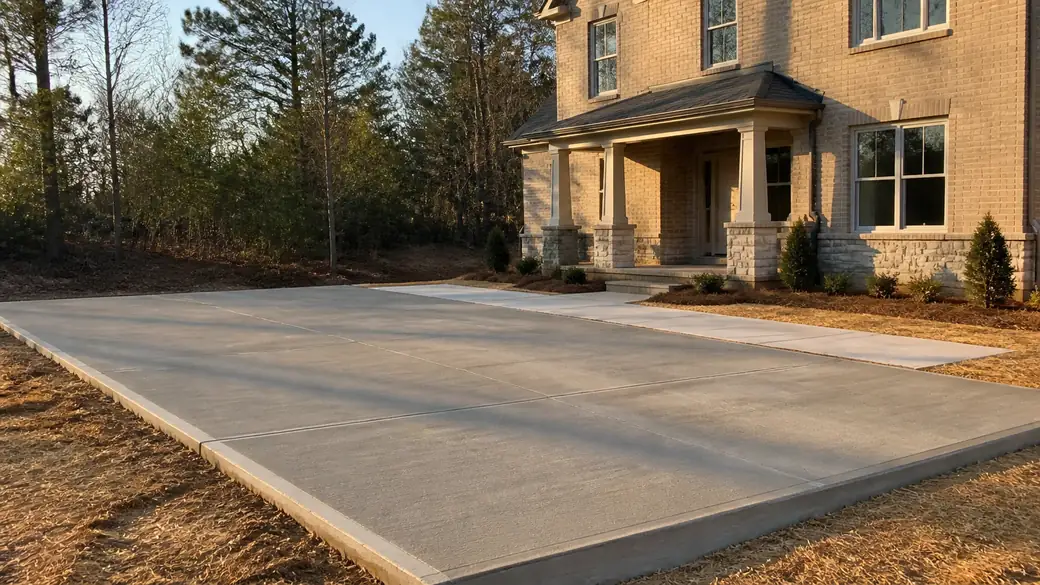
Concrete slab area formed and prepped, wire mesh set before the pour at a stacked-stone and stucco home in Sandy Springs, GA, in late afternoon light.

Slab installation

Most slab installation here replaces something that failed. We strip the old concrete, grade and compact the base, set the forms, and run rebar or wire mesh depending on the load the slab carries. Four inches is standard for a patio, thicker where vehicles park. The failures we see come from thin pours over soft fill, so the base work matters more than anything that happens after the truck arrives.

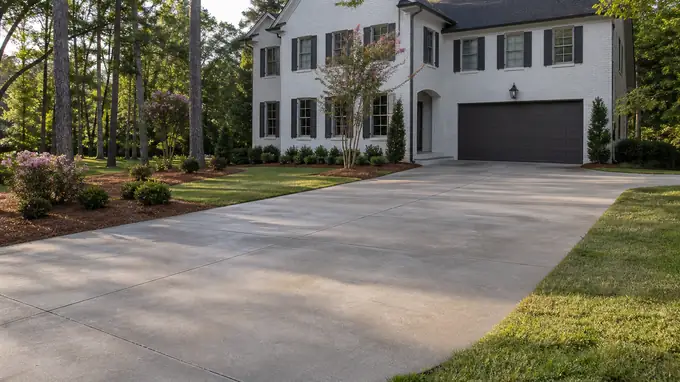
Concrete being poured and screeded across a formed slab at a painted-white-brick two-story home in Sandy Springs, GA, in late afternoon light.

Concrete pouring

Pouring is the short part of the job. We place the mix, screed it level, bull float, and then wait, because timing the finish is what separates a slab that lasts from one that spalls. Control joints go in before the concrete decides where to crack on its own. Broom finish is the default, though stamped concrete and exposed aggregate are both poured the same way and finished differently.

Small square concrete pad poured for a storage shed, anchor bolts set at a red-brick ranch home in Sandy Springs, GA, after a rain shower.

Shed slab

A shed slab needs a compacted base, wire mesh or rebar, and a thickened edge so the perimeter does not break off under the wall load. We form it square, pour four inches, and set anchor bolts if the building calls for them. Homeowners around Sandy Springs often want it tied into an existing concrete sidewalk or walkway, which we form at the same time so the joint lines up.

Concrete Slabs & Pads in metro Atlanta

Most of the slab and pad work we do around metro Atlanta is replacement, not new pour. Suburban development here started in the 1950s, picked up hard in the early 1960s once the highway construction was done, and kept filling in through the 1980s. A shed pad, an HVAC pad, a patio slab: much of it is original to the house, and a slab that old has already done its work. The subdivisions here and the ones running up into Dunwoody were built the same way.

Working on a settled lot is different from working on bare ground. Lots here run rolling and wooded, so we plan access before anything else: where the truck sits, whether we chute the pour or buggy it back, what comes out first. Fences and finished landscaping decide half of it. Old slabs get broken out and hauled. Then we cut grade, set forms to the drainage you already have, and compact the base properly.

What we find under old flatwork is usually the same story. Thin concrete, no rebar and no wire mesh, base material that was never compacted, and a slab riding on soft ground since the day it was poured. Corners break off. Sections tip toward the house. Cracks that open wider every year are almost always a base problem, not a concrete problem, and pouring new flatwork over the old base buys you a few years at most.

Doing it right costs time before the pour, not after. Compacted base at full depth, steel where the slab needs it, thickness matched to whatever will sit on it, control joints cut on schedule. That is most of the difference between flatwork that lasts and flatwork that gets replaced twice. We would rather spend the morning on the base than watch a good pour sit on a bad one. Call for a free estimate on the slab or pad you are replacing.

How the Work Runs

String lines and grade stakes laid out across a yard before a pour at a painted-white-brick two-story home in Sandy Springs, GA, in clear late-morning sun.

Step 1: Site Evaluation

We walk the whole area with you and measure it, then work out why the old slab failed: settlement, tree roots, water running the wrong way. On a rolling, wooded lot, drainage and access matter as much as square footage. We check where the truck can sit, how far concrete has to be wheeled, and whether the grade around a house from the early-1960s boom has shifted since it was first poured.

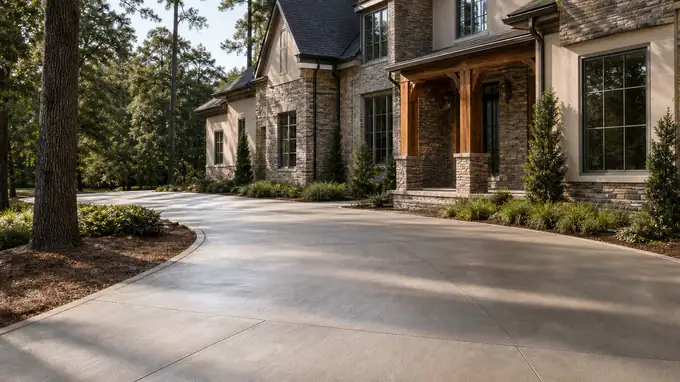
Concrete driveway and walk at a home, the kind of job an estimate covers at a stacked-stone and stucco home in Sandy Springs, GA, in early morning light.

Step 2: Written Estimate and Permits

Everything goes on paper: square footage, slab thickness, reinforcement, finish, joint layout, and what we haul away. You have the scope in writing before anything gets broken out, so nothing about what is included has to be sorted out later. Some jobs need a permit and some do not, depending on scope and location. Where one is required, we handle the paperwork and build the schedule around it.

Broken-out concrete removed and the base rebuilt before a new pour at a charcoal farmhouse-modern home in Sandy Springs, GA, after a rain shower.

Step 3: Demolition and Base Prep

Old concrete comes out in pieces and gets hauled off, not buried on site. We dig to grade, cut any roots running under the old slab, and pull out soft spots rather than pouring over them. The base is compacted gravel, placed in lifts and tamped. Most of the failed driveways we replace failed right here first, because a slab is only as good as what sits underneath it.

Wooden forms and rebar grid set and tied, ready for concrete at a brick-and-siding two-story home in Sandy Springs, GA, under an overcast sky.

Step 4: Forming, Steel and the Pour

Forms get staked to line and grade, with slope built in so water leaves the slab instead of standing on it. Reinforcement is rebar tied in a grid on chairs, or wire mesh where loads are lighter, held up inside the concrete rather than lying flat on the base. On pour day we place, screed and float in one continuous run, keeping cold joints out of the middle of a concrete driveway.

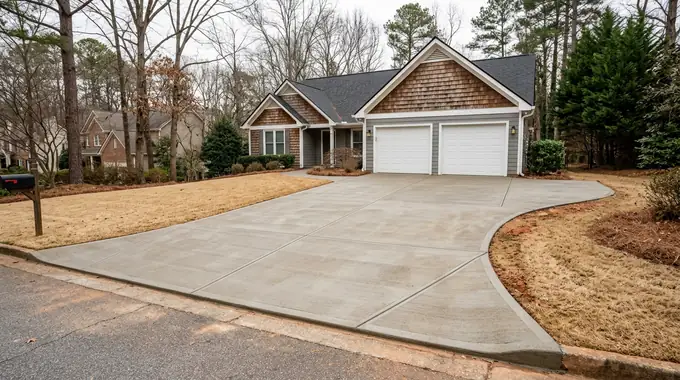
Freshly finished concrete slab curing under a clean broom texture at a grey split-level home in Sandy Springs, GA, under bright midday cloud.

Step 5: Finishing, Curing and Final Walkthrough

Finish depends on what the concrete installation has to do: broom texture for traction on sidewalks, stamped or colored work on a patio, exposed aggregate where you want the stone to show. Control joints get cut early, so cracking happens where we put it. Curing gets water or a curing compound. We tell you when the slab can be walked and when it can take a vehicle, then walk the finished work with you.

What Decides the Price

Two slabs of the same size can land far apart, and most of the reason is visible on your property before anyone quotes. Site condition moves the number more than the concrete does. Here is what we look at when we walk a job.

What changes the priceWhich wayWhy
An existing slab that has to come outCosts moreBreaking out and hauling off old concrete is its own day of work before any pour starts.
Truck reach to the pourCosts less when closeA mixer that can chute straight into the forms saves the labor of moving concrete by buggy or pump.
Slab thickness the use calls forCosts more when thickerA pad carrying a vehicle or a hot tub needs more depth than a walk-behind patio.
Rebar instead of wire meshCosts moreRebar tied on chairs is more material and more time in the forms than rolled mesh.
Tree roots or soft fill in the subgradeCosts moreRoots get cut out and low spots get built back with compacted stone so the slab bears evenly.
Where water runs off the padCosts more if it needs reworkSlope, drains or a thickened edge get built in when the grade sends water toward the house.
Stamped, colored or exposed aggregate finishCosts moreThese finishes add materials and a second stage of work after the pour.
Permit through the City of Sandy SpringsVariesSome pads need review and inspection; others do not.

Compare bids on thickness, reinforcement, base depth, and whether demolition, haul off and permitting sit inside the number or get added later.

Questions About Concrete Slabs & Pads

How level can you get a Sandy Springs slab, and how is that measured?

Flat and level are two different things, and most slabs want a deliberate slope rather than dead level. We screed to a set grade, then check it with a laser level across the pour and again once the concrete has stiffened. Exterior flatwork gets a fall away from the house so water leaves. Interior slabs come closer to true level. We measure high and low points off a fixed benchmark, not off the ground.

What thickness of slab do I need for a shed or workshop in Sandy Springs?

A garden shed sits fine on a four inch slab with wire mesh. A workshop is a different question, because the answer depends on what rolls across it and what sits on it. Vehicles, a lift, heavy stationary tools: those push us toward a thicker slab with rebar and a thickened edge under the walls. Tell us what goes in the building and we will size the concrete to it.

Can you pour a slab in Sandy Springs in winter?

Yes. Cold weather pours need more planning than summer ones, so we watch the forecast rather than the calendar. Concrete cures by chemical reaction, and that reaction slows badly when temperatures drop, so we adjust the mix, keep the subgrade free of frost, and cover the slab with insulated blankets to hold the heat the concrete generates itself. We will not pour onto frozen ground.

Do I need a permit for a slab on my Sandy Springs property?

Usually, though it turns on what the slab is for and how big it is. A slab supporting a structure is treated differently from a patio replacement in the same footprint as the old one. Setbacks, impervious surface limits and any HOA rules also come into it. We handle the permitting side as part of the job and will tell you at the estimate what your particular slab requires.

Would a monolithic or a floating slab suit a Sandy Springs property?

Monolithic pours the slab and its footing together in one go, which suits sheds, workshops and small additions on ground that has been properly prepared. A floating slab sits independent of the footings and moves as one piece. Site conditions decide it: how much fill is under the pad, how the ground drains, and what the slab carries. We look at the actual spot before choosing.

Does a slab need a vapour barrier in Georgia?

Yes, for anything enclosed or heated. Moisture moves up through concrete constantly, and a slab without a barrier will push it into flooring, adhesive and stored goods. We lay a poly sheet over the prepared base, lap and seal the seams, and take it up the edges before the pour. Open patios and detached pads are the common exception.

Get a Free Estimate

Get FREE Estimates

We warranty all of our work because we believe in what we do.

Tap to call +1 470-740-7099